Police, machines deployed to reclaim Phewa Lake territory
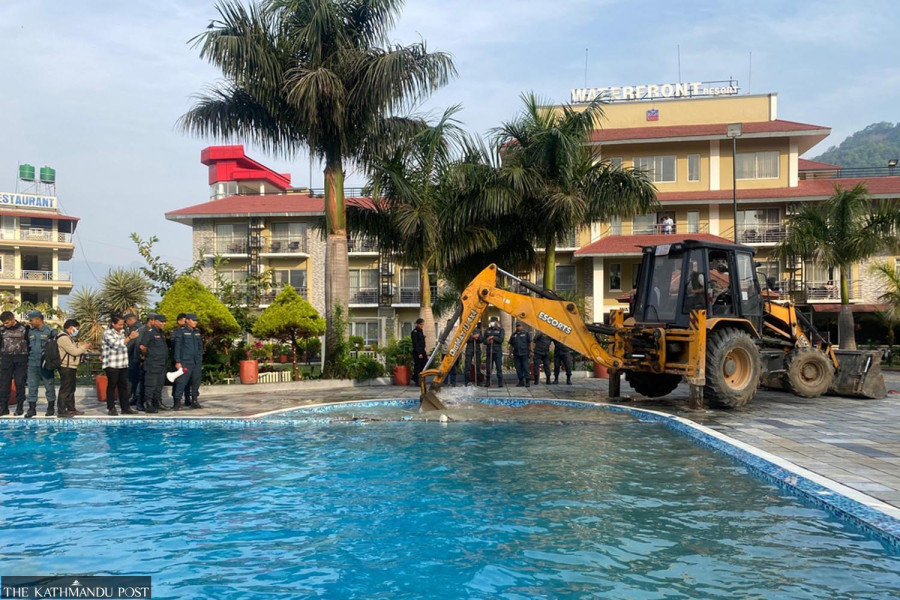
On Saturday morning those living by the lake woke up to the clatter of excavators deployed to remove structures built on lake land.Municipal police stand by as an excavator chips away at the swimming pool of Waterfront Resort in Pokhara on Saturday morning. Deepak Pariyar/TKP
Pokhara, drenched by Friday night’s rain, woke up early Saturday morning to the rumbling sound of excavators. Tourists staying at the Waterfront Resort on the lakesidedrew their curtains and looked outside. The blue water of the swimming pool had turned muddy yellow as an excavator dug through it.
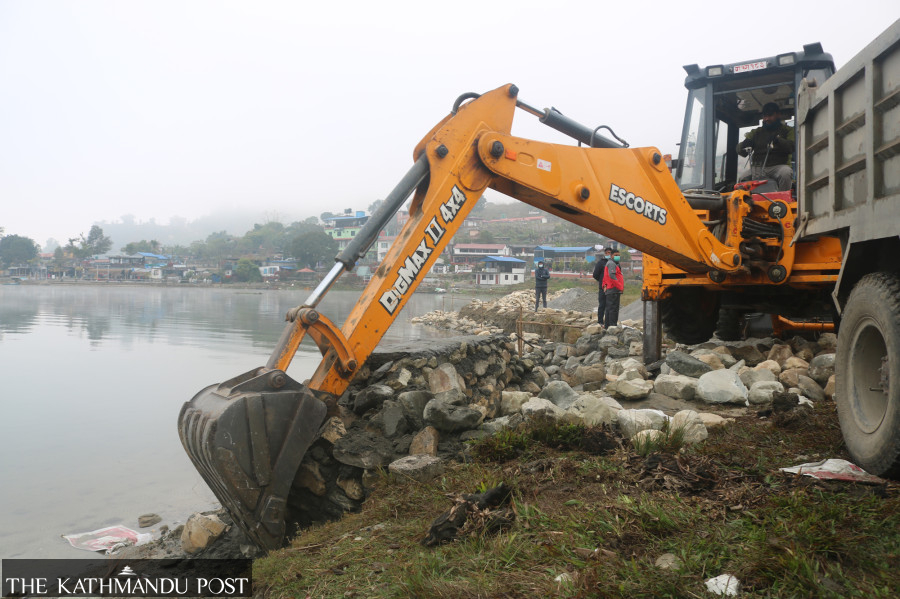
The Pokhara Metropolitan City had dispatched its excavators to the bank of Phewa Lake to implement a Supreme Court order. Acting on the instruction of Prime Minister Balendra Shah and in coordination with the home ministry, the Pokhara metropolis demolished 32 illegal structures built within the lake’s boundary.
Around 150 personnel from the district police, the Armed Police Force, the municipal police, and the Nepal Police were deployed for the demolition.
The municipal authority said the demolition targeted illegal structures built within the demarcated boundary of Phewa Lake.
“We did not demolish the illegal structures overnight. Notices had been issued several times before. The operation began early Saturday as per the instructions of the Ministry of Home Affairs,” said Dhanraj Acharya, the Pokhara mayor.
The action followed a Supreme Court verdict of 20 June 2023. The full text of the verdict, released on 25 September 2023, mandated that the 65-metre zone must be maintained as a “green zone” and that all unauthorised structures—hotels, resorts, and businesses—must be removed within six months.
Authorities aim to clear a 65-meter zone around the perimeter of the Phewa Lake. Studies suggest removing structures could cost up to Rs40 billion. Post file photo
Crucially, the court ruled that land registered after the 1976 survey was fraudulent. The verdict interpreted the Land Revenue Act 1977 to mean that any public or government land registration in the name of individuals is automatically void. Therefore, no compensation needs to be paid for land registered after 1976.
Compensation is only mandatory for those who held valid titles prior to the 1976 survey and have consistently paid land taxes since.
The verdict also instructed the government to cancel land registration of encroached areas within the 65-meter zone and provide compensation for lands registered before 2032 BS (1976), and thus restore them as lakeproperty.
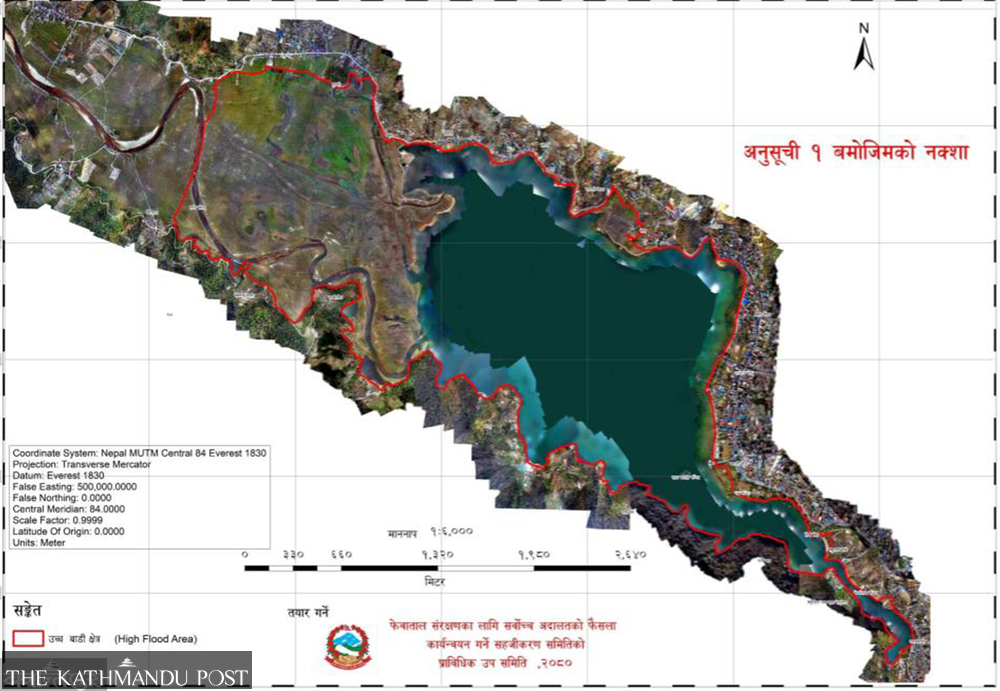
To implement this, a facilitation committee was formed in November 2023 under Gandaki Province Chief Minister Surendra Raj Pandey. A technical sub-committee led by Chief Survey Officer Gangalal Pokhrel was tasked with identifying the lake’s highest water level and demarcating the 65-metre boundary. Using DGPS (differential global positioning system) technology and drone surveys, the subcommittee recently determined the lake’s area to be 6.343 square kilometres—significantly larger than the previously recorded figure.
Earlier, on February 20, the city office issued a public notice, asking owners to remove illegal structures built around the lake within 15 days, warning that it would remove them at the owners’ expense if they failed to comply. Despite repeated notices, most structures stayed intact.
Post file photo
After the government included the Phewa Lake conservation in its reform agenda, Prime Minister Balendra Shah personally called Acharya on March 29 to get an update on the execution of the court order. A week later on Saturday morning, the demolition began, as directed by the home ministry, under tight security amid protests and strong objections from local residents.
“Creating a state of fear in the tourist capital of Pokhara is a serious matter. Even from a practical and legal perspective, this is not justified. Going to hotels where visitors are sleeping at night in a tourist area, using bulldozers, and deploying heavy force to demolish structures is condemnable,” said Nabin Baral, chairperson of Phewa Lake Victims’ Concern Committee. He said it was an act of state-sponsored terror to demolish the properties without any compensation.
Acharya, the mayor, however, has a different take. He said several permanent structures were deliberately built within the 65-meter zone. “Such structures have been erected without giving notice to the metropolis. They will not receive any compensation. However, for land with legal registration [undisputed land], the compensation process will soon begin,” he said.
The current state of Phewa Lake is largely a result of geographical shifts seen after 1961.
In that year, the Nepal-India Cooperation Mission constructed a dam on the eastern side of the lake, and the government introduced its first land acquisition and compensation policies. Historical records at the dam site suggest the lake spanned 4 square miles (10.36 square kilometres) at that time, though contemporary researchers have struggled to find empirical data to verify this area.
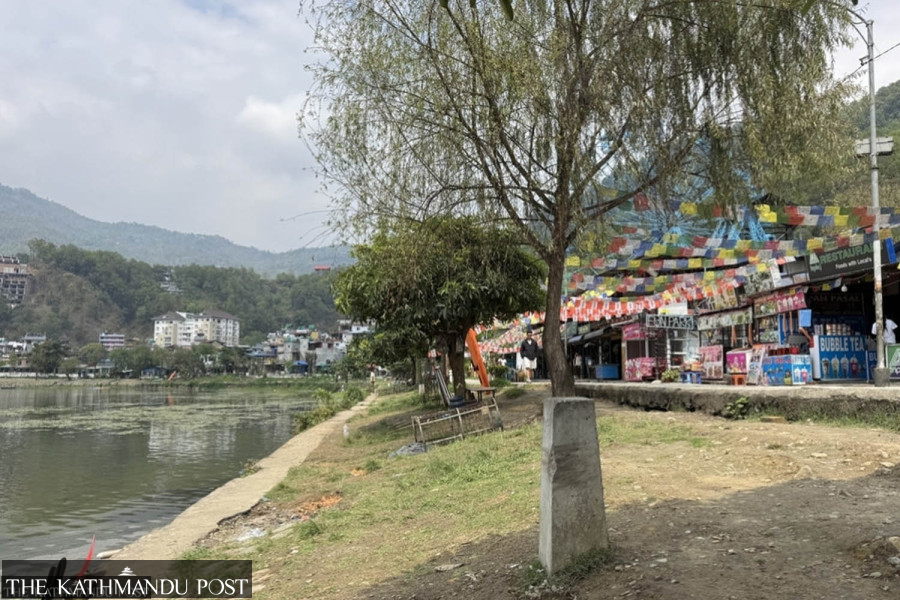
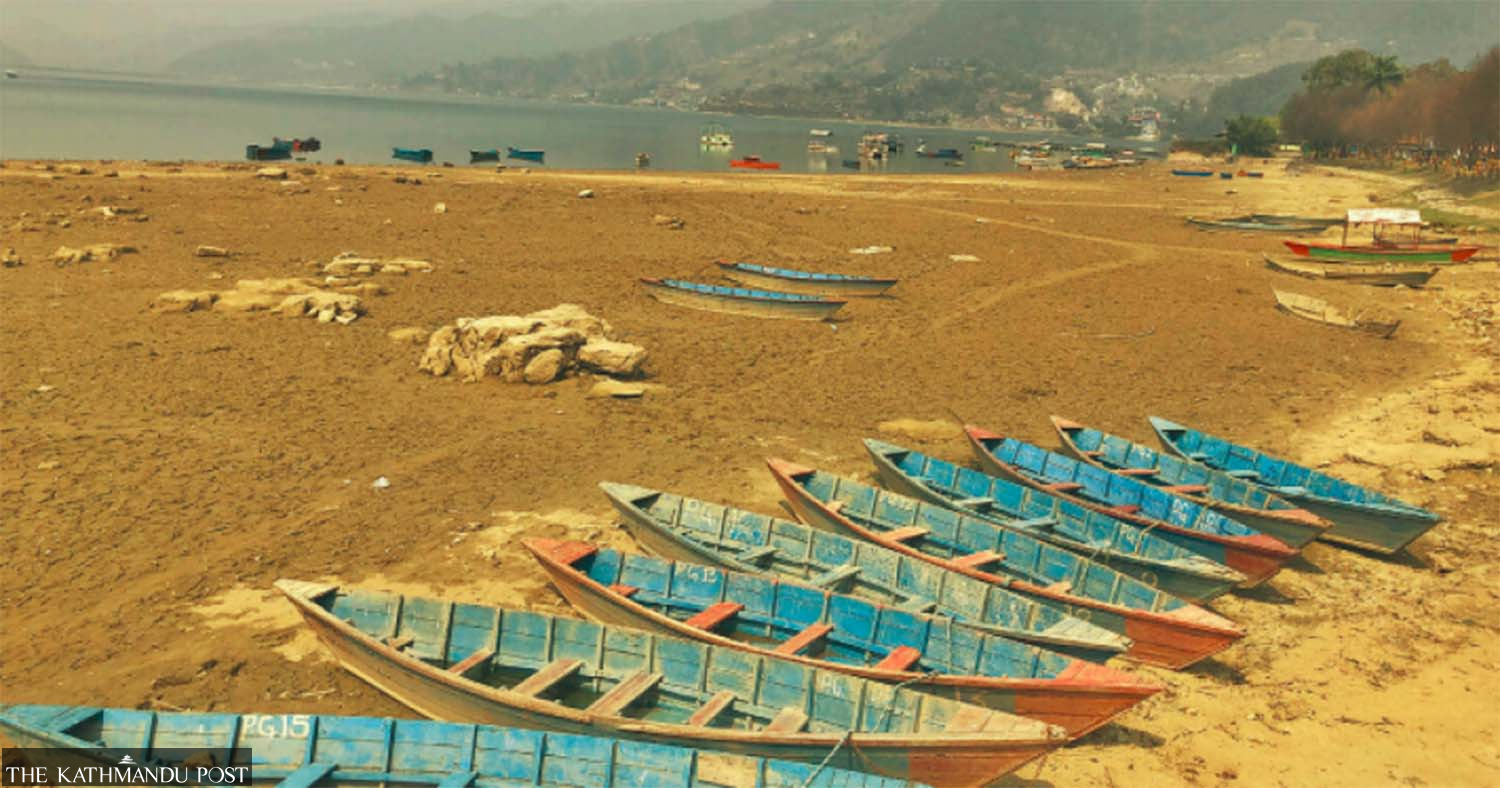
Various reports state that the area of Phewa Lake has been shrinking mainly due to human encroachment Post file photo
The legal framework for protection began in 1973. Following the approval of the Pokhara Town Plan, a government gazette notification on November 30, 1973 designated Phewa as a protected area. It strictly prohibited any form of construction within 200 feet (60.69 metres) of the lake’s perimeter. By 1974, the government believed the issue of compensation for private land submerged by the lake had been largely resolved.
However, a catastrophic failure of the Phewa dam in 1974 changed everything. As the dam collapsed, the water level receded dramatically, exposing vast tracts of the lakebed at the northern end. This exposed land quickly turned into marshland, which local residents began to cultivate. In 1976, a central survey team arrived in the area. Taking advantage of the exposed land, many local residents managed to register plots as private property during the 1976-1977 land survey.
By the time a new dam was completed in 1981 and the water levels rose again, these “private” plots were once more submerged. A 1981 study by the Nepal government and the United Nations Development Project subsequently recorded the lake’s area at a diminished 5.8 square kilometres.
The 65-metre buffer zone rule, which is currently the subject of intense debate, traces its roots to a 2007 decision by the Kaski District Council. Building on the 1973 town plan, the council moved to prohibit any physical structures within 65 metres of the shoreline.
When this decision was ignored and encroachments intensified, advocates Khagendra Subedi and Ramesh Ghimire filed a writ petition in the Supreme Court on 24 January 2011, naming the Office of the Prime Minister and 15 other government agencies as defendants.
Area of Phewa Lake as determined by the facilitation committee tasked with implementing the Supreme Court of Nepal verdict on its conservation. The revised boundary is based on the lake’s highest recorded water level, in line with the court’s mandamus. Post file photo
In response, then-prime minister Baburam Bhattarai formed a high-level committee led by Bishwa Prakash Lamichhane, chief of the Pokhara Valley Town Development Committee, to investigate the encroachment. The 2012 Lamichhane report was a bombshell: it revealed that 1,692 ropanis (2498.29 hectares) of lake land had been illegally registered in the names of individuals.
The report detailed how, during the 1976 survey, locals influenced officials to plot areas ranging from 150 to 750 metres in length across what should have been the lake’s surface. Approximately 500 ropanis of this land, held by 950 individuals, currently remain underwater. Lamichhane’s recommendation was clear: the land titles for these 1,692 ropanis must be revoked.
On April 29, 2018, Supreme Court Justices Om Prakash Mishra and Sapana Pradhan Malla issued a landmark order based on this report. They directed the government to fix the lake’s boundaries within six months, remove structures within the 65-metre zone, and acquire necessary land by paying compensation.
Yet, as years passed without action, contempt of court cases were filed. In 2020, the KP Sharma Oli government formed another committee led by Punya Paudel, which eventually recommended a lake area of 5.726 square kilometres—a figure that got official recognition later.
The conflict escalated when in 2021 then-Mayor Man Bahadur GC tried to reduce the buffer zone from 65 metres to 30 metres. This decision met with immediate legal challenges. On June 20, 2023, the Supreme Court delivered its final blow to the encroachers.
Crucially, the court ruled that land registered after the 1976 survey was fraudulent. The verdict interpreted the Land Revenue Act 1977 to mean that any private ownership of public or government land is automatically void. Therefore, no compensation needs to be paid for land registered after 1976.




 14.4°C Kathmandu
.jpg)