



 22.94°C Kathmandu

Thu, Oct 22, 2026
Money
On Everest, drones are saving lives, not ‘stealing’ jobs
From carrying oxygen cylinders and expedition supplies to hauling human waste and garbage off the mountain, drones are transforming Everest logistics. Sherpas see the technology as a safety tool rather than a threat to their livelihoods.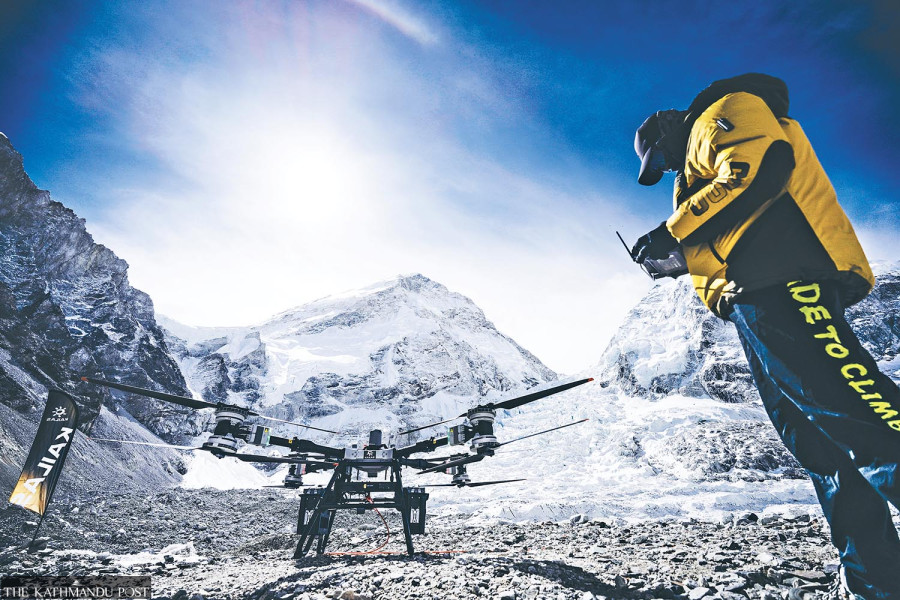
bookmark![]()
Airlift Technology transported 3.5 tonnes of garbage from Camp I to Base Camp using drones. Courtesy of Airlift Technology
Sangam Prasain
Published at : June 4, 2026
Updated at : June 4, 2026 07:27
Kathmandu
For 22-year-old guide Lakpa Ringi Sherpa, this spring climbing season on Everest felt different.
The fear was still there. The Khumbu Icefall remained as unpredictable as ever, with yawning crevasses beneath his feet and towering seracs looming overhead. But unlike previous years, he did not have to make the dangerous journey through the icefall carrying heavy loads over and over again.
Instead of the usual eight to ten supply trips between Everest Base Camp (5,364m) and Camp II (6,400m), Lakpa Ringi made only four.
The reason was not a safer route or calmer weather. It was a drone.
“Every year, we are frightened to cross the icefall,” he said. “Crevasses below, seracs above. We have to walk between unstable ice formations.”
Traditionally, Sherpa guides leave base camp shortly after midnight carrying up to 15 kg of logistics supplies on their backs. The journey through the Khumbu Icefall to Camp I and onwards to Camp II can take six to seven hours, often without rest.
“We never stop,” Lakpa Ringi said. “The icefall section is too dangerous.”
This year, however, most of the supplies destined for Camp I were flown by drone.
The result was dramatic. Tasks that once required hours of climbing and a team of high-altitude guides could now be completed in minutes.
“Every time we carried loads through the icefall, we prayed,” Lakpa Ringi recalled. “Now the drone does most of that work.”
His experience reflects a technological shift underway on Mount Everest, where drones are beginning to reshape one of the world's most dangerous occupations.
In April 2024, Chinese drone manufacturer DJI conducted what was described as the world's first drone delivery test on Everest. Using its FlyCart platform, the company transported oxygen cylinders and supplies uphill while carrying waste downhill.
The trials demonstrated that drones could perform tasks traditionally undertaken by Sherpa guides in one of the most hazardous sections of the mountain.
The technology moved beyond testing in 2025, when drones began transporting supplies to Camp I.
This spring, drone-assisted logistics entered commercial operation.
According to mountain officials and drone operators, work that once required six to seven hours can now be completed in about ten minutes. In some cases, a single drone flight can replace the efforts of more than a dozen guides.
For many in the Khumbu region, the significance extends beyond efficiency.
“This is a life-saving initiative,” said Mingma Chhiri Sherpa, chairman of the Khumbu Pasanglhamu Rural Municipality, within whose jurisdiction the Everest region falls.
“There is a huge risk even for a normal hike in the Khumbu Icefall. Imagine how dangerous it is when people are carrying heavy equipment and supplies. Technology can reduce that burden and save lives.”
The Khumbu Icefall is widely regarded as the most dangerous section of the standard South Col route to Everest. Stretching roughly 600 metres between Base Camp and Camp I, the constantly shifting glacier is riddled with deep crevasses and unstable ice towers that can collapse without warning.
For decades, Sherpa guides have shouldered the greatest risks there.
The danger was tragically highlighted in April 2014, when a massive ice collapse killed 16 Sherpa guides in the deadliest disaster in Everest's history at the time. In 2023, three Sherpa guides were buried by an avalanche in the icefall. Their bodies were never recovered.
According to government records and the Himalayan Database, nearly 50 people died in the Khumbu Icefall between 1953 and 2023.
The risks remained evident this year.
A massive unstable serac blocked route preparation for nearly three weeks, delaying progress through the icefall. According to data from the Sagarmatha Pollution Control Committee (SPCC), the ice formation measured approximately 55 metres long, 37 metres wide and 28 metres high.
The Icefall Doctors, the elite team responsible for preparing the route each spring, began work on March 16 and managed to secure a path only up to a critical point before the giant ice wall halted further progress.
For 19 days, drone imaging and aerial monitoring were used to assess the formation.
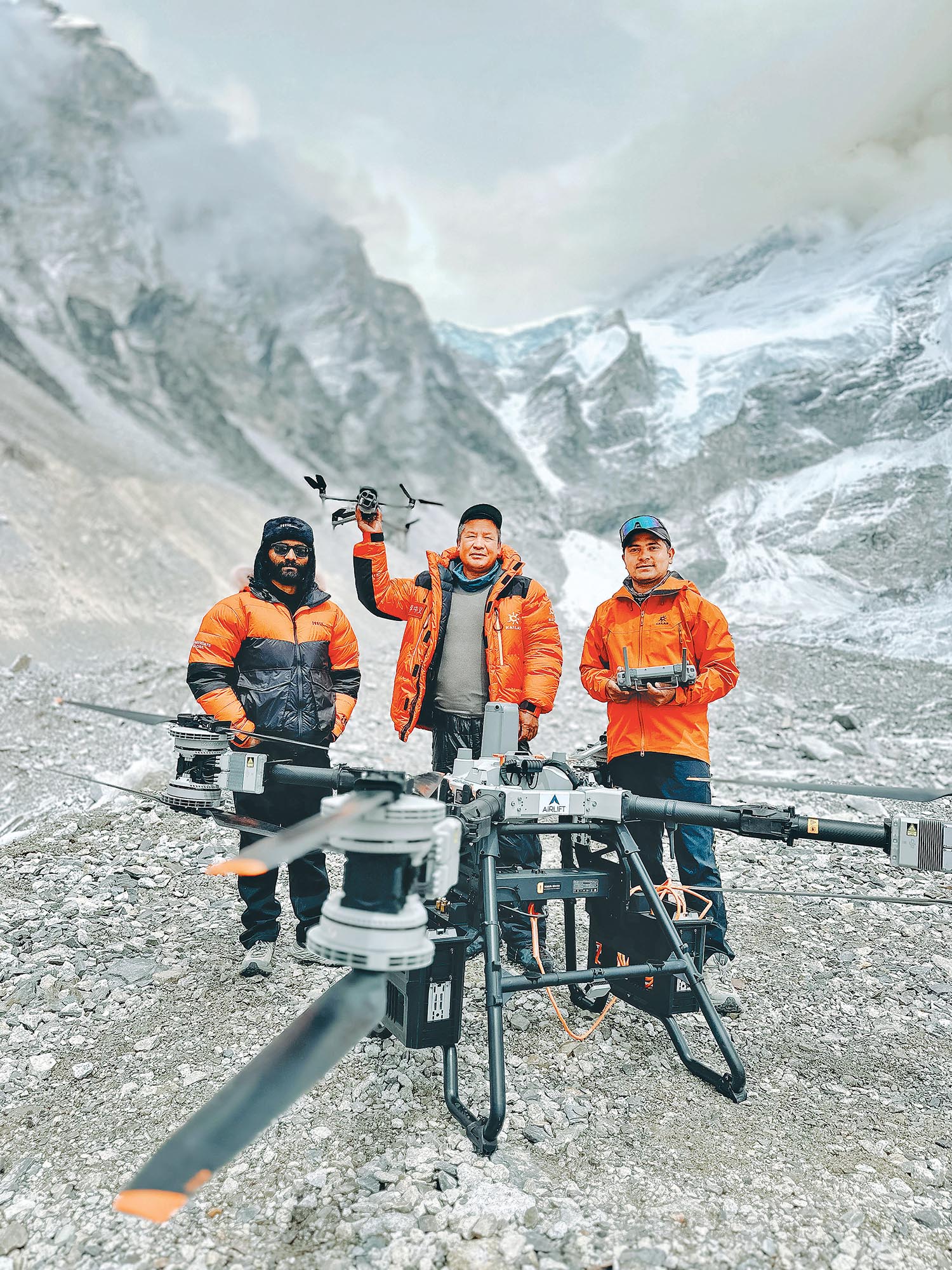
“Multiple site inspections and drone imaging sessions monitored the formation throughout the period,” said Milan Pandey, co-founder of Airlift Technology Pvt Ltd.
Part of the serac eventually collapsed, but the remaining mass stayed unstable. The route was finally completed on May 13, officially opening the mountain to summit attempts.
The episode highlighted another emerging role for drones: reconnaissance and risk assessment.
Their growing presence on Everest is also helping tackle a long-standing environmental challenge.
This spring, Airlift Technology transported 3.5 tonnes of garbage from Camp I to Base Camp using drones.
“Altogether, we flew more than 10 tonnes of goods up and down,” said Pandey. “Of that, 3.5 tonnes was garbage brought down from the mountain.”
Much of the waste consisted of human waste bags.
Last year, local authorities made it mandatory for climbers to carry specially designed poop bags during their ascent to reduce contamination and improve sanitation on Everest.
The initiative complements Nepal's broader efforts to clean the mountain. Since 2014, climbers have been required to return with at least eight kilograms of waste or lose a $4,000 refundable deposit. Proposed legislation would convert that deposit into a non-refundable environmental fee dedicated to conservation and cleanup activities.
After the climbing season ended on May 29, drones conducted roughly 20 flights a day carrying garbage back to Base Camp.
For local officials, cleaner mountains and safer working conditions are closely connected.
“Everest supports hotels, lodges, airlines, helicopter operators, guides, porters and many businesses across the mountain region,” said Mingma Chhiri. “But the risks remain very high. We want to reduce those risks through technology.”
Not everyone, however, views the drone revolution without reservations.
Some fear that expanding drone operations could eventually reduce employment opportunities for Sherpa guides and high-altitude workers.
Lakpa Ringi believes those fears are misplaced.
Guides earn money both by escorting climbers and by carrying supplies between camps. While drones may reduce some of the lower-altitude load-carrying work, the more lucrative jobs higher on the mountain remain dependent on human expertise.
Guides typically earn between Rs350 and Rs500 per kilo carrying loads from Base Camp toward Camp II. Above Camp II, rates rise sharply to between Rs1,000 and Rs1,500 per kilogram.
Transporting oxygen cylinders is particularly profitable. Carrying a four-kilogram oxygen bottle can earn a guide Rs4,000, while bringing down an empty cylinder can fetch Rs10,000. A guide normally brings down 8 empty cylinders.
“Most climbers need multiple bottles,” Lakpa Ringi said. “The real earnings are from Camp II to Camp IV. Even if drones reduce some work below Camp I, it doesn't mean we lose income.”
Instead, he sees drones as partners rather than competitors.
“We don't want to carry loads through the icefall if we don't have to,” he said. “Our main job is guiding climbers. The drone makes us more confident crossing the dangerous sections.”
This year also witnessed an unexpected twist in the evolving drone story.
After Chinese-made DJI drones demonstrated their effectiveness on Everest, an American challenger entered the race.
US drone manufacturer Freefly Systems sought permission to test its Alta X Gen 2 heavy-lift drone on Everest, potentially challenging DJI's dominance in one of the world's harshest aviation environments.
Nepali authorities temporarily suspended operations of DJI's FlyCart 100 for ten days while reviewing permissions for both systems.
The move sparked debate within Nepal's mountaineering community. Supporters welcomed greater competition and technological innovation. Others worried that Everest could become a stage for commercial and geopolitical rivalry between foreign technology firms.
“We were banned for ten days and there was no reason for it,” said Pandey.
Despite the interruption, he said drones proved indispensable, particularly after the delayed opening of the climbing route created logistical bottlenecks.
“In emergencies, drones allowed bottled oxygen to be delivered quickly to higher camps,” he said.
The 2026 Everest season ultimately ended with more than 1,000 climbers and guides reaching the summit, according to preliminary estimates. This spring, the government issued a record 495 permits for fee-paying climbers. Normally, a climber hires one sherpa guide for the expedition.
For many, the season may be remembered not only for successful ascents but also for a quiet technological transformation taking place beneath the world's highest peak.
For generations, Sherpas have carried the weight of Everest on their backs, often at enormous personal risk. Now, as drones buzz above the shifting ice and crevasses of the Khumbu Icefall, some of that burden is finally being lifted.
And for guides like Lakpa Ringi Sherpa, that may be the most important summit of all.
Sangam Prasain
Sangam Prasain is Business Editor at The Kathmandu Post, covering tourism, agriculture, mountaineering, aviation, infrastructure and other economic affairs. He joined The Kathmandu Post in October 2009.

Most Read from Money

Nepal travel agents threaten to stop selling Thailand trips over visa rules

Why does an hour long flight to Dhangadhi cost more than a flight to New Delhi?
Malaysia rejects Nepal’s demand to open recruitment to all manpower agencies

No school, but a graduation cap for women dairy farmers
Nepal arrests four medical service providers as Malaysia recruitment row deepens
Editor's Picks




E-PAPER | October 22, 2026

×