How Nepal’s tax lottery works—and how a Rs250 purchase won Rs1 million
The government’s new taxpayer incentive programme is designed to encourage consumers to demand bills, promote digital payments and make businesses more transparent in reporting sales and taxes.
A consumer who spent just Rs250 at a grocery store in Kanchanpur has won the government’s Rs1 million bumper prize under its new taxpayer incentive lottery programme, with the first winners announced on Friday. The winner bought the goods from Shiva Krishna General Store in Punarbas Municipality, according to the Inland Revenue Department.
How does the lottery work?
The prize is part of a government programme designed to encourage consumers to ask for bills and promote transparent transactions. According to the procedure, anyone making a personal purchase of goods or services worth more than Rs100 in a single transaction is eligible to participate. This excludes commercial purchases, transport, airfares and transactions with non-PAN/VAT vendors.
On Friday, 15 consumers won daily prizes of Rs100,000 each (Rs133,334 before tax), while one consumer was selected for the Rs1 million bumper prize (Rs750,000 after tax). The prize money will be subject to applicable taxes. The winners were selected from among 25.60 million electronic transactions and 7,077 cash transactions.
The winners were selected using the “cryptographically secure uniform random sampling without replacement” method. This ensures that every coupon has an equal chance of being selected, that the same coupon cannot be selected more than once in a single draw, and that the selection process remains completely fair and secure.
According to the Inland Revenue Department, there are over 7 million taxpayers in Nepal, most of them individuals holding personal Permanent Account Numbers (PAN). Similarly, there are around 193,724 business PAN holders, 338,316 businesses registered for Value Added Tax (VAT), and 121,682 excise duty licence holders.
Why has the government introduced the lottery?
The programme is intended to encourage consumers to demand official bills whenever they purchase goods and services. By increasing consumer demand for bills, the government hopes to discourage businesses from hiding sales and underreporting their income, thereby improving tax compliance.
Finance Minister Swarnim Wagle announced the taxpayer incentive programme in the federal budget for fiscal year 2026-27. The idea is to turn consumers into an additional layer of tax monitoring by giving them a financial incentive to insist on documented transactions.
Winners will be selected through a computerised system in the presence of senior government officials, invited dignitaries and media representatives.
Keshav Raghuvanshi, information officer at the Inland Revenue Department, said the programme is designed to encourage consumers to ask for tax invoices, improve the recording of business transactions and strengthen tax compliance.
Who can participate in the lottery?
Consumers who purchase goods or services and make payments through digital channels such as QR are automatically entered into the programme. However, they must keep their purchase bills if they win a prize.
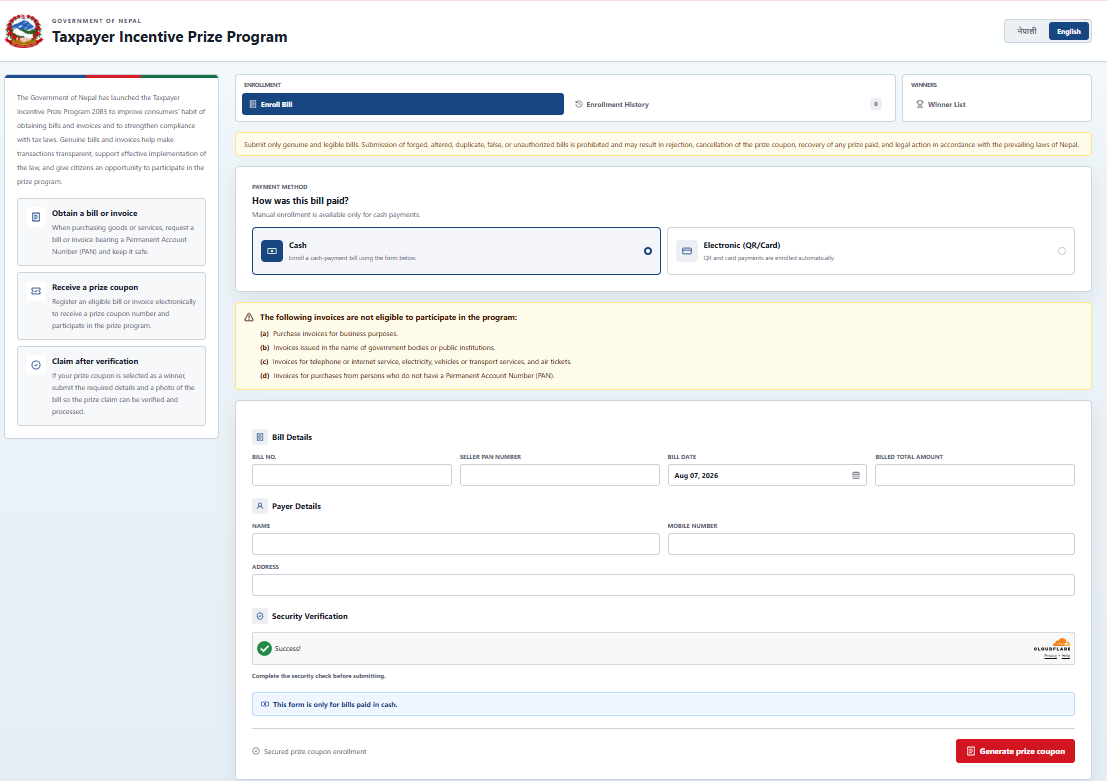
Consumers paying in cash can also participate, but they have to take a PAN or VAT bill from the seller and upload it through the Inland Revenue Department’s website. After uploading the bill, they receive a prize coupon that makes them eligible for the lottery. The programme covers purchases made between July 17 and July 31 for the first draw.
How are the winners selected?
The government will conduct the prize draw twice a month. The prizes will be announced on the 16th day of each Nepali month for purchases made from the first to the 15th day, and on the final day of the month for purchases made during the remaining days.
The 15 daily winners are selected separately from transactions made on each of the 15 days. The bumper prize, however, is drawn from all eligible consumers who made purchases during the first half of the Nepali month. The Inland Revenue Department is responsible for the technical arrangements for the lottery system.
What does the programme mean for consumers and businesses?
For consumers, the programme provides a chance to win cash simply by asking for proof of purchase and using formal payment channels. More importantly, the government expects the incentive to make consumers more conscious of obtaining bills.
For businesses, greater demand for PAN and VAT bills could make it harder to conceal sales and evade taxes. The government hopes that this consumer-driven pressure will encourage more transparent transactions and improve tax compliance.
How are winners notified?
The department will notify winners by SMS and email and publish their names on its official website and social media platforms.
Prize winners must submit their claims within 15 days of the announcement at the nearest Inland Revenue Office. They will be required to produce the original tax invoice, a citizenship certificate, national identity card, passport or driving licence, bank account details and a PAN card.
A 25 percent windfall tax will be deducted from the prize before payment, in accordance with Nepal’s tax laws. The remaining amount will be deposited into the winner’s bank account within 10 days after verification of the required documents.
Any unclaimed prize money will be transferred to the Prime Minister’s Disaster Relief Fund.




 15.52°C Kathmandu