Oli, Dahal move to extend alliance to next year’s local and provincial polls
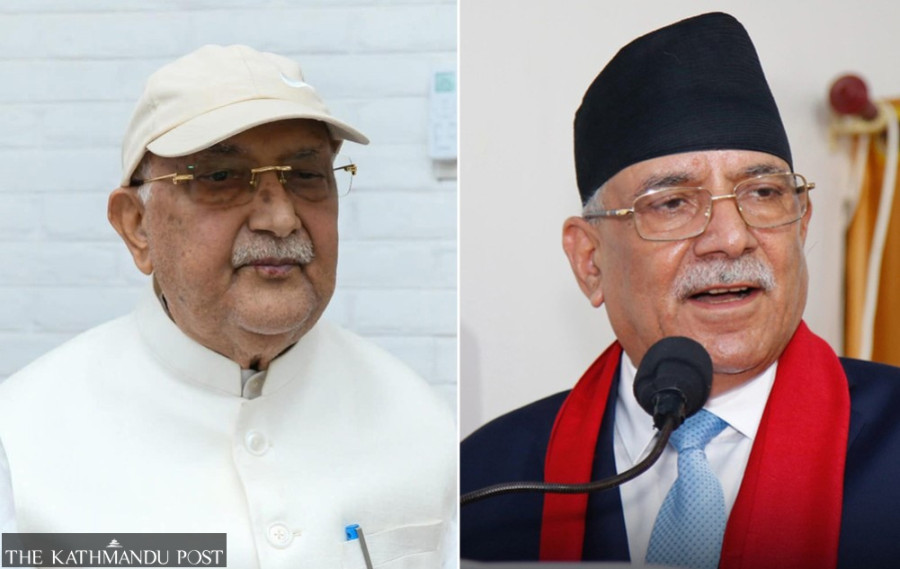
UML and Nepali Communist Party leaders are exploring grassroots-level electoral cooperation to prevent further erosion of left-wing support. CPN-UML chair KP Sharma Oli (left) and Nepali Communist Party coordinator Pushpa Kamal Dahal Post File Photo
After a poor showing in the March 5 House of Representatives election, CPN-UML chair KP Oli and Nepali Communist Party (NCP) coordinator Pushpa Kamal Dahal have begun preparations to extend their alliance in provincial governments to the local and provincial elections next year. The NCP, formed last year in the aftermath of the Gen Z movement, is an amalgam of Dahal's CPN (Maoist Centre) and several other leftist parties.
The two parties, which have joined hands in five provinces, have informally instructed their lower-level committees to prepare a framework for electoral alliance. According to leaders, the objective behind the alliance is to prevent further erosion of left-wing votes and strengthen their political influence.
The UML-NCP alliance began in provincial governments following the election debacle, and the two leaders have continued communicating. Leaders close to both say they have reached an initial understanding to explore an electoral alliance in the local and provincial polls.
Last week, Oli and Dahal discussed expanding their alliance after the UML withdrew its support for the Nepali Congress-led provincial government in Madhesh on October 16.
“The two leaders are in regular discussions about working with left-wing forces in the coming days,” a leader close to Oli said. “Preparations are under way to establish a basis for continuing the partnership in provincial governments through the next elections.”
Unlike the 2017 general election, when the UML and the then CPN (Maoist Centre) formed a national electoral alliance, the two parties are now focusing on building an understanding through district and local committees.
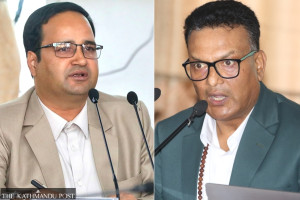
UML secretary Bhanu Bhakta Dhakal said the UML-NCP alliance in provincial governments had laid the groundwork for cooperation in the upcoming elections.
“Trust between the two parties needs to be strengthened to establish a basis for cooperation in the upcoming local and provincial elections,” said Dhakal. “This time, rather than reaching an agreement from the top, we are working to build a strong understanding at the local level.”
The parties are also preparing common programmes on national sovereignty, protection of the constitution and rising living costs.
NCP leader Barshaman Pun said the alliance had already begun through provincial governments and could extend to parliament, street protests, and elections.
“We have also agreed to work with the UML on issues including the protection of the constitution and democracy.”
However, Dahal has made it clear that electoral cooperation does not mean an immediate merger between the parties. Launching a two-month political campaign on Saturday, he said collaboration was necessary to defend democratic rights and national interests, but that organisational unity was not on the agenda.
“Democracy is in crisis, and national sovereignty and democratic rights are under threat. We are ready to work with whoever can help protect them,” said Dahal. “This does not mean there is any possibility of an immediate party merger with the UML. We still have much to review about our history and backgrounds.”
Dahal had also said on October 4, during a function organised by the party’s Bagmati provincial committee, that an understanding had been reached to collaborate with the UML and the Rastriya Janamorcha, while discussions with other “patriotic and left-wing forces” continued.
Oli has similarly advocated UML-NCP alliance. At a UML central committee meeting in September, he said the party could work with the NCP. The UML’s subsequent inter-party directive also called for cooperation and collaboration with political parties, citizens and intellectuals who support national interests, democracy, and the constitution.
Oli has argued that cooperation among left-wing and democratic forces is necessary following the Gen Z protests and the March 5 election.
“Efforts are being made to weaken left forces. Left and democratic forces must unite to prevent regression,” Oli said in late June. “All left and democratic forces must move forward together.”
Both parties have informally asked their lower-rung committees to explore electoral alliances. Local committees have reportedly warned that communist parties risk further marginalisation if they contest elections separately.
The push comes amid a steep decline in the electoral strength once enjoyed by Nepal’s communist parties. In the 2017 election, the UML and the Maoist Centre won 174 seats combined, approaching a two-thirds majority, and secured around 47 percent of proportional representation votes.
Their combined proportional vote share fell to around 42 percent in the 2022 election. Left parties had secured around 60 percent of the vote in the 2008 Constituent Assembly election, but their combined share dropped to about 42 percent in the 2013 election.
In the latest election, the UML won 25 seats and the NCP won 17 seats in the House of Representatives. Their proportional representation vote shares were 13.44 percent and 7.49 percent respectively, giving them a combined 20.93 percent.
Leaders say contesting separately in future elections could further divide their support and reduce their representation.
The two parties are also preparing a common response to government decisions, including investigations involving political leaders, the displacement of squatters and plans to abolish trade unions. They intend to pressure the government through parliament and public protests.
Oli and Dahal began speaking publicly about the alliance after sharing the same platform during the 75th birth anniversary celebrations of UML former general secretary Madan Bhandari in June.
Their earlier alliance, however, ended in a bitter split. The UML and the Maoist Centre formed an electoral alliance in 2017 and secured a near two-thirds parliamentary majority. They formally merged in 2018 to establish the Nepal Communist Party.
But the merger failed to resolve the power struggle between Oli and Dahal. Their conflict intensified, and their relationship broke down in 2021, barely two years and 10 months after their party unity.




 13.03°C Kathmandu