Devoid of options, flood survivors return to damaged homes
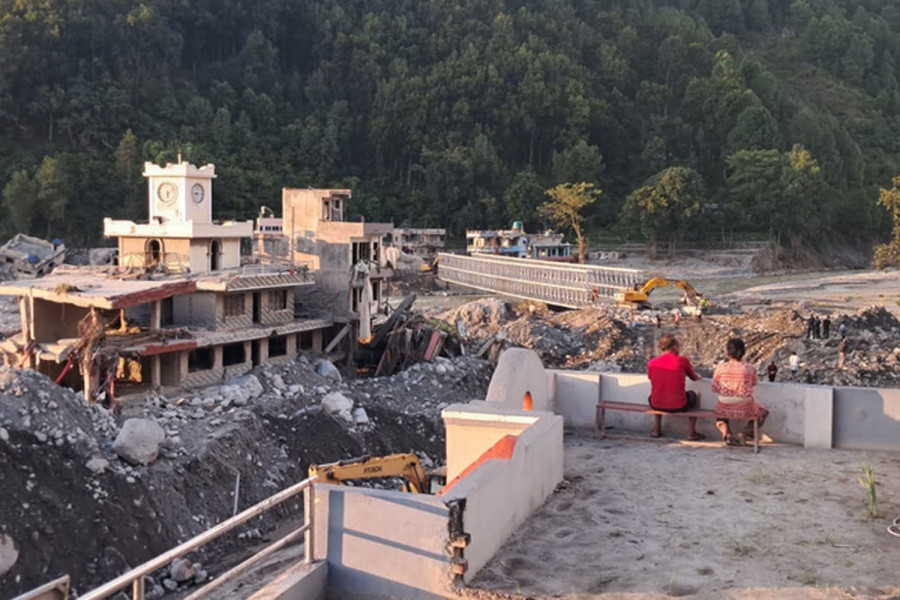
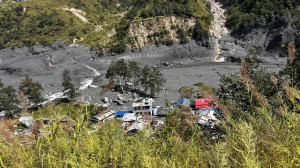
The government has announced rent assistance, temporary shelters and new land for resettlement. Survivors and local officials say little of it has reached them. Sashi Dangol and his wife sit on the roof of his house overlooking the ruins of Betrawati. Their house was buried by mud and debris in the August 26 flood. Photos: Courtesy of Sashi Dangol
Ram Kumar Bhandari and his seven-member family have returned, after two months, to the same house that was buried by mud and debris in the August 26 Bhotekoshi flood. Their safety there remains uncertain.
After the disaster, Bhandari rented a house in Pipaltar for about a month. But paying rent was a struggle, particularly while arranging care for his mother, who has a mental health condition. With no clear government plan for his family’s rehabilitation, he decided to return to the damaged house in Devighat in Bidur Municipality-5, Nuwakot.
“We could not afford to rent an entire house. And my mother has a mental condition. It was difficult to keep her in somebody else’s home, so we were forced to return to our own house, even at the risk of our lives,” he said. “Two months have passed, but the state has not communicated its plan. We had no alternative but to return.”
According to Bhandari, around 15 other families in the neighbourhood had also returned to houses buried by the devastating floods. Where only the lower floors were inundated, families are living in upper storeys. Others have cleared mud and debris themselves to make their homes habitable.
Their return reflects the growing dilemma facing flood survivors in Nuwakot and neighbouring Rasuwa districts. With resettlements uncertain, promised government assistance yet to reach many families and safety assessments incomplete, some displaced residents are returning to damaged homes while others struggle to pay rent.
The federal government says it has approved monthly accommodation assistance, temporary housing and plans to identify safer land for resettlement. But the people’s representatives and survivors complain that the decisions have yet to translate into meaningful support on the ground.
In its October 16 report, the National Disaster Risk Reduction and Management Authority (NDRRMA) did not provide a clear account of how many families had received rent assistance, returned to their homes, or found accommodation elsewhere.
A Cabinet decision on September 11 stipulated monthly assistance for displaced families for up to six months, until alternative accommodation became available. Families with up to four members are entitled to Rs15,000 a month, with an additional Rs2,000 for each member beyond four.
But the announcement has offered little immediate relief to families trying to rebuild their lives.
Rabindra Nepal, ward chair of Bidur-7 and the municipality’s spokesperson, said no displaced family in the municipality had received the monthly rent assistance and that the funds had not been transferred. Nepal is himself a flood survivor. After his house was buried, he moved into his elder brother’s home.
“The municipality has also sent suggestions about where displaced families could be resettled, but the federal government has yet to make a decision,” said Nepal. “Organisations such as the World Food Programme and the Red Cross have provided some financial assistance. But the federal government seems to have counted that as government relief as well.”
Ram Bahadur KC, an under-secretary at the NDRRMA, deflected the blame to the local governments. “Local governments are carrying out identification, registration and verification of eligible beneficiaries,” he said. “We are also going to the field to provide training and help them with the process.”
According to the NDRRMA’s report, the government released Rs370 million for relief, of which Rs184.86 million had been distributed to 4,108 households identified by local governments. Each household received Rs45,000 in the first tranche of relief. The report, however, does not clarify how many families have received the monthly rent assistance.
For residents, the administrative process offers little certainty about when they can return safely or where they should live.
Deepak Chitrakar, another displaced resident of Devighat, has been renting a room in Pipaltar since the flood damaged his house. He said survivors had visited Bidur Municipality and submitted a memorandum seeking answers.
“We went to the municipality office and submitted a memorandum,” he said. “We would at least have been grateful if an expert team had inspected our houses and told us whether they were safe to live in. Even that has not been done.”
It was the third time Devighat’s displaced residents had submitted a memorandum. They want to know whether they can return to their properties, when river-control works will begin and where families whose homes are no longer safe will be resettled.
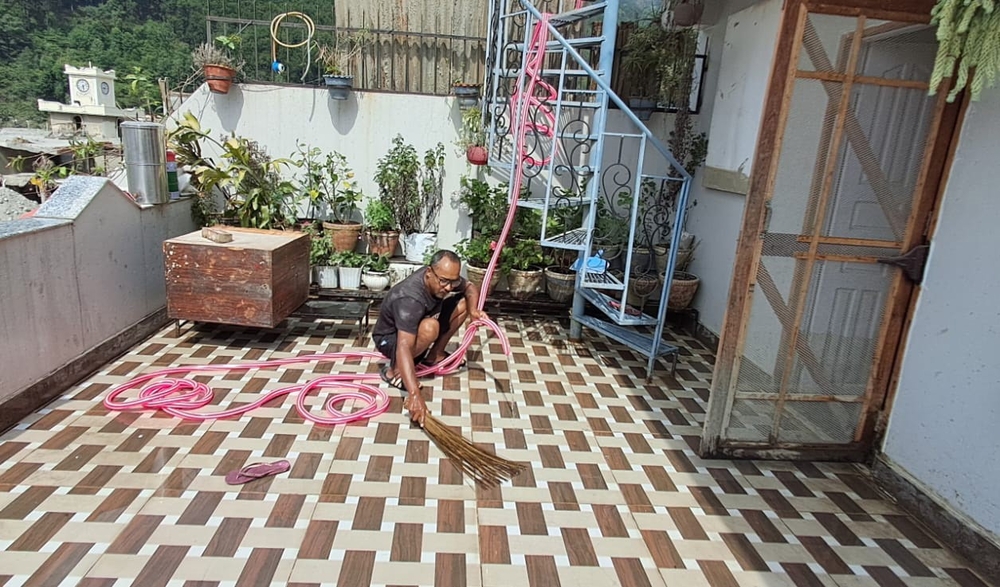
Similar uncertainty is evident in Tupche, Bidur-7, where residents have started clearing sand and debris from houses that survived structurally but were buried by the flood. Some have received help from organisations to clean their properties.
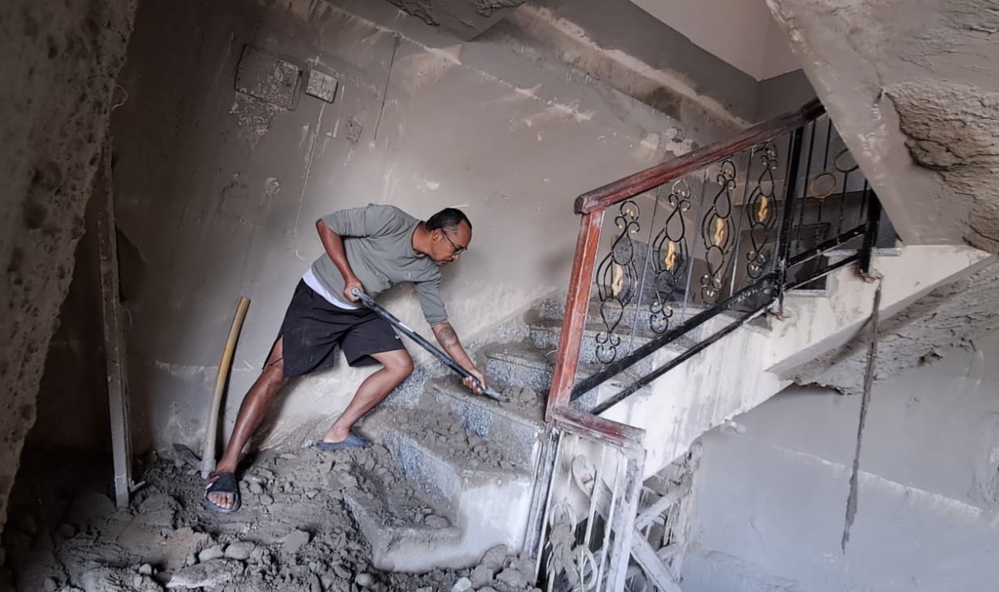
Sashi Dangol, whose home in Betrabati, Nuwakot, was damaged by the Bhotekoshi floods, clears debris from his house.
“People have started cleaning their houses, but they do not know whether they can live there safely,” said Nepal. “The federal government’s delay in making decisions is increasing their distress.”
The government says it will not allow people to rebuild settlements in areas identified as highly vulnerable to flooding. KC said the authority’s executive committee had decided against allowing people to live within the flood-risk zone marked by the water’s reach.
“Our executive committee has decided that people should not live within that flood mark,” said KC. “That is why the Rs15,000 monthly assistance and the construction of temporary and transitional shelters are moving ahead. Their designs have been approved.”
However, the authority’s report does not provide details of individual structural safety inspections to establish which damaged houses remain habitable and which are unsafe. The Department of Urban Development and Building Construction surveyed 2,027 households to assess damage preliminarily and the need for temporary accommodation, but the report does not state how many buildings have undergone structural assessments.
For families whose homes and land have disappeared, returning is not even an option. Madan Chitrakar, who ran a hotel in Devighat, lost his three-and-a-half-storey house and the land on which it stood. The river now flows through the location where his house once stood. He has moved to Kathmandu with his eight-member family and is renting a flat.
“I have nowhere to return to. The river is flowing where my house once stood,” said Madan. “We lost not only our property but also our business. We are in a very difficult situation.”
The authority’s latest report said 943 displaced people were staying in 13 holding centres as of October 16. But authorities have not published an updated breakdown of how many families who left holding centres returned home, rented rooms or found shelter elsewhere. The authority has acknowledged that the gap between the initial survey and the current situation makes it difficult to establish the actual circumstances of displaced families.
In Betrawati, residents have started clearing debris and reclaiming whatever remains of their properties. Astaman Dangol said some families had resumed raising goats and pigs, while two shops had reopened. He has also planted leafy greens and vegetables to earn a living.
“There is nowhere else to go. Everything we had was swept away, so we have to clear the debris and live here,” said Dangol. “How long can we survive on relief money alone?” He said some families in Betrawati have been reduced to one member.
While some survivors in Nuwakot are returning to damaged homes, displaced families in Rasuwa are exploring safer locations for collective resettlement.
Nima Tamang, a flood survivor from Timure in Gosainkunda Rural Municipality-2, said a group of 36 people had left their holding centre to inspect possible sites for an integrated settlement. “We held a meeting at the holding centre and discussed who wanted to go. Thirty-six of us came to inspect possible sites for an integrated settlement,” he said.
Most families from Timure have ancestral land in Khaidi, an upper settlement they believe could provide a safer alternative to their former homes. Tamang said nearly every household already owned land there, except around 10 to 12 families.
“The old settlement is frightening, and honestly, unhabitable. We have the possibility of living in our ancestral village above,” Nima said.
He believes families could move to Khaidi relatively soon if access roads were improved. But the infrastructure required for a permanent settlement and government support for relocation remain uncertain. “If we keep waiting for the state, who knows when anything will happen? Two months have passed, and there is still no sign of progress,” he said.
The authority says land identification has been completed. KC said a committee involving the director general of the Department of Survey and a joint secretary from the Ministry of Federal Affairs and General Administration had identified more than 3,000 land parcels at various locations in Rasuwa and Nuwakot. “The committee has identified land and submitted its report. Temporary and transitional shelters will be built there,” he said.
However, the suitability of the identified land has yet to be assessed, and the necessary legal procedures have not been completed. The authority’s report does not specify how many households could be resettled on the identified plots.
According to the report, a seven-day public notice for temporary housing construction was issued on October 8. The building department prepared structural designs and cost estimates for capsule houses on October 9. The authority said land development at identified sites was completed by October 11.
KC expects recovery work to advance between Dashain and Tihar.
The government has also prepared a rehabilitation and housing management action plan 2026, alongside a plan for detailed damage assessment. But it has not provided a clear timeline for when displaced families will receive safe accommodation.
Shiva Devkota, a local resident in Bidur, said fundamental questions remained unanswered—whether settlements could be rebuilt at their original locations, how far houses must be set back from rivers, when river-control work would begin and how local heritage structures would be protected.
“Those displaced from Rasuwa are staying in holding centres in Nuwakot. Those who have rented rooms are struggling because they cannot afford rent. The state has not even provided funeral expenses for relatives who died,” he said.
Arjun Poudel is a health reporter for The Kathmandu Post. Before joining the Post, he worked for Sagarmatha Television, Naya Patrika, Republica and The Himalayan Times.




 13.03°C Kathmandu