Dalit devotees face caste segregation at Chhath celebration in Madhesh
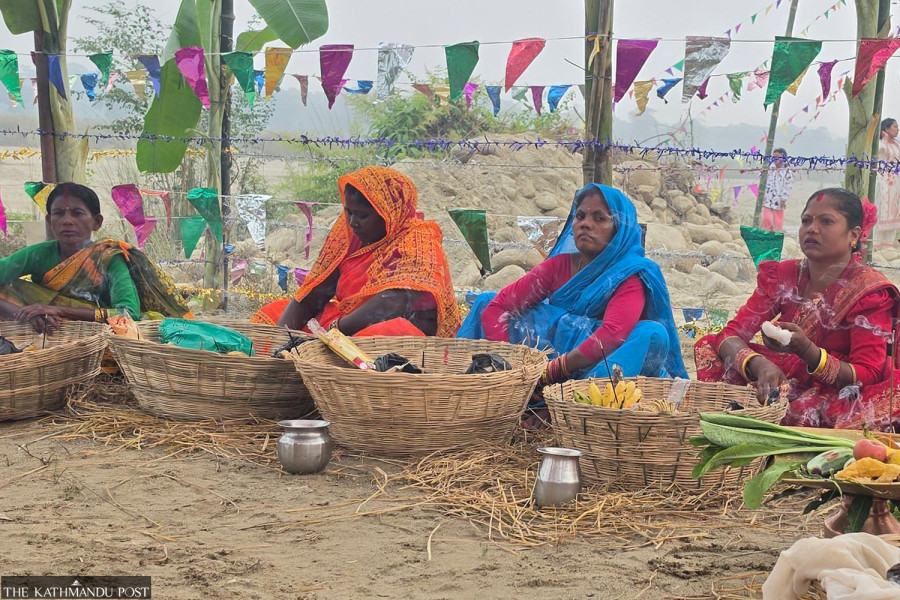
Separate ghats and tents in Saptari and Rautahat expose the gap between the festival’s message of equality and the discrimination that persists despite constitutional guarantees and laws against caste-based discrimination. There is an entrenched practice of Dalits worshipping separately in Madhesh. Post Photo
Ponds, rivers and canals are decorated for Chhath across Madhesh. The observances draw families to water bodies before dawn and after sunset together. Yet in Saptari and Rautahat, Dalit families worship at separate ghats or under separate tents.
At Darpi pond in Katti of Bishnupur Rural Municipality-5, Saptari, the southern bank is brightly decorated. At the eastern edge, near a peepal tree, the Dom community has its own ghat.
Baijanath Marik, who has celebrated Chhath there with his family for years, said discrimination had eased but persisted. “Earlier, discrimination was much worse. It has reduced a little now, but it has not ended,” he said. “We cannot go to their ghat. We can only watch from nearby.”
Baijanath said the exclusion hurt because Dom families make the bamboo baskets, trays and other items used to carry offerings of fruit and sweets. “They use the things we make to offer prayers to the same god, but seeing them discriminate against us makes our hearts ache,” he said. “Why were we born untouchable? Even though we are human, we are never treated as equals.”
At Amrit pond in Bishnupur-7, members of the Ram, or Chamar, community also worshiped separately for decades. After young residents protested, Dalit families stopped celebrating there and moved to Tarbara and Gosai ponds five to seven years ago, said Kashindra Ram.
Residents cleared water hyacinth from Tarbara pond to make a ghat. “The local people cleaned the pond and built a ghat,” said Kashindra. Seventeen families now worship at Tarbara and 32 at Gosai. Other communities had avoided Tarbara because it had been used to dump animal carcasses, he said.
Kashindra said Chhath should bring all castes together. “Despite laws and policies meant to end caste discrimination, such practices continue,” he lamented.
But Lochan Sahu, ward chief of Bishnupur-7, denied discrimination, saying people had chosen convenient places. “We also celebrate Chhath at the canal, where all communities are together,” he said.
A similar divide is visible on the Chandi riverbank in Chandrapur Municipality-5, Rautahat, where a separate tent has been set up for Musahar and Mahara families. Around 30 Musahar and Mahara households live in the largely Chaudhary settlement.
Bhagali Devi Musahar, 65, was preparing for the ritual on Sunday, the main day of Chhath festival, in the tent designated for Dalits. After years of celebrating alongside others, she said the arrangement hurt. Until three years ago, Dalit devotees were allotted a corner inside the main tent. They began setting up a separate tent after objecting to being confined there.
Sixteen Musahar and Mahara households worshipped in the separate tent this year. “When the festival comes, people from the so-called upper castes behave differently towards us,” said local resident Ramnath Mahara. “Their status may be high, but their behaviour has not changed. We are saddened.”
Ganesh Chaudhary, chair of the Rajpaida Chhath Ghat Committee, rejected the allegations. He said all communities once worshipped together and Dalit residents had chosen to leave. “We have respect for every caste and religion. There has been no discrimination from our side,” he said. Sunita Mahara disputed that account, saying Dalit worshippers had been assigned a corner even inside the same tent.
Ramji Ram of Gadhimai Municipality-9, Rautahat, said separate spaces showed that caste discrimination remained embedded in social life. “The deity is the same, but non-Dalits cannot accept Dalits worshipping alongside them, or even accept the place where Dalits pray,” he said. He wondered when Dalits would be respected in public spaces.
Ramji criticised weak enforcement of existing laws. He said the Ministry of Women, Children, Gender and Social Security had appealed against caste discrimination and separate Chhath ghats, but authorities had not adequately monitored compliance. He said local governments had failed to bridge the divide.
The constitution guarantees equality under Article 18 and the right against untouchability and discrimination under Article 24. The Caste-Based Discrimination and Untouchability (Offence and Punishment) Act, 2011, makes discrimination and exclusion from public places punishable. Yet, Dalit devotees in Madhesh have repeatedly been made to worship separately during Chhath.
Chhath is a four-day festival. Devotees bathe and eat a simple meal on the first day, fast and prepare offerings on the second, then observe a fast and pray to the setting sun on the third. They complete the rituals by worshipping the rising sun on the fourth morning. Devotees offered arghya on Sunday evening and were to conclude the festival on Monday morning.




 12.12°C Kathmandu