Why is Tatopani border still closed? Stakeholders say it’s time Kathmandu asked Beijing
Traders and local representatives want the government to seek an explanation from China and secure a lasting arrangement for the operation of the key trade route. Post Illustration
Over a decade after the 2015 earthquakes disrupted trade through the Tatopani border crossing, traders in Sindhupalchok are still struggling to understand why China has not allowed it to operate regularly.
The latest closure, following the August 26 floods in the Bhotekoshi River, has deepened their frustration, prompting calls for the Nepali government to seek a clear explanation from Beijing and secure a lasting arrangement.
“Traders and businesspeople have lost hope and are thoroughly frustrated,” said Buddha Raj Basnet, president of the Sindhupalchok chapter of the Federation of Nepalese Chambers of Commerce and Industry.
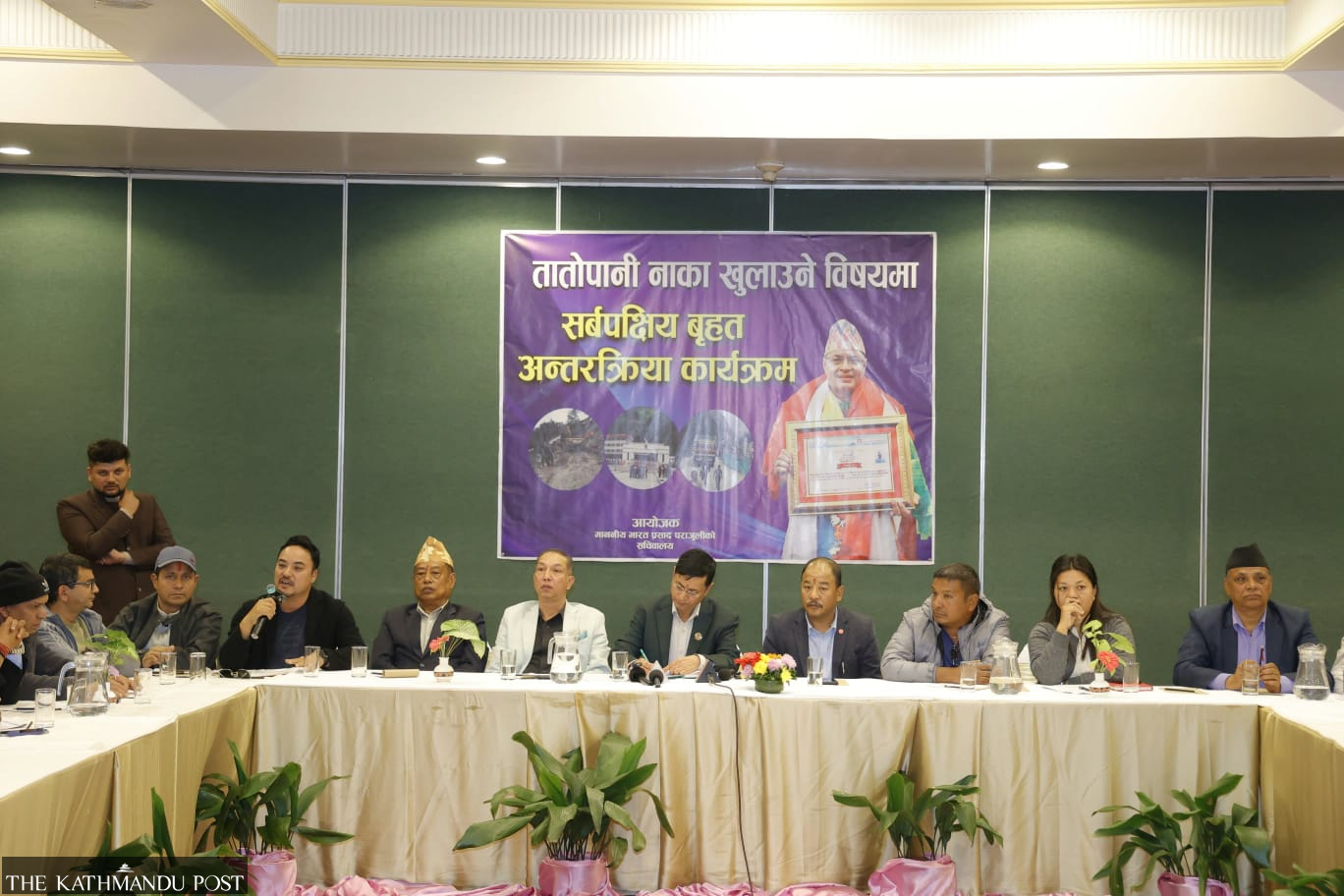
At an interaction organised on Monday, lawmakers, business leaders, local representatives and importers urged the government to initiate diplomatic talks with China to ensure year-round operations. They said regular operations would give Nepali consumers access to affordable Chinese goods through the shortest trade route.
“Since the political changes of the 1990s, the Tatopani border has remained in the shadows,” said Bharat Prasad Parajuli, a lawmaker from Sindhupalchowk, arguing that successive governments had failed to give the crossing adequate attention in their dealings with China.
The latest closure has compounded existing problems in Nepal-China trade. China shut the Tatopani crossing following the Bhotekoshi floods. Trade through the Rasuwagadhi-Kerung border has also been disrupted by infrastructure damage, while the Korala crossing has yet to emerge as a reliable alternative because of logistical difficulties.
But traders say natural disasters and infrastructure problems do not fully explain the repeated restrictions at Tatopani. Several participants questioned whether security concerns were behind China’s decisions, saying Beijing had not clearly explained its position.
Lawmakers, business leaders, local representatives and importers express their views at the interaction programme on Monday. Post Photo: Anil Giri
Parajuli said Nepal was ready to address any such concerns and improve infrastructure on its side. Infrastructure Development Minister Sunil Lamsal had assured him that resources would be made available to repair the Araniko Highway and manage landslides, he said.
“If security is the concern, we are committed to the one-China policy and are ready to provide all necessary assurances to China if it has any security concerns about reopening the border,” Parajuli said.
For traders, the restrictions have also meant losing access to the Chinese market. Basnet said Tatopani had remained largely inaccessible to Nepali exports since the 2015 earthquakes, despite occasional openings.
“Since the 2015 earthquakes, we have not been able to export even a single bundle of green leafy vegetables to China. Before the quakes, we used to export eight containers of goods to China through the Tatopani crossing,” he said.
Basnet said Nepal also needed to address infrastructure problems, including 26 kilometres of highway requiring maintenance and landslide risks in the Eco area of the highway, which runs around 250 metres. But he questioned the point of investing in the route if China did not intend to operate it.
The uncertainty has also affected importers waiting for goods from China. Trader Tej Prasad Acharya said some goods dispatched in June had only recently reached Kathmandu because of disruptions at the Tatopani and Kerung crossings.
“Without diplomatic initiatives, this crossing cannot be reopened. Since the earthquake, Tatopani has effectively faced an unofficial blockade,” he said.
Acharya argued that repeated closures could not be attributed solely to landslides, saying the government had failed to address infrastructure problems and properly raise the issue with China.
Trader Hem Kharel said both businesses and consumers were bearing the cost of the disruptions. Ram Chandra Pudasaini, an office-bearer of the Nepal Trans-Himalaya Border Commerce Association, called for direct diplomatic engagement, including sending a delegation to China if necessary.
“Whether through the prime minister, the foreign minister or the Nepali ambassador, diplomatic efforts are needed to reopen this border. If necessary, we should send a delegation to China for talks. We have failed to convince the Chinese government of the importance of this crossing and must also assure it that there are no security threats at this border point,” he said.
Basnet, meanwhile, maintains a harder line.
“If China does not want to operate this crossing, it should officially announce its decision and close it permanently,” he said.
Anil Giri is a Chief Sub Editor covering diplomacy, international relations and national politics for The Kathmandu Post. Giri has been working as a journalist for more than two decades, contributing to numerous national and international media outlets.




 15.12°C Kathmandu