As AI-generated covers spread, Nepali musicians fight to reclaim their voices
Artists say their songs are being recreated with cloned voices and sold on digital platforms without permission, even as the technology quietly becomes the soundtrack of everyday life. Post Illustration
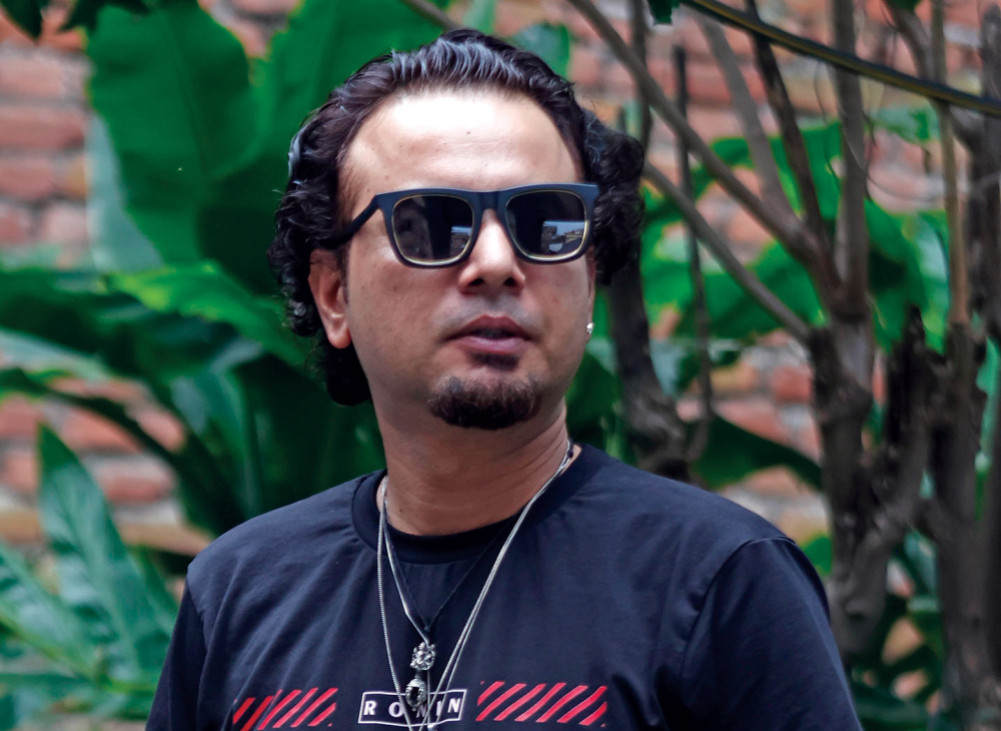
On June 29, singer Sugam Pokharel posted a status on Facebook with a stern warning. He issued an immediate demand for the removal of unauthorised AI-generated content utilising his or other artists’ works. “If you ignore this request,” he wrote, “we will have no choice but to bring you within the jurisdiction of the law, wherever you may be, in Nepal or anywhere else in the world.” The status included screenshots of AI covers of his originals uploaded on Youtube and Tiktok.
Pokharel says he first learned his songs were being run through AI months earlier, not from any platform notification but from listeners who told him directly.
He says he is not opposed to AI itself. He uses apps like Suno, the AI music creation platform, in his own creative process. He feeds in his lyrics and compositions to the app to sketch out arrangements before handing them to a producer. For an arranger, the work would take hours, if not days. Now it can be done at a fraction of the cost and time, he says.
What Pokharel objects to is the unauthorised use of his voice, melodies and lyrics. This distinction—AI as a creative tool versus a means of misappropriation—is a hot topic in Nepal’s music industry today.
The debate has reached law enforcement. Bimal Adhikari, who runs the label Bhavna Music Solution, recently took his complaint to Nepal Police’s Cyber Bureau. He first noticed songs under his label being altered and re-uploaded about six or seven months ago and initially assumed the trend would fade out on its own. It didn’t. His work was relabelled under different names and traded commercially; by the time he acted, somewhere between 40 and 50 of his songs had been altered with the help of AI, several traced to a single person operating 10 to 12 YouTube channels.
Adhikari is precise about what makes this different from AI music in general. “Even if a song is made by AI, the melody is 100 percent the melody I created,” he says. “The lyrics are also the same. It isn’t an ‘AI-generated song’. It is my composition and my words.”
Deputy Superintendent of Police Gajendra Acharya said the Bureau categorises complaints based on the nature of the offence rather than under a dedicated AI music category. As a result, it was unable to provide statistics on AI music-related complaints.
Adhikari adds he worries about what comes next. Automated copyright-detection systems, he fears, could eventually flag original artists for infringement on their own material, while the anonymous channels that triggered the confusion disappear and resurface under new names, leaving the strike behind on the real artist’s account.
Adhikari has so far filed an individual copyright complaint against around 95 YouTube channels for unauthorised use of his content. Many of the cases were later settled after those responsible apologised, acknowledged their wrongdoing and removed the offending content.
Both Pokharel and Adhikari trace part of the problem back to the law itself. Nepal’s Copyright Act was passed in 2002. Pokharel argues that it was never formulated to anticipate voice cloning. “If someone takes your house or your property, paints it a different colour, and then puts it on the market to sell, that’s illegal, isn’t it?” Pokharel says. Noting that current prime minister, Balendra Shah, is himself a musician, Pokharel says the Ministry of Communication and Information Technology should prioritise updating the laws.
What Pokharel objects to is the unauthorised use of his voice, melodies and lyrics.
Not everyone experiencing the shift sees only loss in it. Santosh Chapagain, who owns Pass Café in Kathmandu, has played AI-generated music for eight or nine months now, a habit he traces to the period around the Gen Z movement. “Music is life for musicians,” Chapagain says. “But for us, music is for entertainment, for peace of mind.” He adds, “We play whichever music makes us happy.” From devotional songs in the morning to timeless classics or rap, he plays it all in his cafe. His customers have noticed this change, some have remarked that he used to play the old songs before, but he says there has been no real pushback, and he has found uses for the technology beyond convenience: AI-generated bhajans, or turning a sad Dashain song into a happy one on request.
According to Nepal’s laws, and laws around the world, Chapagain says, using someone’s copyrighted work without permission is illegal. He would support a labelling requirement if regulators introduced one for cafés, he says. But he doesn’t see the original and the AI version as competing versions. “Original is original. Gold is still gold,” he said. “Its price changes over time, but its value remains.”
Utsaha Joshi (Uniq Poet), an artist who works with AI tools directly, says the popular image of how the music actually gets made—one prompt, one upload—is wrong. It starts with a human vision: humming a melody, writing lyrics, sometimes playing and recording instruments before any prompting begins. Only after that groundwork comes AI-assisted production, which includes prompting, re-prompting, separating stems, and assembling the result “brick by brick.” What gets automated, in this account, is manual execution, not creative direction.
If a generation draws on an artist’s own data, Joshi argues, that artist should be paid for it, however small the amount, which would require music models to be trained alongside a genuine attribution system and a clear opt-out for artists.
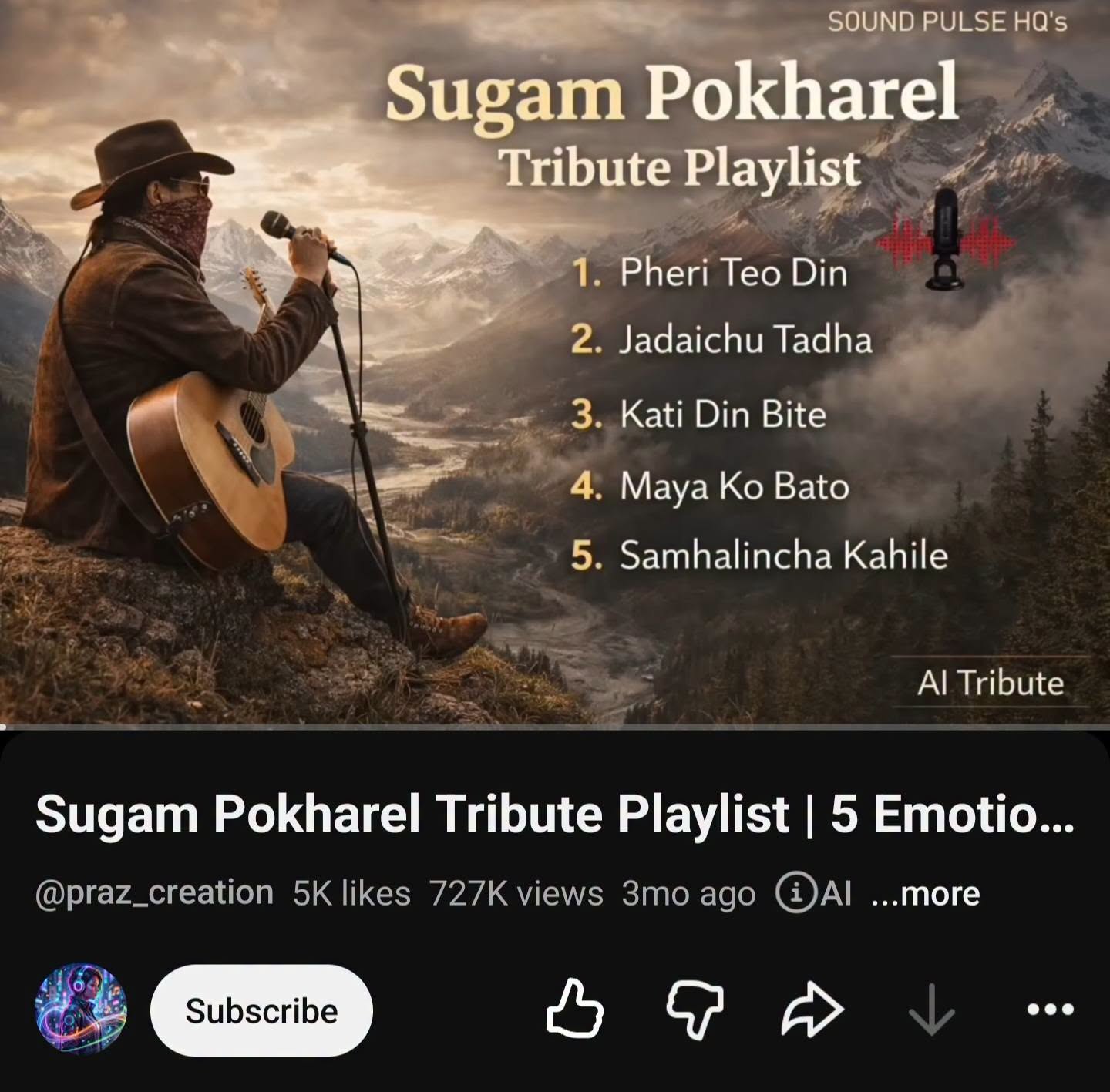
An AI-created cover version of Sugam Pokharel’s much-loved song “Pheri Tyo Din”.
The question—how to make AI’s use of an artist’s voice visible, if not yet compensable—is what a new global labelling initiative is also attempting to address, at least on paper. Announced by the International Federation of the Phonographic Industry (IFPI) and the Recording Industry Association of America (RIAA), alongside other organisations including the Grammy Awards’ organisers, the voluntary framework introduces two labels: “Created by AI,” for content where the main vocals or lead instrumental tracks were substantially AI-generated, and “AI-Assisted,” for human-made music that used AI for specific elements, with a requirement to disclose clearly if a person did not perform the main vocals or instruments.
Some platforms are already moving. Deezer now automatically tags AI-generated uploads and reports that nearly half of new submissions to the platform are AI-generated, with a detection system it says is 99.8 percent accurate. An Apple Music official said earlier this year that more than a third of new uploads to the platform are fully AI-generated. Spotify introduced a “Spotify-verified” label last April aimed at confirming official artist content and curbing AI impersonation. The Digital Media Association, which represents Apple Music, Amazon Music and Spotify, has welcomed the framework, saying it will give listeners clearer information and strengthen the metadata attached to AI content.
None of this is specific to Nepal. No domestic streaming service or regulator has proposed a comparable disclosure system, even as Nepali listeners are, by several accounts here, already encountering unlabelled AI-generated music daily: in cafés, on buses, at devotional gatherings, without being told.
A screenshot shared by Sugam Pokharel shows an AI-generated cover of his songs that he says were created and uploaded without permission.
Suresh Manandhar, an AI scientist, sees the same divide from a different angle. In his view, AI has genuinely lowered the barrier to making music. From cutting the cost and time of composing and writing lyrics for artists who already create, while opening music-making to people who couldn’t previously afford it. “That is a very positive effect,” he said. The problem, he said, isn’t the tool. It’s that someone who is skilled with the tool but isn’t a creator can take an original artist’s lyrics or music and “twist it into their own creation,” which is where questions of ownership and attribution—still unresolved in Nepal—begin.
Asked where the line should sit between creative use and unauthorised imitation, Manandhar reached for an analogy from his own field. “Just as we provide citations and references in academic work, any AI-generated content should be clearly labelled as ‘AI-Generated,’” he said. Voice cloning, in his view, is the clearest case for mandatory labelling and attribution. Lyrics are trickier, since reworking existing lyrics or melodies into something new predates AI, Hindi film songs have long borrowed from English or Nepali ones. He argued that the ownership rules therefore shouldn’t change just because AI was involved: if a person turns one set of lyrics into another using an AI tool, the work, and the ownership, is still theirs, and the legal question should be judged exactly as it would be without AI in the picture.
But Manandhar also cautioned that labelling alone won’t settle what Nepali musicians are asking for, because “what exactly we are protecting” is not one thing. Lyrics, musical style, audio-visual style, and an artist’s cloned voice each need their own rule, he said, rather than a single blanket policy. He offered his own hypothesis: turning a Narayan Gopal song into a rap track. That transformation was possible before AI—it would simply have taken longer by hand—so the financial and intellectual ownership of the original hit, he argued, should be treated no differently whether AI was used to do it or not.
Looking ahead, Manandhar expects the technology to move from a production shortcut to something closer to a collaborator. Within the next year, he said, artists are likely to work with AI agents that hold a working knowledge of everything they’ve previously created, letting a musician describe a mood, an instrument, or a visual setting and have the assistant draft variations to refine into a finished song—an extension, he said, of what people are already doing informally with short-form drafts on platforms like TikTok.
For now, the burden of flagging AI-generated music falls on artists themselves, checking their own catalogues, filing their own complaints, writing their own warnings on Facebook.
Adhikari says his own case is resolved, for now. But he does not think it is over. “Other friends have thousands of songs that are being used purely for trade,” he said. “I believe this issue will be raised by many others in the coming days.”
Aarya Chand is a reporter at The Kathmandu Post covering social issues. Before moving to the social beat, Chand was an intern covering culture and lifestyle for the Post.




 16.01°C Kathmandu

.png&w=900&height=601)