As crises mount, Nepal’s parliamentary committees struggle to hold the government to account
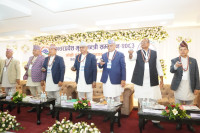
The ‘mini-parliaments’ have largely remained silent on issues of public concern—from police killings and executive pressure on constitutional bodies to financial controversies—raising questions about their independence and oversight role.Speaker Dol Prasad Aryal (left, in light grey coat) administers the oath of office and secrecy to the chairpersons of 12 parliamentary committees at Singha Durbar in Kathmandu on April 17. Angad Dhakal/TKP
On August 5, the Law, Justice and Human Rights Committee of the House of Representatives convened a meeting apparently called to discuss international concerns regarding the country’s judiciary. The core agenda centred on a joint statement issued on July 24 by three prominent global human rights organisations—Amnesty International, the International Commission of Jurists, and Human Rights Watch—claiming that the government was applying undue pressure on several Supreme Court justices to tender their resignations under the direct threat of potential impeachment proceedings.
But, rather than using these serious allegations as a starting point to conduct an independent parliamentary inquiry into potential executive interference in the judiciary, the committee spent more than four hours deliberating the motives of the watchdog groups. By the end of the lengthy session, the committee reached a controversial decision that these three international organisations should furnish clarification. The decision drew severe criticism from civil society, legal experts, and constitutional observers across the country.
A body constitutionally mandated to keep the executive in check had effectively transformed itself into a shield for the government, asking state authorities to demand answers from the international organisations that had raised concerns about state behaviour. Critics argued that the committee had completely forgotten its primary duty and chosen instead to act as a defender of the executive.
Under established parliamentary traditions, the committee possessed full authority to launch its own factual investigation, summon judicial administrators to verify whether the government had coerced Supreme Court justices.
“The fundamental purpose of a parliamentary committee is to hold state organs accountable to the people,” said Amaresh Kumar Singh, a parliamentarian from the ruling Rastriya Swatantra Party. “It is completely outside the mandate of any parliamentary committee to debate statements made by non-state actors. If an ambassador makes a public comment tomorrow, does that mean the International Relations Committee should summon the diplomat for a cross-examination?”
There are growing concerns that parliamentary committees, often described as ‘mini-parliaments,’ may be struggling to fully uphold their constitutional oversight roles. Out of 12 standing committees in the HoR, almost all are coming under public scrutiny for inaction, executive subservience, and a clear failure to address pressing public grievances.
The political arrangement of these committees further complicates their independence. While 11 committees are chaired by members of the ruling RSP, only the Public Accounts Committee is led by the main opposition Nepali Congress.
The government has registered only 12 bills in the lower house so far. Among them, merely two bills are undergoing detailed clause-by-clause discussions within committee chambers, while the remaining 10 sit idle in the parliament. As grievances multiply across the country, mini-parliaments remain remarkably silent and disengaged from citizens’ concerns.
Within the past four months, the country witnessed a cascade of critical events that directly impacted everyday citizens. Farmers across the country faced severe shortages of chemical fertilisers during the peak planting season, compounded by systemic corruption in distribution networks and a total lack of timely procurement planning. The landless squatters were forcibly evicted without proper relocation plans or social safety nets. Freedom of the press faced visible pressure when there were attempts to restrict operations at major media houses following critical reporting on the government.
Simultaneously, the self-immolation of Ganesh Nepali highlighted systemic economic neglect, while the arrests of Gen Z youth activists, including Majid Ansari, sparked public outrage regarding civil liberties, youth rights, and freedom of speech. At the southern border, citizens endured harassment due to sudden and strict customs enforcement, while everyday consumers struggled with shortages of cooking gas in urban markets. Basic administrative services ground to a halt as long queues formed at passport centres, smart driving licence distributions were suspended due to management disputes, and traffic fine structures were sharply increased without public consultation or clear legal justification.
In the economic sphere, private sector leaders voiced growing anxiety over arbitrary arrests, raids on private residences, and high-handed financial investigations that shattered investor confidence and threatened business operations across key industrial sectors. Constitutional balance suffered a setback when reports emerged that officials from the Prime Minister’s Secretariat had summoned the chief commissioner and commissioners of the Commission for the Investigation of Abuse of Authority to the Prime Minister’s Office, detaining them in discussions for nearly five hours regarding a controversial passport procurement contract. The incident raised serious questions about executive intimidation of independent constitutional watchdogs.
Furthermore, public anger mounted when the Cabinet chose to prorogue parliamentary sessions simply to issue eight ordinances, bypassing legislative debate, public accountability, and democratic scrutiny. Academic integrity was compromised when the MBS question paper at Tribhuvan University leaked on WhatsApp just five minutes after the exam began. Meanwhile, frequent failures in government digital systems disrupted essential public services, leaving ordinary citizens unable to obtain basic administrative documentation. Additionally, public resentment flared when the government reinstated personal secretarial allowances for MPs—a benefit abolished in October last year by Sushila Karki's government following the Gen Z movement.
Hari Bahadur Thapa, a journalist who has reported on parliamentary affairs for over three decades, says that parliamentary committees have lost sight of their fundamental democratic mandate. “A parliamentary committee is not merely a drafting room for legislative clauses,” Thapa told Kantipur. “It is the primary democratic forum where the questions raised on the streets, in the media, and throughout society must find formal answers.”
Thapa added that the committees are meant to hold the executive branch accountable on national security, law enforcement, public policy implementation, and administrative overreach. “Today, our committees are failing completely in this duty,” he said.
Thapa recalled how parliamentary oversight functioned in earlier decades, citing a benchmark case from September 2000. On 22 September, 2000, following a brief investigative report published in Kantipur daily concerning financial irregularities in the lease of a Lauda Air aircraft by the national flag carrier, the Public Accounts Committee convened an emergency meeting within hours to initiate a full-scale parliamentary investigation. That probe ultimately led to high-profile accountability measures.
“Contrast that historical precedent with what happened recently regarding the passport contract,” Thapa said. “When reports emerged that members of the prime minister’s private secretariat held constitutional commissioners inside the Prime Minister’s Office for five hours, the State Affairs Committee should have summoned the people concerned. Instead, there was absolute silence.”
The passivity, however, is not limited to committees led by the ruling party. The Public Accounts Committee (PAC), traditionally chaired by the main opposition party to guarantee independent financial oversight, has fared no better under the leadership of Congress lawmaker Bharat Bahadur Khadka.
Historically, the PAC was known as one of the most feared and effective oversight bodies in Nepal. It successfully investigated massive financial corruption scandals, including the controversial purchase of two wide-body airbus aircraft by Nepal Airlines Corporation, where the committee calculated specific financial losses, identified responsible officials, and formally instructed the CIAA to file criminal corruption charges against political leaders and top bureaucrats. Similarly, the committee earned national attention by launching independent investigations into multi-billion-rupee cost overruns and construction irregularities at Pokhara International Airport and Gautam Buddha International Airport in Bhairahawa.
In stark contrast, the present Public Accounts Committee has remained passive amid severe contemporary economic controversies. When widespread public complaints emerged regarding recent budget reallocations and unusual customs clearance procedures for imported electric vehicles, the committee conducted only a cursory discussion without launching a formal investigation.
Furthermore, after the national budget bill had been formally passed by Parliament and signed into law by the President, Prime Minister Balendra Shah announced via a personal Facebook post that the government would withdraw the newly enacted equity tax imposed on health and education services. This decision sparked a fierce constitutional debate over whether a prime minister could unilaterally alter statutory tax laws through social media posts without legislative approval. Yet, the PAC ignored the matter entirely.
PAC Chairman Khadka defends his committee’s performance, arguing that comparing the current committee to past investigative bodies overlooks structural political constraints. The PAC met on Tuesday after a gap of more than a month, having last convened on July 11. According to Khadka, the Tuesday meeting brought together the finance minister and finance secretary to evaluate structural damages resulting from public property fires during the Gen Z protests.
“People assume the committee is inactive simply because we are not engaging in aggressive media stunts or political brawling like in previous years,” said Khadka. “We are working quietly and methodically to settle long-pending audit accounts that remained stagnant for sixteen years. However, observers must understand our practical constraints.”
The ruling party holds an absolute majority in the committee, Khadka went on. “Out of 26 members on the Public Accounts Committee, 15 belong to the RSP,” he said. “If they choose to boycott a meeting, we cannot even meet quorum.”
Veteran journalist Thapa rejects the argument that procedural routine equates to effective parliamentary oversight. “Settling historical audit arrears is routine administrative work,” Thapa argued. “The primary duty of the Public Accounts Committee is to investigate ongoing financial irregularities and policy corruption. If parliamentary committees turn a blind eye when citizens, civil society, and the media raise urgent questions about state power, where else can the public turn for answers?”
The decline in parliamentary scrutiny is equally evident in the State Affairs and Good Governance Committee, arguably the most powerful committee in Parliament, which supervises the Prime Minister’s Office, Home Ministry, Defence Ministry, CIAA, and Election Commission.
On July 26, when violent communal tensions erupted in Sunsari district, leading to security forces opening fire and killing four citizens across two eastern districts, the committee failed to hold a single meeting. RSP lawmaker Singh, a committee member, admitted that failing to hold the executive accountable for the Sunsari fatalities represented a grave failure.
“Four citizens lost their lives to police bullets, yet the committee was nowhere to be seen,” Singh said. “Failing to summon the prime minister or the home minister was an undeniable blunder.”
Ramhari Khatiwada, a Congress lawmaker who chaired the State Affairs Committee during the previous Parliament, echoed these concerns, noting that during his tenure, he repeatedly summoned sitting prime ministers, including KP Sharma Oli and Pushpa Kamal Dahal, to appear before the committee and answer direct questions regarding state decisions.
“However, serious questions are currently being raised about the prime minister, home minister, and other executive leaders, but the committees have failed to hold them accountable,” Khatiwada said. “The HoR and its members appear to have become a mere shadow of the executive.”
Historical records show that then prime minister Oli appeared before parliamentary committees on multiple occasions, including in November 2019 to brief lawmakers on diplomatic steps following India’s publication of a new political map featuring Limpiyadhura, Kalapani, and Lipulekh, in August 2024 to discuss the Corruption Prevention Act 2002, and in October 2024 to debate revisions to the CIAA Act 1991. Similarly, former prime minister Dahal appeared before the committee in December 2023 regarding the Ncell telecommunications share deal, and in January 2024 during discussions on the Constitutional Council Bill.
Surya Kiran Gurung, former general secretary of the Parliament Secretariat, attributes the current institutional weakness to a profound lack of respect for parliamentary procedures within the ruling establishment.
“We see lawmakers reprimanding an army officer or a department director in public, while government ministers openly use aggressive rhetoric against contractors,” Gurung said. “Yet, when it comes to bringing those very ministers into committee rooms to answer for their statements, Parliament falls silent. The Speaker is the constitutional guardian of the HoR, but current circumstances show a leadership unable to enforce legislative authority. It has been more than two months since the prime minister last delivered an address to Parliament.”
Gurung added that, following major communal clashes in the Tarai-Madhesh region, the prime minister was constitutionally obligated to address the nation through the floor of the House while Parliament was in session. “Addressing these issues through external public speeches while ignoring Parliament undermines democratic norms,” he said.
The situation of other committees reveals a similar pattern of administrative routine replacing active political oversight. The International Relations and Tourism Committee under Chairperson Sumnima Udas held eleven meetings, but focused primarily on formal courtesy visits with foreign diplomats—including the Russian Ambassador on July 6, German Ambassador on May 5, and French Ambassador on April 28—rather than conducting substantive foreign policy debates.
The Finance Committee held meetings 22 times. It met on the Nepal Rastra Bank Act Amendment Bill while ignoring broader economic stagnation. The Education Committee met 13 times on forensic lab legislation while neglecting the long-delayed School Education Bill. The Industry and Commerce Committee met 13 times but ignored cooking gas shortages and market price volatility. The Infrastructure Committee met six times, ignoring highway deterioration and failing to question the infrastructure minister when he publicly threatened to break contractors’ legs during a field visit.
In response to criticisms regarding the August 5 meeting, Samikshya Baskota, chairperson of the Law, Justice and Human Rights Committee, strongly defended her committee’s jurisdiction. “As a mini-parliament, we hold full authority to gather facts and issue directions on matters within our legislative domain,” Baskota said. “We spent four hours conducting an open discussion on judicial independence. Representatives from Amnesty International, the ICJ, and Human Rights Watch were invited but declined to attend. The narrative that our committee has become an agent of the executive is completely false.”
Baskota maintained that having a ruling party majority “does not mean our decisions are dictated by the government.”
“Our duty is to enforce executive responsibility while safeguarding judicial independence based strictly on verified facts,” she said.




 14.4°C Kathmandu