Gagan Thapa signals a more assertive role for Congress as main opposition
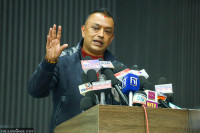
President says the party will no longer just issue statements over government actions; it would make a more concerted effort in favour of press freedom, judicial independence and the economy. Nepali Congress President Gagan Thapa speaks to the media at the party’s central office in Sanepa on Sunday. Dipesh Darshandhari/TKP
Nepali Congress President Gagan Thapa has signalled a tougher approach towards the government, saying the main opposition party will no longer remain silent over what it considers the government’s wrongful actions and conduct.
The party, which has often confined its response to issuing statements on such incidents, now intends to play a more active role in holding the government accountable, Thapa said.
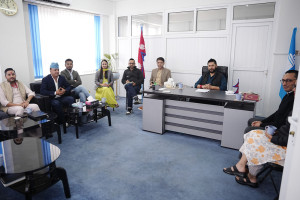
The Congress convened an emergency meeting of its central working committee on Sunday after taking serious note of police entering media offices and arresting journalists. Thapa addressed the central committee after a separate discussion with party office-bearers prior to the meeting.
Raising concerns over press freedom, the rule of law, impartial investigations, judicial independence and the state of the economy, Thapa called on the government and the ruling Rastriya Swatantra Party (RSP) to take the issues seriously. He said the Congress would now demonstrate a more effective opposition role.
Soon after the meeting, Bhishma Raj Angdembe, leader of the Congress parliamentary party, called a meeting for Monday. According to Joint General Secretary Ramhari Khatiwada, the Congress plans to consult other political parties, civil society representatives, intellectuals, journalists and young people before deciding how to respond to the government's conduct.
“We can no longer overlook the way the government is behaving,” Thapa said. “At first, we were cautious in our criticism, thinking that the government might have made mistakes simply because it was new to office. But this is beginning to look like a pattern, not a series of isolated missteps. We will not stay silent when democracy, civil liberties and press freedom are being undermined.”
Thapa had been signalling a shift in the party’s opposition strategy since the Congress general convention. He said the party had deliberately adopted a softer tone for some time after the elections but had made clear that it would take a tougher stand against government actions it considered wrong following the convention.
The five issues he raised at Sunday’s meeting, along with his warning to the government, are seen as a continuation of that position.
The first issue he addressed was the arrest of journalists after police entered a media house. Thapa said the incident evoked memories of the royal regime, when state authorities intervened in media operations. He argued that the government had crossed the line in its treatment of democracy, civil liberties and fundamental rights, and said the Congress would not remain silent.
According to the Congress president, statements issued by the police following the arrests, a response from the prime minister’s secretariat and subsequent disclosures had made the incident even more serious. He told the meeting that the police had initially issued a statement about the arrests, while the Prime Minister's Office secretariat said it had no knowledge of the operation.
Thapa also referred to reports that the prime minister’s office had withdrawn its statement issued in the morning and that its secretariat had sent the police a list of 28 people.
“The journalists were arrested and later released. But that does not mean the matter is over, nor should it be allowed to end there,” Thapa said. “We can be certain that the police did not decide on their own to enter media houses. They acted on orders from the authorities above them.”
Thapa also recalled an incident on July 13, when vehicles were parked outside media houses and the residences of some political leaders.
“We are prepared to challenge the government and take to the streets if necessary.”
The second issue concerned the rule of law. Thapa said neither the prime minister, ministers nor the police administration were above the law, and warned against the arbitrary use of state institutions. He cited the arrest of the Sunkoshi-Marin Diversion Project chief, who was taken to the Prime Minister's Office for questioning.
Thapa questioned why a project official had to be arrested and brought to the Prime Minister's Office when institutions such as the Public Procurement Monitoring Office and the Commission for Investigation of Abuse of Authority are there to investigate such matters.
He said the fight against corruption and the push for good governance were legitimate goals, but warned that the government must not use them as a pretext to misuse the law.
The third issue raised by the Congress chief was the need for impartial investigations into various controversies and allegations involving middlemen. Thapa expressed particular concerns over questions surrounding some Supreme Court justices.
He said no one should be declared guilty simply because a news report or allegations surface. Investigations, he stressed, must reach conclusions based on evidence. He also called for all cases to be investigated under the same standards.
Thapa also questioned the government’s failure to make public the findings of an investigation committee formed after questions were raised about the home minister’s assets, as well as the report of a separate committee investigating the Kaptanganj incident in Sunsari. Setting up investigation committees without releasing their findings, he argued, would only raise doubts about the credibility of the process.
The fourth issue raised by the opposition party concerned judicial independence. Thapa questioned the government over the possibility of executive interference in the judiciary, saying neither courts nor judges should be subjected to pressure or influence from the executive.
He called for a serious investigation into allegations that middlemen had attempted to influence cases pending in court by invoking the name of the Prime Minister’s Office, as well as reports of financial transactions linked to such activities.
While acknowledging the need for judicial reform, Thapa said the process should not be used to serve vested interests or settle scores. He added that the Congress was willing to hold discussions with all political parties on reforms to the judiciary.
The fifth issue was the economy and the investment climate. He pointed to the accumulation of deposits and excess liquidity in banks without a corresponding expansion in investment, difficulties in lending and loan recovery, lower-than-expected foreign investment and pressure on government finances caused by disasters.
“The biggest problem facing the economy is a crisis of confidence. Businesses cannot predict what the government will do or how its policies and decisions will change,” Thapa said. “This has created fear among the private sector, businesspeople and public servants. An economy cannot run under fear and intimidation. It needs confidence and trust.”
Thapa reminded the ruling RSP that voters had given it a five-year mandate to govern, just as they had entrusted the Congress with the responsibility of remaining in the opposition and holding the government to account for the period.
“The ruling party cannot support the government when it suits its interests and distance itself when things go wrong. If it takes credit for the government's successes, it must also answer for its failures,” the Congress chief said.
“If the government continues to act arbitrarily, the Congress will push back.”




 14.33°C Kathmandu