23.32°C Kathmandu
Fri, Oct 23, 2026
Koshi Province
Inside Kaptanganj: How a religious flag dispute and a loudspeaker turned a border village deadly
A month-old incident that engulfed a village that had never seen Hindu-Muslim conflict before shows what happens when religious tensions in plain sight and official warnings go unheeded.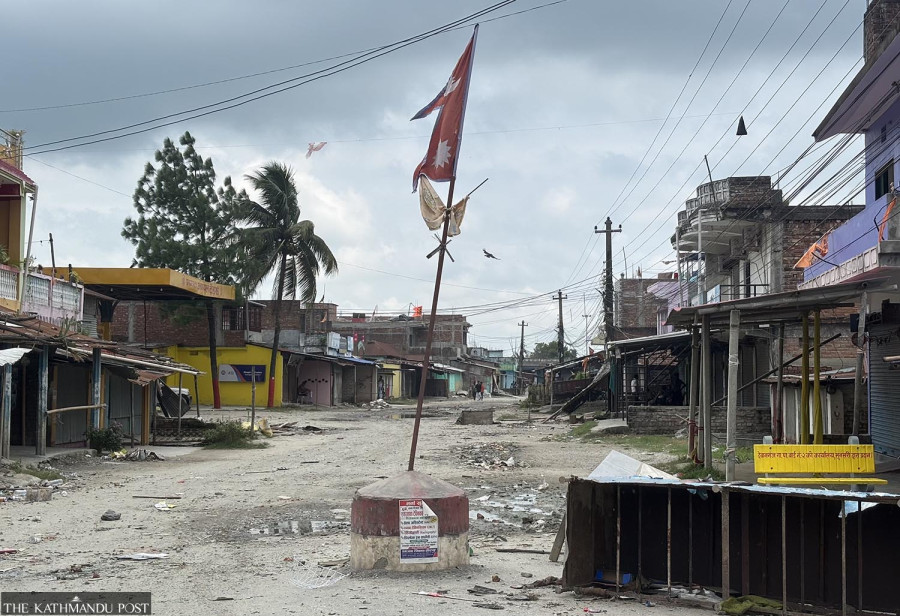
bookmark![]()
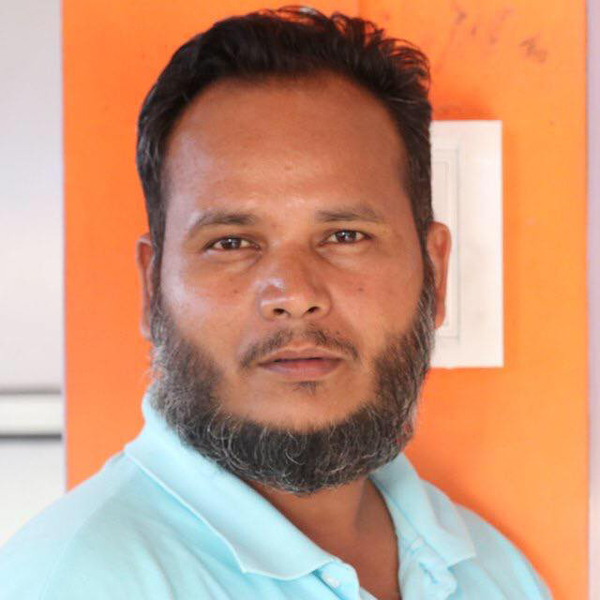
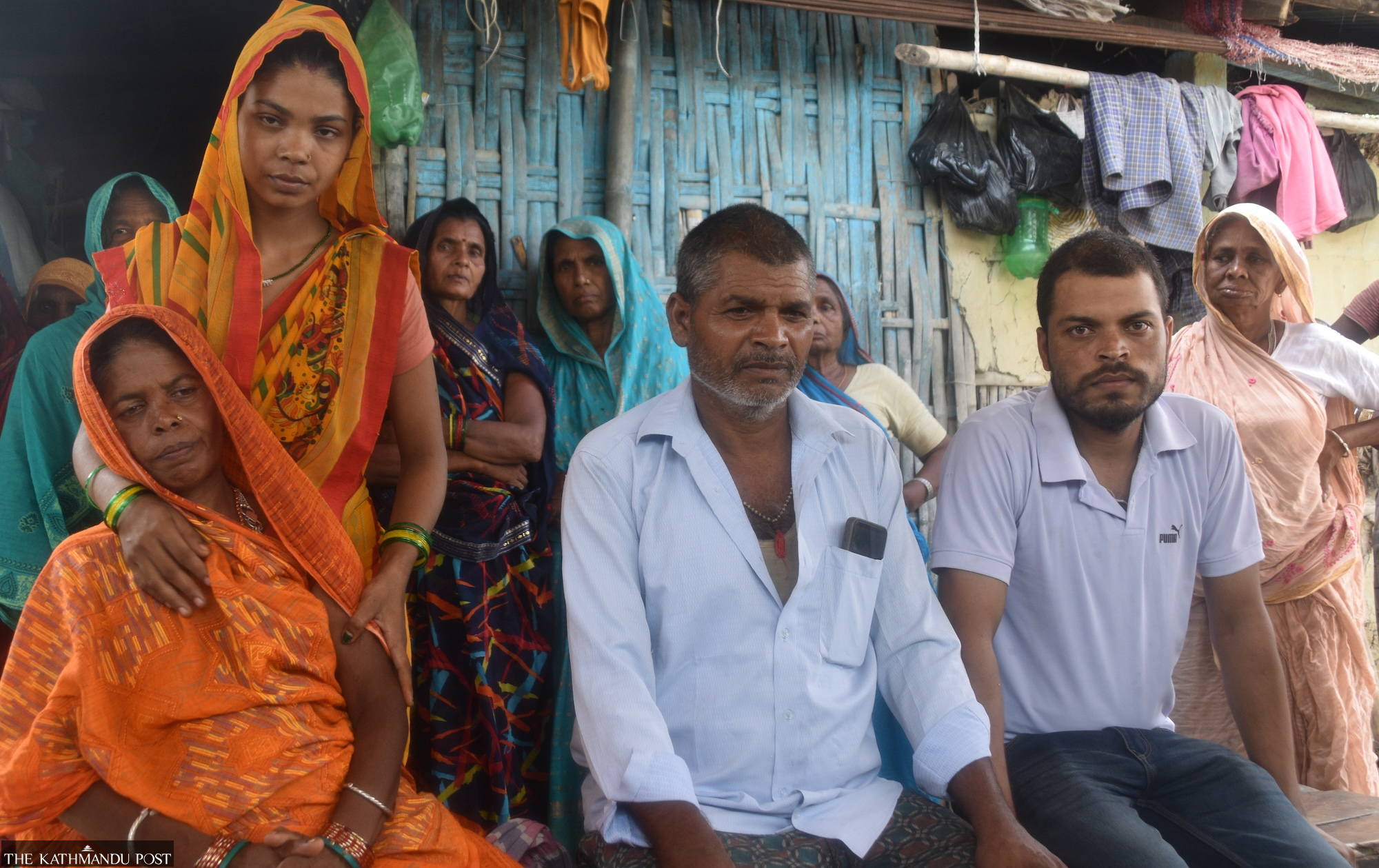
Krishnadev Mehta, second from right, and rest of the family of Om Prakash who died on July 26. Parbat Portel/TKP ![]()
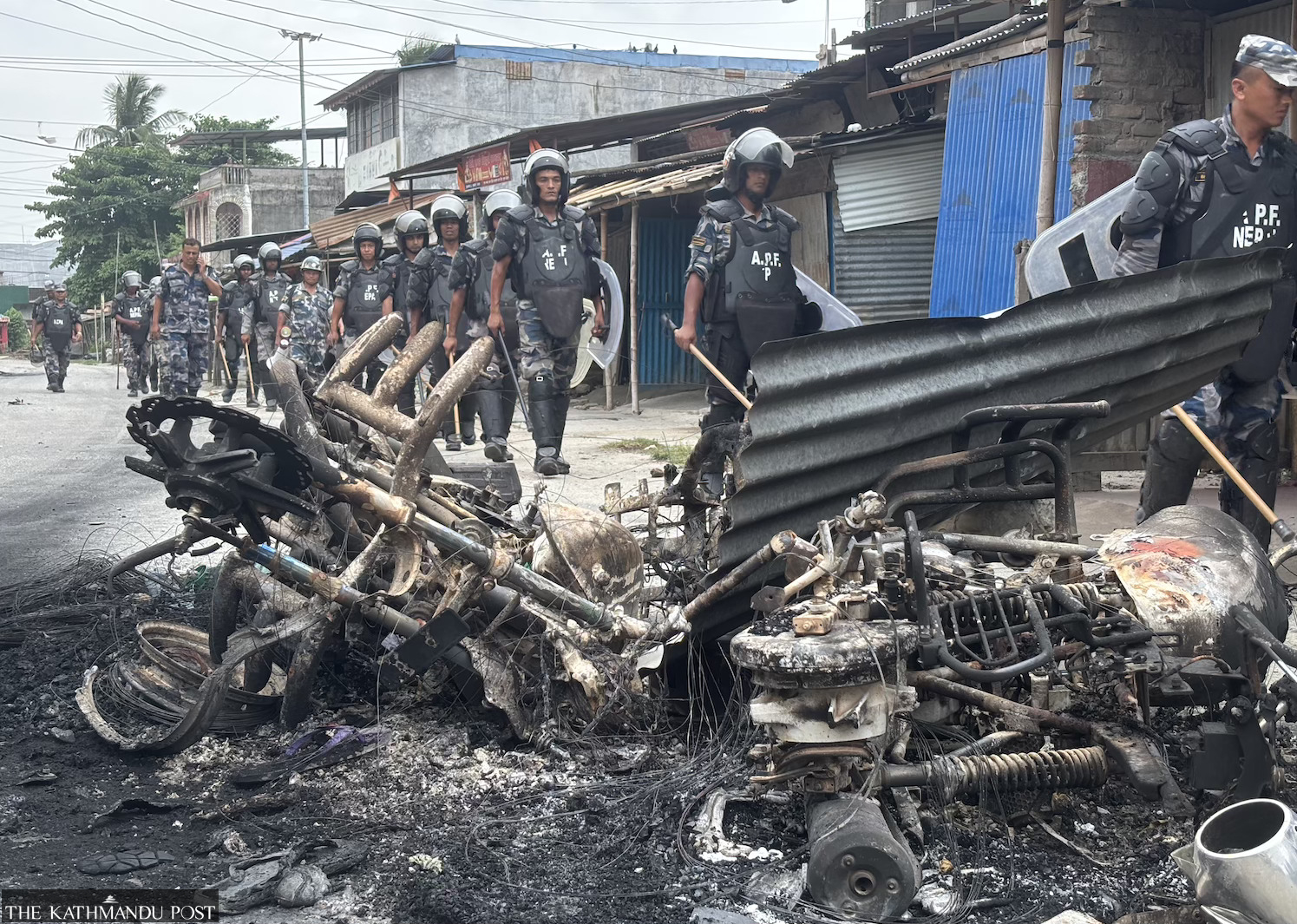
Tahir Miyan's house was burned down by an angry mob amid a curfew on July 27. Parbat Portel/TKP ![]()
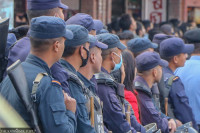
Armed Police Force personnel patrol Kaptanganj. Partbat Portel/TKP ![]()
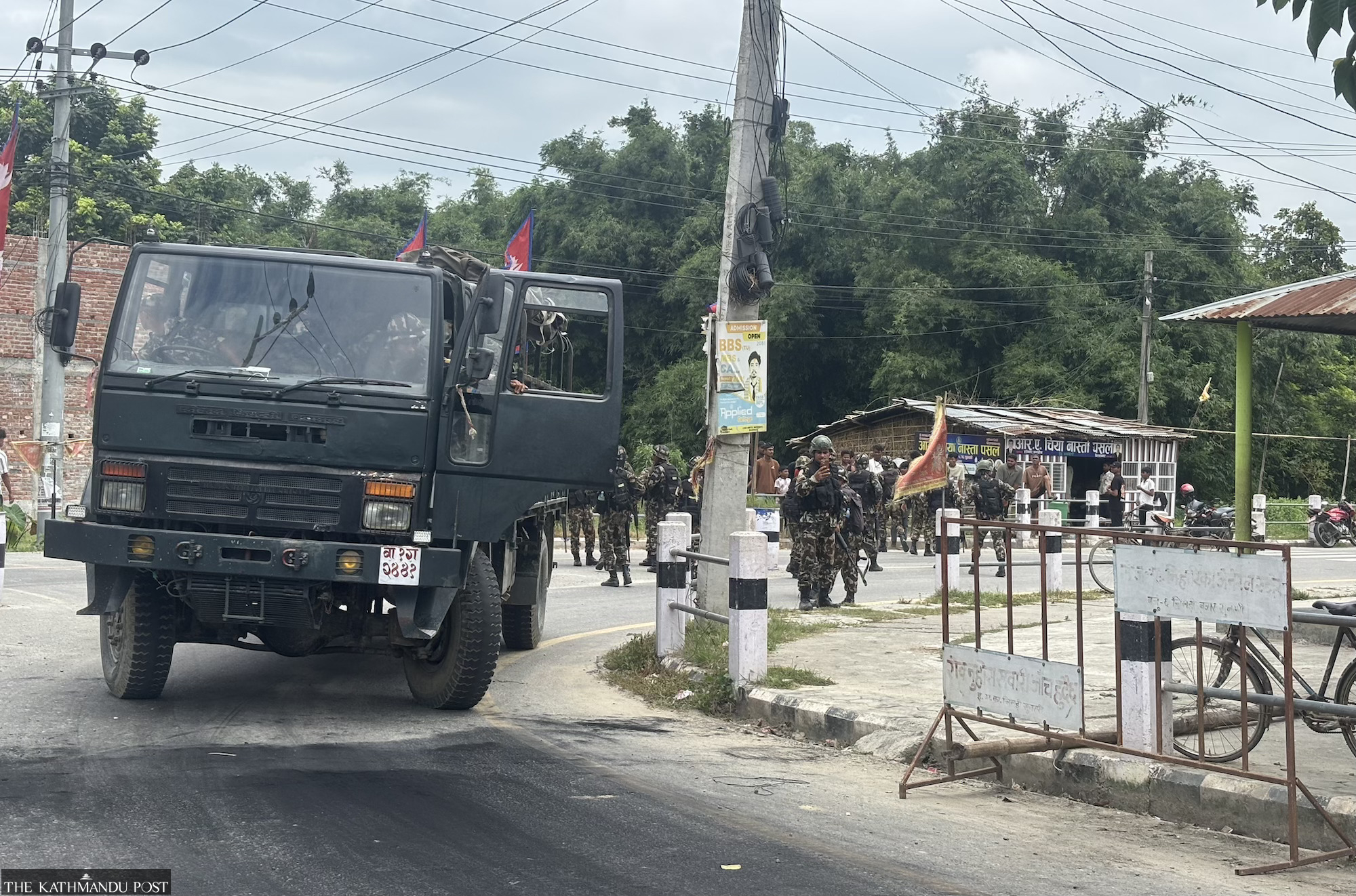
Security forces were widely mobilised in the region following July 26's violence. Partbat Portel/TKP ![]()
Flags like this depicting an angry-looking Hanuman can be seen along the roads and in towns across Madhesh, including Biratnagar, Itahari, and Inaruwa. Partbat Portel/TKP
Tufan Neupane & Parbat Portel
Published at : August 3, 2026
Updated at : August 3, 2026 14:30
Kaptanganj (sunsari)
Om Prakash Mehta was already in bed at around 9 pm on the evening of July 26. But as tensions began rising at the Kaptanganj Chowk, about 700 metres from his home, he watched videos on social media of his own friends at the scene, and decided to go there as well. His father, Krishnadev, tried to stop him, but he didn’t listen.
At around 10 pm, Krishnadev called his 31-year-old son and asked him to come back quickly. “I’ll be there soon,” Om Prakash said, before ending the call. Right then, gunfire erupted at the chowk. Moments later, Krishnadev received a call from one of his son’s friends. “Om Prakash has been shot,” he was told.
By the time Krishnadev ran and arrived at the chowk, Om Prakash had already been placed in an ambulance and taken to the Neuro Hospital in Biratnagar. People there told him it wasn’t very serious and that he’d recover.
Krishnadev changed his clothes and arrived at the hospital, about 25 kilometres east. By then, Om Prakash had been placed on a ventilator. Next morning, his relatives and neighbours told him that the treatment was going well, and he should go home and take care of his wife.
While Krishnadev was returning to Kaptanganj, news of Om Prakash’s death began to spread on social media. His nephew, who was driving, broke the news on their way back.
“As soon as I heard it, I lost consciousness,” Krishnadev recalled. The last time he saw Om Prakash was when he’d left his bed that night, ignoring his plea to stay back.
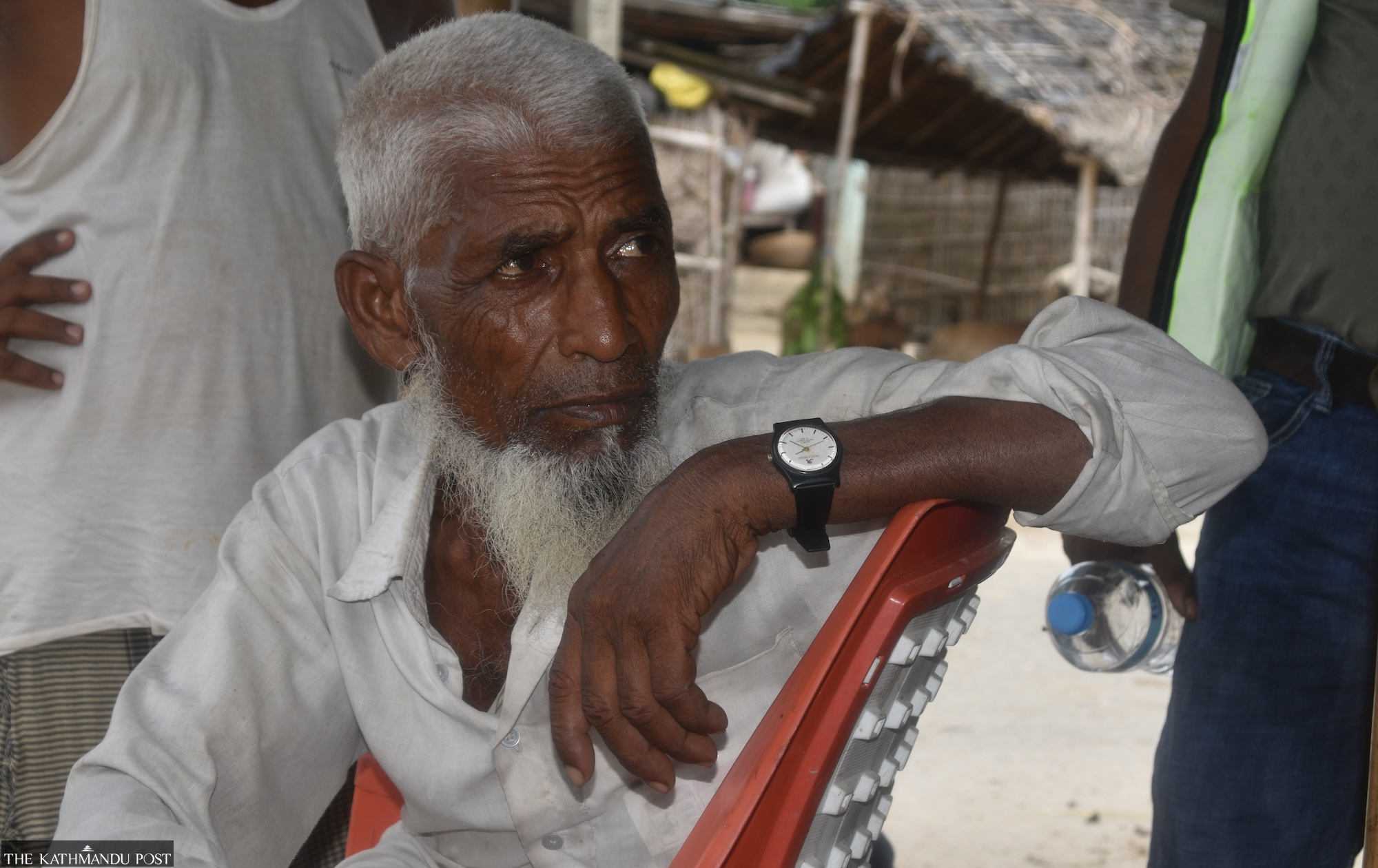
On the other side of the settlement, west of Om Prakash’s house and about 100 metres south of Kaptanganj Chowk, lives 72-year-old Mohammad Tahir Miyan.
On the afternoon of July 27, a day after tensions began in town, a curfew had already been imposed in Kaptanganj. At around noon, an angry crowd of young men with bottles filled with petrol arrived at Tahir’s house. “They began sprinkling petrol and set the house on fire,” he said.
Those inside the house managed to escape, but two houses — belonging to his eldest and third sons — and a pile of straw were burned down.
“We had always lived like brothers,” Tahir said, struggling to come to terms with what had just happened over the last 24 hours. Kaptanganj, located in Dewanganj Rural Municipality about one kilometre south of the Indian border, had no history of Hindu-Muslim violence. Om Prakash was killed in police firing. Tahir’s house was destroyed by an enraged mob. The shared account of these two families from two different communities — Hindu and Muslim — is simple: “Nothing like this had ever happened here.”
The dispute that began there eventually claimed three lives. Jay Prakash Mehta, 21, who was also from Kaptanganj, died four days later while undergoing treatment for a gunshot injury. Ganesh Yadav, 15, from Golbazar of Siraha, also died on July 30. Bystanders say he died in police firing. However, in an interview with Kantipur, Home Minister Sudan Gurung denied that the police shot Yadav.
Kantipur’s field reporting, interviews with more than a dozen people, and a review of previous records suggest that the violence in Kaptanganj unfolded amid a wider pattern of simmering religious tensions in some parts of the Madhesh. In recent years, local disputes, social media amplification, political mobilisation, and repeated institutional failures have been contributing to escalation. This time, it had turned deadly.
The Armed Police Force, Nepal’s border security and riot control force, had flagged the risk of growing communal violence some three years ago, especially in the Madhesh region. A senior APF official familiar with the report told Kantipur last week that the force had repeatedly briefed the political leadership on the risks posed by rising communal polarisation, but its recommendations were largely ignored.
The episode also highlights failures at multiple levels — local authorities that neglected early warning signs, security agencies that responded after violence had already broken out, and political actors who largely remained on the sidelines until there were casualties from the conflict.
Kathmandu, however, largely remained passive in the face of violence that broke out in Kaptanganj, with its immediate response limited to reshuffling of police and administrative officials. Curfew came into effect at 7 am on July 27.
In the days that followed, protests spread throughout Sunsari, then to Morang and later to Siraha, Saptari and Dhanusha. Security personnel were deployed in large numbers as local authorities imposed curfews, yet protesters defied the restrictions. As calls grew for Prime Minister Balendra Shah to address the nation and for Home Minister Gurung to visit the incident site, both leaders faced criticism for their response. Neither appeared in Parliament; Shah instead expressed grief over the deadly clashes on social media while Gurung remained in Kathmandu. Shah also skipped an all-party meeting called by his party chair Rabi Lamichhane to discuss the spread of violence across Madhesh.
Dewanganj Rural Municipality, one of the 12 local levels in Sunsari district, lies about 25 kilometres south of the district headquarters, Inaruwa. According to the 2021 census, the municipality has a population of fewer than 40,000, with Hindus making up 86 percent and Muslims 14 percent. This Maithili- and Magahi-speaking region is largely dependent on agriculture. Nearly two-thirds of households use firewood or cow dung cakes for cooking, while only one in 10 households uses LPG gas. Many young people have migrated to Gulf countries or Malaysia, leaving villages with a larger presence of elderly people, women, and teenagers.
The people who appeared on the streets after the night of July 26 were mostly teenagers and young who had only recently entered adulthood. Elderly and responsible members of both communities remain bewildered with what happened.
“How did something like this suddenly happen?” That is the question many are asking as things try to return to normal after a week.
The dispute that eventually erupted into violence last Sunday began about a month earlier. On June 28, the Muslim community celebrated Muharram on public land at Naya Hatiya Bazaar in Kaptanganj after receiving permission from the ward office.
“We have been observing Muharram for 50 years,” said 36-year-old Jabir Alam, a goat and sheep trader. “Earlier there was a Shiva temple here. Now a Kali temple has been built, one temple after another. We do not have a fixed place, and we have celebrated wherever the local government gives us permission.”
On the day of Muharram, the Muslim community planted 40–50 religious flags at the public site, along with Nepal’s national flag. After the festival ended, two religious flags and the national flag remained there, according to Jabir, for another gathering scheduled after 40 days. They removed the rest themselves.
Before the next gathering after 40 days, Shrawan had begun — the month when Hindu devotees worship Shiva, undertake Bol Bam pilgrimages, and visit temples in large numbers. Hindu residents requested the ward office to take initiative to remove the flags placed near the Shiva temple.
“About ten days earlier, after there was a dispute over the flags, I myself went and said — if the flags are causing problems, we will remove them; let’s not create a dispute,” Jabir said. “But the ward chairman and rural municipality chairman did not pay any attention.”
Shatrughan Prasad Mehta, former principal of the local Babuji Basic School, also points to the same failure by local authorities.
“The ward chairman gave land for celebrating Muharram,” he said. “But afterwards, when our boys asked him not to leave the flags there, he paid no heed to the request.”
On July 26, according to Manoj Kumar Pokharel, the local coordinator for human rights organisation INSEC, a group of youth removed the flags that had been placed there earlier and replaced them with new flags bearing images of Hanuman.
That night, Hindu youths preparing for the Bol Bam pilgrimage the following day, gathered near the Shiva temple. They were playing songs on loudspeakers, including “Jai Shri Ram” and “Bol Bam ka Nara Hai, Baba Ek Sahara Hai.”
They planned to travel about 40 kilometres northwest to the Koshi Barrage to collect holy water and return to offer it at the Shiva temple. The loudspeaker installed on a vehicle facing north was turned toward the south, where the Muslim settlement begins about 100 metres away.
According to people from the Hindu community, Muslim youths went there to object to the playing of those songs. People from the Muslim community, however, claim that the songs were played on loudspeakers at a very high volume toward the Muslim settlement located south of the Shiva temple, and that 8 to10 motorcycles with Indian number plates were repeatedly riding through the road, creating fear among them.
Soon, tensions escalated, a verbal confrontation began, followed by a physical clash. There is no single account of what happened next.
People from the Hindu community say that Muslim youths, who had come in greater numbers than the Hindu youths, started beating them and when they got beaten back, the Muslim youths themselves informed the police. Members of the Muslim community say they did not beat anyone but informed the police after sensing that the dispute could escalate.
Based on details gathered through their field investigation, INSEC’s Pokharel said that the boys from the Hindu side were fewer in number. “Initially, they were beaten,” he said. “Then some among them exaggerated the incident and sought support from the village.”
By then, the police had arrived. “After the police told them to leave, the Muslim youths went home. But the Hindu youths refused to return, saying they had been beaten and wanted revenge,” Pokharel said. “They tried to move toward the Muslim settlement, and then there was a clash with the police who tried to stop them.”
Jabir’s account is broadly consistent with Pokharel’s version.
“The police stopped us in our own neighbourhood, and after that we did not go anywhere. The police stopped them from coming here from the north. During the pushing and shoving, they clashed with the police,” he said. “There was no Hindu-Muslim fight. There was a clash between them and the police. Not a single person from the Muslim side was injured. There are only 50–60 Muslim households here, while they are in the hundreds. How can we survive by fighting them here?”
Although an incident like the one in Kaptanganj had not been seen before, a review of records from previous years shows that the surrounding region has had some history of tensions linked to religious disputes.
According to INSEC records, seven such incidents have been recorded in Sunsari alone — three in 2024, two in 2025, and two so far in 2026. Publicly available reports show that such incidents have occurred from Sunsari westward through Madhesh districts all the way to Nepalgunj.
Kantipur found records of at least 17 such incidents in the Terai over an eight-year period, from 2018/19 until now. Since this list is based only on incidents reported in the media, it represents the minimum number. These incidents occurred in districts ranging from Banke in the west, to Parsa in the centre, and Sunsari in the east. All of these are Terai-Madhesh districts bordering India.
The causes of these incidents also appear to be similar. Around two-thirds of the 17 incidents (11 cases) involved disputes during religious processions and idol immersions held during festivals: immersions related to Durga, Lakshmi, Saraswati and Krishna Janmashtami; processions for Ram Navami and Hanuman Jayanti; Chhath and Kalash processions. In many of these cases, the administration had to impose curfews.
In recent years, social media has become a powerful channel through which local disputes are rapidly amplified and spread. Whether it was an insensitive Facebook post by a Hindu youth in Nepalgunj or an offensive comment against Hinduism by a Muslim youth in Rajbiraj — neither of which Kantipur is linking to or describing in detail — anger that often begins online has started spilling onto the streets.
Chandrakishore, a journalist and author who regularly writes about the Madhesh, believes that the growing access to social media has helped spread tensions rapidly.
“The person who was killed in Kaptanganj had gone to bed. After an allegation or rumour reached him through social media, he came running outside,” he said. “These days videos appear immediately on social media. YouTubers livestream everything, and there is no time for filtering good and bad or right and wrong.”
Incidents deliberately aimed at insulting and provoking another community have also become public. Last year, near the election period in Birgunj, police arrested three people carrying a pig’s head and homemade bombs allegedly intended to be thrown inside a mosque. In Gaur, a dispute occurred after loudspeakers were used during a Hindu wedding procession while prayers were being conducted.
Muslims are Nepal’s third-largest religious group. According to the 2021 census, Muslims make up 5.1 percent of the population. Most of them live in the Terai districts.
The United States Department of State’s 2023 report on religious freedom included complaints from Muslim leaders advocating religious inclusion that they faced pressure from both government officials and the Hindu community.
Dinesh Shrestha, chairman of the Biratnagar chapter of North-South Collectives, a Madhesh-based think-tank, says such disputes that have recently become public are not isolated incidents occurring suddenly or by chance.
“There appears to be an organised effort to increase religious conflict in Nepal,” he said, without identifying those whom he believed were responsible for fomenting such conflicts. “Whether it is incidents that happened elsewhere in the past or the current Kaptanganj incident — all of these have happened as part of that effort.”
Jayaprakash Prasad Gupta, a former minister and the author of the book “Madhesh: Saamajik Samrachana ra Bibhed,” points to the influence from across the border in India.
“In the past, Bihar had governments shaped by caste structures. Now there is BJP’s Hindu-majoritarian politics,” he said. “Nepal too has been becoming polarised under its direct influence.”
Chandrakishore says that four trends seen in growing religious tensions in recent years are reflected in the Kaptanganj incident.
The first trend is the positioning taken by members of the same community elsewhere when an incident occurs in one place. “If something ordinary happens in Malangwa, immediately a procession comes out in Bhairahawa. Earlier, such matters would end locally; they did not spread elsewhere,” he said.
The second trend is the unspoken competition seen in public religious activities in recent years. “If one person puts up one microphone, I have to put up four; if he breaks two swords, I have to break four; if he drives 25 motorcycles, I have to drive 50,” he said.
The third trend, he says, is going in front of another community’s place of worship and loudly raising one’s own community’s slogans as a direct challenge.
The fourth trend is how these conflicts are addressed. Earlier, political representatives played the central role in meetings aimed at reducing social tensions. That space, he says, has been replaced by representatives claiming to speak on the basis of religious identity.
“Suddenly, someone emerged as a Muslim leader, while someone else began attending meetings as a Hindu leader,” he said. “If they had remained in political parties, they might have been ordinary party workers. But now they have become leaders.”
Ram Rijan Yadav, who used to be active in the Janata Samajbadi Party, led by Upendra Yadav, says he has personally witnessed how religious politics from across the border has begun influencing Madhesh. Four years ago, the Rashtriya Swayamsevak Sangh (RSS) had already built an organisation inside their party. “The ‘Yadav boys’ who were part of our party committees had already become associated with the Rashtriya Swayamsevak Sangh (RSS),” he said.
That growing religious polarisation is also visible in the symbols that have appeared across the public landscape.
At Kaptanganj Chowk and along the route west through Biratnagar, Itahari, Inaruwa and into Madhesh, the same image appears repeatedly — on flags, at intersections, outside shops, on rooftops and electricity poles.
The image is of Hanuman. But it is not the traditional depiction of the deity; it is an angry-looking version of Hanuman. The high-contrast image, featuring saffron and black colours and a tightened face, also appears as stickers placed on motorcycles and vehicles.
“The Hanuman I saw while growing up was peaceful,” said Yadav. “For the last two or four years, I have started seeing images of a very angry Hanuman everywhere in Madhesh. The Bajrang Dal and Hindu nationalist groups have promoted this image,” Yadav said.
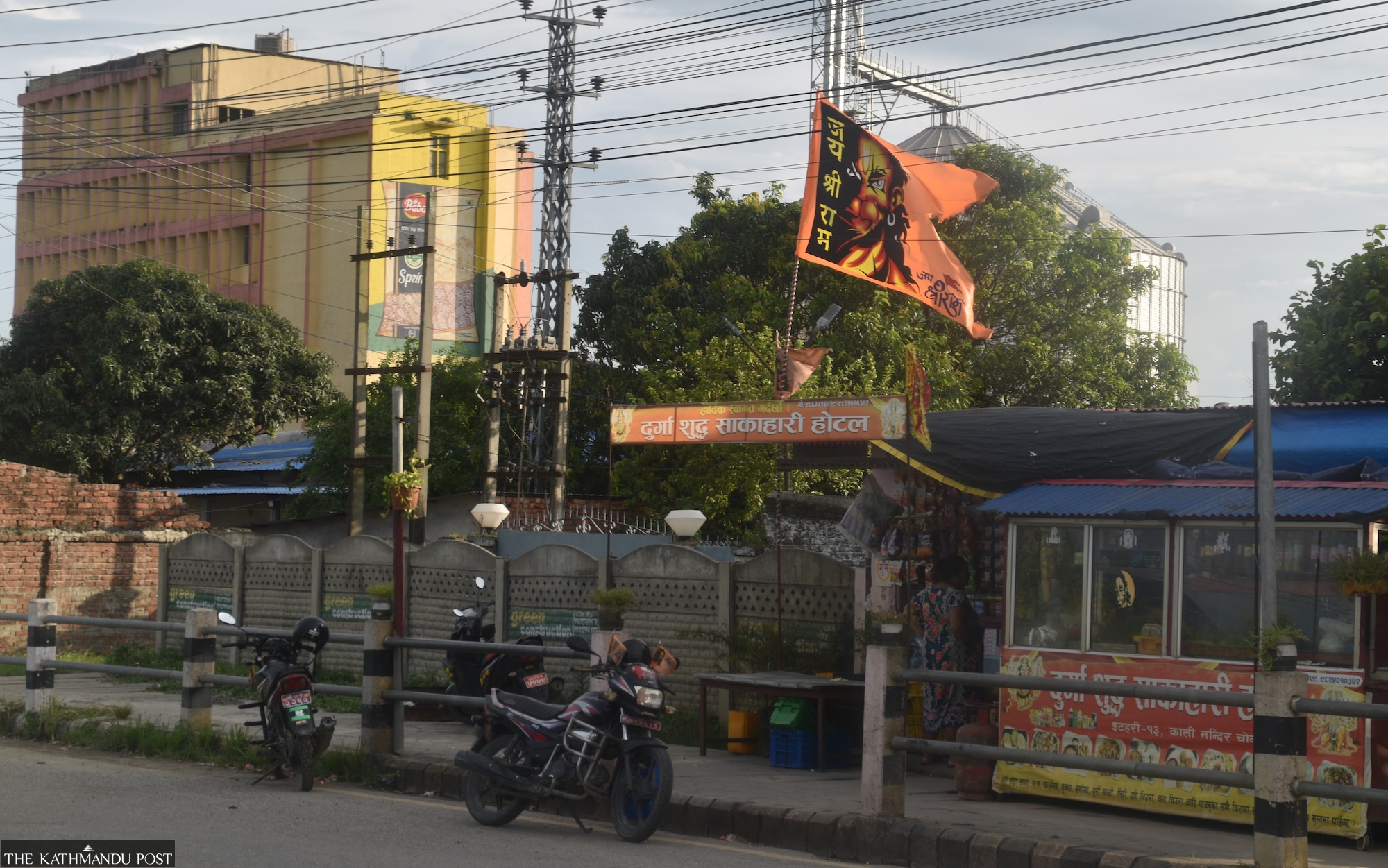
The image is not rooted in Nepal’s traditional religious iconography. According to reports in Indian media, the ‘angry Hanuman’ image was created in 2015 by Kerala-based graphic designer Karan Acharya. Reports say Acharya designed it for a local temple’s Ganesh Chaturthi festival after friends asked him to create a Hanuman with “a different expression.”
The saffron-and-black image soon became popular across India and later appeared in Nepal as well.
“Culturally and religiously, Hanuman’s image is peaceful. What we have learned is that Hanuman represents knowledge, virtues and humility,” Chandrakishore said. “But for political purposes, Hanumanji was made to appear angry.”
Five days after violence began, the situation in Madhesh began gradually returning to normal following Prime Minister Balendra Shah’s address to the nation, RSP leader Rabi Lamichhane’s marathon meetings, the Home Minister’s field visit, agreements with affected families, appeals by political parties for harmony, and continued dialogue among representatives of different communities at the local level.
But civil society activists warn that if rising religious suspicion among communities is not addressed, the tension may only appear to have subsided while remaining alive beneath the surface, waiting to flare up again.
Curfew has now been lifted in Kaptanganj. Army armoured vehicles stationed at intersections have been withdrawn. Yet, a sense of unease continues to linger over the village.
Both Om Prakash and Jay Prakash had left their homes after learning that tensions had intensified at Naya Hatiya. According to eyewitness Ramesh Kumar Mehta, the crowd became even more agitated after Om Prakash collapsed after being shot by the police.
“People were running in different directions. At that moment, Jay Prakash was also shot in the courtyard of the Shiva temple,” Ramesh said.
In the courtyard of a small hut about 500 metres north of Naya Hatiya, Jay Prakash’s auto-rickshaw has remained parked since the day of the incident.
In Om Prakash’s father’s room, the fan has remained still since Krishnadev left that night after his son was shot.
Tahir Miyan no longer has a house.
Tufan Neupane
Neupane reports affairs related to law, judiciary, human rights, transitional justice and wildlife crime.
Parbat Portel
Parbat Portel is the Jhapa correspondent for Kantipur Publications.