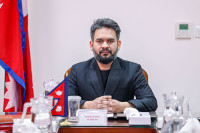
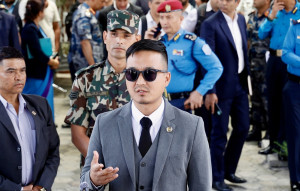
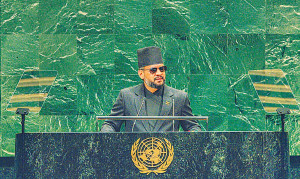
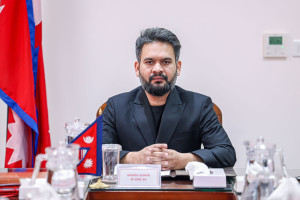
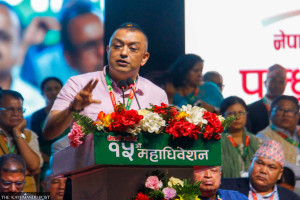
Critics say the government is sidelining women, Madheshis, Dalits and other marginalised groups in public appointments, despite the Constitution’s mandate for proportional representation.A cabinet meeting, Tuesday. Although the cabinet appears relatively inclusive, critics say the government has fallen short of the constitutional principle of inclusion in key state appointments. RSS
Prime Minister Balendra Shah’s 17-member council of ministers includes six women, or 35.29 percent of the cabinet. While the Khas-Arya community remains dominant, the cabinet also includes ministers from Madheshi, Janajati and Dalit communities, making the administration appear relatively inclusive at first glance.
However, appointments to constitutional and public bodies made on the recommendation of the Constitutional Council, chaired by Shah, and through cabinet decisions tell a different story. Critics say the government has fallen short of the constitutional principle of proportional inclusion, with women, Madhehis and other marginalised communities poorly represented in key appointments across the state.
The criticism goes beyond individual appointments.
Opponents say the issue is whether the government is applying the constitutional commitment to inclusion consistently when filling influential posts, rather than only when forming the Cabinet.
Public bodies such as the judiciary, Election Commission, National Planning Commission and cultural academies shape decisions that affect citizens across the country. The composition of these institutions is therefore a test of the government’s approach to representation.
The contrast between the cabinet and appointments to other bodies has emerged as a growing point of contention.
Although the presence of six women in a 17-member Cabinet and ministers from several communities offers some diversity at the executive level, critics argue that this has not translated into comparable diversity in appointments outside the cabinet.
Immediately after the government was formed on March 27, the cabinet appointed four key advisers overseeing political affairs, administration, governance and reform, and information and technology. None was a woman.
Between March 27 and August 11, the cabinet met 28 times and made more than 50 appointments. Only four women were among those appointed. Representation of Madheshis, Indigenous Janajatis and Dalits was also exceptionally weak, while the Muslim community had no representation.
The pattern was also evident in appointments recommended by the Constitutional Council.
At its May 7 meeting, the council recommended Supreme Court Justice Manoj Kumar Sharma for chief justice, bypassing the senior-most justice, Sapana Pradhan Malla. Women’s rights activists criticised the government for excluding a woman from the country’s top judicial post. After parliamentary hearings and other procedures, Sharma took office on May 19.
The three appointments to the Election Commission also failed to reflect gender and regional diversity. Man Bahadur Karki was appointed chief election commissioner, with Guru Prasad Wagle and Rajib Subba as commissioners. None of the three is a woman or Madheshi.
Other appointments were made directly by the Cabinet or through executive decisions by the prime minister and line ministers.
On April 7, the Cabinet appointed the vice-chairperson and six members of the National Planning Commission. Only one woman was included, while the appointments also lacked geographical and communal representation.
On April 15, the cabinet formed a five-member property investigation commission chaired by former justice Rajendra Kumar Bhandari, again without considering gender or community representation.
Six days later, on April 21, it formed a three-member troubled cooperatives management committee that included neither a woman nor a Madheshi.
On June 2, a four-member land issue resolution committee was established under the chairmanship of Balbhadra Bastola from Kaski. The committee had no representation from the Tarai-Madhesh region, where landlessness is most acute.
The government’s appointment record has begun to draw criticism even from lawmakers of the ruling Rastriya Swatantra Party (RSP).
Speaking at a meeting of the State Affairs and Good Governance Committee on August 6, lawmaker Amresh Kumar Singh said the government had failed to uphold constitutional provisions guaranteeing proportional and inclusive representation.
“In the name of meritocracy, inclusivity and the constitution are being flouted,” Singh said, calling for a white paper on recent appointments. “Looking at the appointments made so far, it appears there are no Yadavs, Jhas, Singhs, Alams, Paswans, or Tharus left in the country.”
Singh said the exclusion of marginalised communities could not be justified in the name of merit.
“You cannot run a country by sidelining 33 percent Madheshis and 33 percent Indigenous Janajatis under the guise of meritocracy. This King Mahendra-era mindset no longer works. The constitution guarantees that the country is multi-ethnic and multi-religious,” he said.
The criticism was followed the next day by another set of appointments that drew scrutiny, this time in the cultural sector.
On August 7, the Ministry of Culture, Tourism and Civil Aviation published the names of 29 office-bearers appointed to three premier state-run academies: the Nepal Academy, the Nepal Academy of Fine Arts and the Nepal Academy of Music and Drama.
The appointments showed significant regional and communal gaps. No appointee was from Sudurpashchim province. Madhesh received no representation in the leadership and membership of the Nepal Music and Drama Academy.
Across the three academies, only two of the 29 appointees are from Madhesh, both from Siraha district, while Karnali has one representative.
The distribution prompted criticism on social media, with users questioning whether Sudurpashchim, Karnali and Madhesh provinces lacked literary and artistic figures.
Former minister Bhim Rawal wrote on social media that the appointments “bear no resemblance to the governance, justice, and fairness the RSP constantly claims to champion”.
By community, the 29 appointees comprise six Brahmin, eight Newar, nine Indigenous Janajati, two Madheshi, two Tharu, one Dalit and one Chhetri.
The appointments were finalised by the prime minister on the recommendation of a committee chaired by Culture, Tourism and Civil Aviation Minister Khadga Raj Paudel, and the decision has intensified criticism of the minister.
One recent appointment, however, was different. On August 5, Yanki Ukyab was appointed as chief executive officer of the Investment Board Nepal. This is the first time a woman has become head of the agency. Ukyab is from an indigenous community in remote Olangchungola in Taplejung district.
At the same time, critics say other appointments have not been as diverse.
Scrapping prior roles and shifting to merit
The government’s approach to public appointments has also been shaped by its decision to remove hundreds of officials appointed by previous administrations.
The government collectively relieved political appointees who had been appointed before March 26 and were serving across public bodies.
In May, it introduced the Special Provisions Relating to Removal of Public Officials Ordinance, 2026, which removed more than 1,500 officials. The government has since moved quickly to fill the vacancies created by the removals, but questions over proportional representation in the new appointments have persisted.
Government officials defend the appointments, saying they are based primarily on competitive merit rather than identity or quotas.
At a press conference, when asked by the Kantipur daily why recent appointments did not adequately reflect the constitutional principle of proportional representation, Sasmit Pokharel, minister for education and sports and government spokesperson, said the outcome reflected the results of open competition. He said that expert panels had been formed through open calls to shortlist candidates, in a process intended to minimise political interference.
“Appointments in the ministries are being conducted transparently through open competition. The application process is entirely open,” the government spokesperson said. “It was done in a way that is as inclusive as possible. However, because it relies on open calls and competition, meritocracy has taken precedence over strict inclusivity.”
Excluding appointments made to the personal secretariats of the prime minister and ministers, more than 200 positions have been filled across public bodies since the government began replacing the officials removed under the new ordinance. Yet critics say the emphasis on open competition has not addressed the structural under-representation of women and marginalised communities.
The pattern has continued in several recently constituted public bodies.
On July 2, the government appointed a chairperson and two members to the Public Procurement Review Committee without reflecting the diversity. Similarly, when the chairperson and three members of the Electricity Regulatory Commission were appointed on July 22, none was a woman, while Indigenous Janajati and Madheshi communities were also absent.
The lack of diversity is particularly stark when multiple positions in the same institution are filled at once. Critics say appointments to bodies with a chairperson and several members are often made without considering the institution’s overall composition. The scope for maintaining representative diversity is even narrower when executive positions are filled individually.
The same issue has emerged in higher education, where Prime Minister Shah, in his capacity as chancellor, has made a series of senior university appointments.
He appointed Bhola Thapa as vice-chancellor of Tribhuvan University, Kishan Datta Bhatta as vice-chancellor of Sudurpashchim University and Rajan Suwal as vice-chancellor of Mid-Western University.
On July 3, further vice-chancellorial appointments were made, with Rishi Ram Kattel appointed at Agriculture and Forestry University, Shyam Narayan Labh at Janaki University, Devendra Adhikari at Pokhara University and Sujan Babu Marhatta at Purbanchal University.
On July 15, Prof Dr Sunil Kumar Joshi and Bhim Bahadur Chand were appointed vice-chancellor and registrar, respectively, at the Shahid Dashrath Chand National Academy of Health Sciences in Geta, Kailali.
Across the seven consecutive university vice-chancellor appointments, not a single woman was selected to lead an institution.
The government also appointed former secretary Kishor Thapa as chairperson of the Tribhuvan University Service Commission and Khadga Bahadur KC as chairperson of the University Grants Commission. KC was appointed rector of Tribhuvan University during KP Sharma Oli’s premiership.
The Ministry of Education has defended the process, saying the vice-chancellors were selected through open competition on the recommendations of committees chaired by Education Minister and Pro-Chancellor Sasmit Pokharel.
The appointments have nevertheless added to the broader debate over how merit-based selection should be reconciled with Nepal’s constitutional commitment to inclusion. While the government says open competition is intended to reduce political patronage and prioritise qualifications, critics argue that a formally open process can still reproduce existing disparities if institutions do not actively consider gender, geography and social diversity in their final selections.




 14.4°C Kathmandu