Two-wheeler ride-hailing drivers suspend protest, but fare dispute remains unresolved
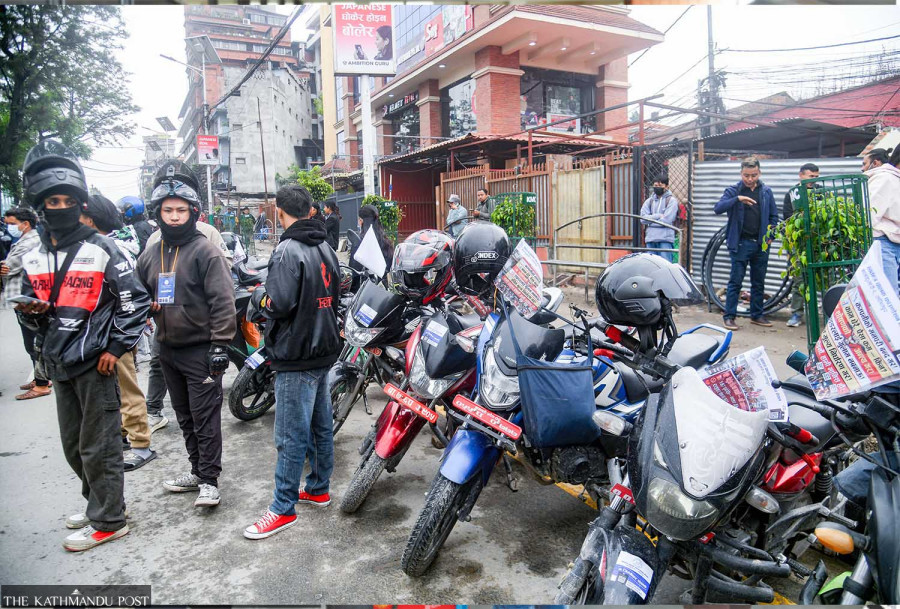
inDrive has pledged to address drivers’ demands, but no agreement has been reached on a minimum fare as Nepal lacks a clear legal framework governing ride-hailing services. Ride-hailing drivers protest at Maitghar Mandala in Kathmandu, in this file photo. Post file photo
Drivers affiliated with ride-hailing platform inDrive staged a sit-in outside the company’s office in Kupondole, Lalitpur, on August 5, demanding a minimum base fare for ride-sharing services and greater safety for drivers.
Following a tripartite meeting at the Ministry of Physical Infrastructure and Transport on Tuesday, inDrive made a written commitment to addressing their demands. The drivers subsequently suspended their agitation.
However, no concrete agreement has been reached on the minimum fare per kilometre. With more than 300,000 drivers and around 19 ride-hailing platforms operating in Nepal, the lack of clear laws regulating the sector has made it increasingly difficult to balance fares, drivers’ incomes and passengers’ interests.
Here are five things to know about the issue.
What happened?
Drivers led by the Independent Drivers Foundation Nepal staged protests in Kathmandu and Lalitpur for several days. They organised a 24-hour sit-in outside inDrive’s office, spending a night on the streets chanting slogans.
“We are aware that a group of rider partners has gathered outside our office,” said Rita Pokharel, head of inDrive Nepal. “The company values the feedback and grievances raised by drivers and is responsibly reviewing and monitoring their concerns to find solutions. We remain committed to maintaining continuous dialogue with drivers.”
Following the prolonged sit-in and mounting pressure, the Ministry of Physical Infrastructure and Transport intervened. A three-party meeting was held at Singha Durbar on Tuesday in the presence of Minister Sunil Lamsal. Representatives of inDrive made a written commitment to addressing the drivers’ demands. The drivers suspended their protest after the commitment letter was signed.
“We are positive for now, but not confident,” said Muktinath Phuyal, founding chairman of the Independent Drivers Foundation Nepal. “If the problem is not resolved within the next five days, or if we receive only assurances and delays as before, we will be forced to resume our protest.”
What was the dispute about?
Drivers have demanded that they be consulted before companies change their policies on fares, commissions, bonuses or penalties. They say companies should not be allowed to introduce rules unilaterally.
They also complain that the commission rates charged by companies are too high. They have demanded that companies share the financial burden of the 5 percent value-added tax (VAT) introduced through the current fiscal year’s budget, arguing that the entire tax should not be deducted from drivers’ earnings.
Bike drivers say their minimum operating cost is Rs14-15 per kilometre, while they currently earn only Rs12-14 per kilometre.
“We are under financial strain because we have to work for fares below our operating costs,” said Bhupendra Lama, a rider who participated in the sit-in. “When our bikes break down or we are involved in accidents, we even have to borrow money to pay for treatment.”
Drivers say unhealthy competition in the market has prompted apps such as Pathao, Yango and inDrive to compete by lowering fares. They have demanded a minimum fare of Rs25-27 per kilometre.
While other companies agreed to the demand, they said inDrive was reluctant to accept it.
“At the meeting held at the ministry, Yango, Pathao and other Nepali companies all agreed, but only inDrive disagreed and walked out of the meeting,” Phuyal said. “We then began our protests.”
Even after Tuesday’s meeting at the ministry, no specific fare per kilometre has been agreed upon. Drivers continue to insist that a uniform minimum fare of at least Rs25 per kilometre be maintained.
They argue that a satisfactory base fare would increase the number of drivers on the roads, allowing passengers to get faster service even during peak hours. They also say setting a base fare would reduce disputes between drivers and passengers over fares and curb arbitrary bargaining during offline trips.
Why do companies oppose a fixed fare?
Ride-hailing companies argue that setting a uniform fare in a competitive market would make rides more expensive. Students, employees and other regular ride-hailing users could face higher monthly transportation costs.
Anukul Nidhi, a transport expert at the Ministry of Physical Infrastructure and Transport, said fare-setting was a complex three-way issue.
“We have to consider the interests of all three sides—the company’s business, the rider’s minimum income and the consumer’s purchasing power,” he said. “If fares are made excessively expensive without a scientific basis, they could go beyond consumers’ purchasing power and reduce the number of passengers. We also have to take into account the Competition Promotion and Market Protection Act.”
In the case of inDrive, the company's business model is based on 'peer to peer pricing,’ says Manjeeta Gurung, InDrive's head of communications and public relations. “Our app allows passengers to propose a fare and drivers to make counter-offers,” she said.
“Rather than having the algorithm automatically set the fare, priority is given to mutual understanding. If a passenger offers Rs100, the driver can reject it or make a counter-offer of Rs120 or 130. Drivers can also see the per-kilometer rate, for instance, more than 27 rupees per kilometer, and choose whether to accept the ride."
What are the legal provisions?
According to transport expert Nidhi, the current dispute has arisen because Nepal has no clear legal framework to regulate or formally recognise ride-hailing services, or aggregators.
The 1993 Vehicle and Transport Management Act does not recognise this technology, he said, adding that the ministry is preparing a new legal framework. He said the ministry was consulting various stakeholders on how to manage the sector during the interim period until the new law comes into effect.
Nidhi said India introduced reforms after its Motor Vehicle Aggregator Guidelines issued in 2020 proved unsuccessful. Nepal is also open to the option of setting a fixed base fare and defining a range for “dynamic surging”, under which fares could increase by up to two times depending on demand, supply, weather or traffic.
“However, when the federal government or the Ministry of Physical Infrastructure and Transport establishes a standard or base rate, it must also take into account the rights and jurisdiction of provincial governments, because the Constitution has assigned the regulation and management of the transport sector to provincial governments,” he said.
Gandaki Province has formulated its own law. Separate laws in different provinces could create fragmented regulation.
India revised its guidelines in 2025 to bring ride-hailing aggregators such as Ola, Uber and Rapido under a legal framework, regulate competition and protect the interests of drivers and passengers.
The revised rules increased the maximum surge pricing companies can charge during periods of high demand to twice the base fare. State governments have been allowed to set their own rules within a range of 1.5 to two times the base fare. To prevent unhealthy competition, fares cannot be reduced by more than 50 percent of the base fare.
How did the dispute escalate?
In April, following the appointment of a new minister at the Ministry of Physical Infrastructure and Transport, representatives of the Independent Drivers Foundation approached the ministry. They raised demands for a base rate for ride-hailing services and better safety measures.
The ministry began consultations with stakeholders to draft a long-term regulatory framework and convened its first meeting. Representatives of 18-19 ride-hailing platforms, a drivers’ association, and officials from the finance and labour ministries participated.
Although the ministry wanted to discuss the regulatory draft, drivers insisted that they could not move forward without addressing their immediate problems related to their livelihoods and fares.
As the dispute intensified, a second meeting was held about a month later, attended by major platforms including Pathao, Yango and inDrive. While drivers continued to demand a uniform fare, companies argued that they should be allowed to compete in an open market.
To address the complexity, the ministry studied India’s practices. It also involved experts from the Institute of Engineering at Pulchowk Campus to prepare a “base fare sheet” based on 13 indicators. The study found that drivers’ minimum operating cost was Rs14-15 per kilometre.
“Based on this, we have been insisting that the base rate should not be lower than Rs25,” said Phuyal of the Independent Drivers Foundation.
While Pathao, Yango, Uber and other companies agreed to the idea of a minimum base rate, inDrive refused to agree, saying it would affect its business model.
“inDrive had asked for two or four days to make a decision on the base fare, but even after a month there was no response,” Phuyal said. “They did not give a clear response even to the ministry, kept delaying the issue and said they did not know. We were then forced to stage sit-ins and rallies.”




 13.76°C Kathmandu