Nepse slips below 2,600 as selling pressure broadens
Benchmark index falls 1.17 percent as all 13 sectoral indices decline, while average daily turnover drops 26.47 percent from the previous week.AI generated
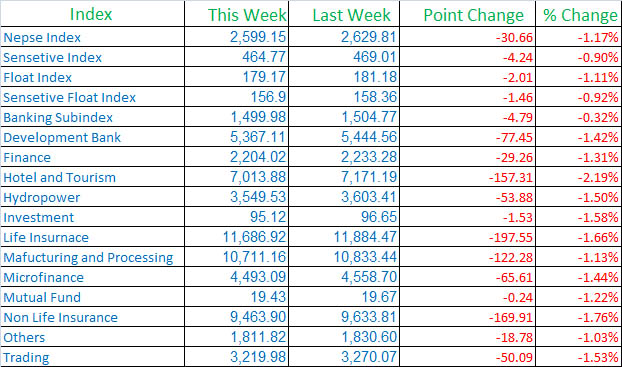
The Nepal Stock Exchange (Nepse) index fell 30.66 points, or 1.17 percent, this week to 2,599.15, slipping below the psychologically important 2,600 mark as selling pressure persisted across the market. The index had closed at 2,629.81 the previous week.
The 2,600 level is important not only as a widely watched round-number threshold but also because it now sits close to the market’s short-term technical indicators. The index ended the week below its 20-day exponential moving average at 2,619.73 and its 50-day EMA at 2,602.99, suggesting that sellers retained the upper hand in the short term.
The decline reduced market capitalisation by around Rs50 billion, from Rs4.52 trillion to Rs4.47 trillion. The fall came despite a rise in total weekly turnover, which increased to Rs22.51 billion from Rs18.36 billion the previous week. The comparison, however, is affected by the number of trading sessions: this week had five sessions against three in the previous week. On a daily basis, turnover fell 26.47 percent, from Rs6.12 billion to Rs4.50 billion.
That suggests the increase in cumulative turnover was largely a function of having more trading days, rather than stronger underlying participation. The lower daily turnover also points to weaker trading intensity as the index approached and slipped below 2,600.
Selling was broad-based. All 13 sectoral indices ended lower, with hotels and tourism falling the most, by 2.19 percent, or 157.31 points. Non-life insurance declined 1.76 percent, life insurance 1.66 percent, investment 1.58 percent, and both trading and hydropower 1.53 percent.
Commercial banks were relatively resilient. The banking sub-index fell 0.32 percent, or 4.79 points, to 1,499.98, limiting the sector’s contribution to the broader decline.
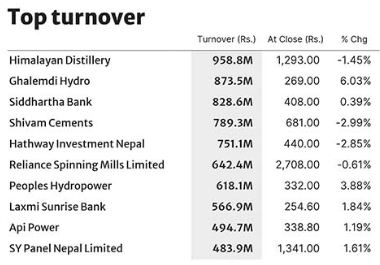
Trading activity remained concentrated in a handful of sectors and stocks rather than being evenly distributed across the market. Hydropower, manufacturing and processing, and commercial banking accounted for much of the turnover. Himalayan Distillery recorded the highest turnover at Rs958.8 million, followed by Ghalemdi Hydro at Rs873.5 million, Siddhartha Bank at Rs828.6 million and Shivam Cements at Rs789.3 million.
Ghalemdi Hydro also led in the number of shares traded, with 3.292 million changing hands, followed by Laxmi Sunrise Bank with 2.237 million and Liberty Energy with 1.897 million. The concentration of volume in selected hydropower and banking counters suggests that investors were still actively rotating into individual stocks even as broader market participation weakened.
That divergence was also visible in individual stock performance. Sindhu Bikash Bank gained 7.20 percent, followed by Mandu Hydropower, up 7.00 percent, and Ghalemdi Hydro, up 6.03 percent. At the other end, Appolo Hydropower fell 11.80 percent, Sopan Pharmaceuticals declined 11.07 percent and Bhujung Hydropower dropped 10.58 percent.
The technical indicators point to a market still under pressure, although not yet in oversold territory. The 14-period Relative Strength Index fell to 45.26, remaining in the neutral range but moving towards its lower end. The MACD line and signal line were also approaching a bearish crossover below the zero line.
The next level to watch is around 2,586 points, near recent reaction lows. A more important support zone lies at 2,500-2,520. On the upside, 2,620, around the 20-day EMA, is the immediate resistance, followed by 2,680.
Market analyst Shakti Koirala said he did not expect a major near-term move in the overall market, although individual stocks could see sharper swings. He said the market appeared to be forming a bottom around the 2,500 level and could gradually move higher as the impact of favourable government policies and efforts to promote the market became more visible.
“Policies take time to show their impact,” Koirala said.
He said the market appeared to have returned to fill the opening gap created on September 15, making that zone an area of interest. However, he cautioned that reaching the gap did not necessarily mean the market would move higher from there.
“Banking, manufacturing and processing, as well as some hydropower stocks, have shown relative strength,” he said.
Koirala also expects trading to remain relatively subdued around Dashain, saying the market has historically tended to see limited movement during the festival period.




 17.29°C Kathmandu