Nepal’s track and field athletes train for the Asian Para Games on their own terms
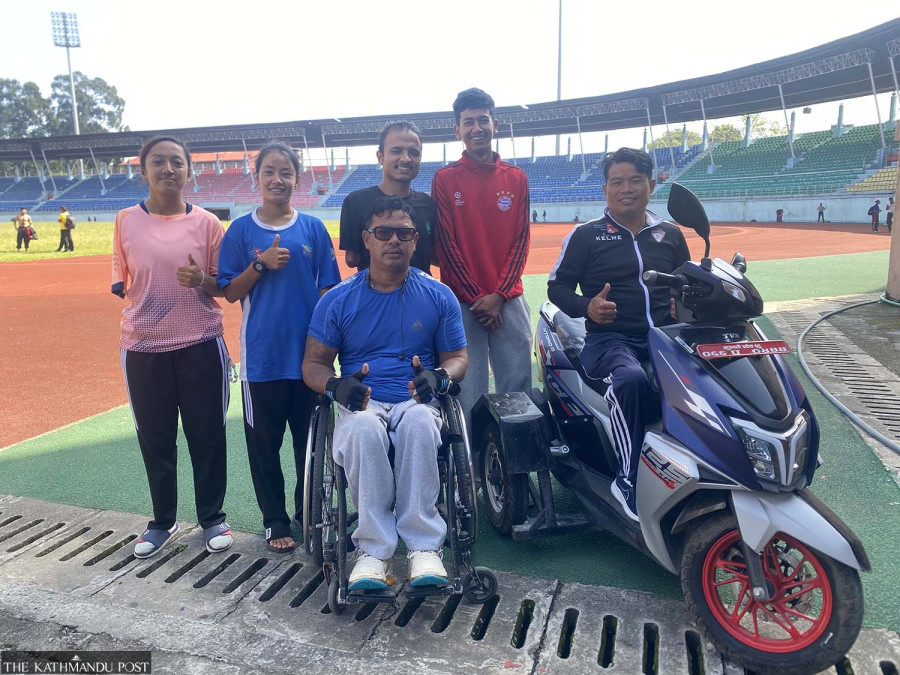
The Post profiles the members of Nepal’s athletics squad who are training without state sponsorship, adapting to disabilities, financial hardship and personal tragedies as they prepare for the Asian Para Games in Nagoya. Nepal’s para athletics squad is pictured at Dasharath Stadium in Tripureshwar, Kathmandu, on September 21. Nayak Paudel/KP
At around 7:30am on September 21, four athletes began their drill on the synthetic track of Dasharath Stadium in Tripureshwar, Kathmandu. They stretched their body, walked and sprinted to the whistle of coach Bimala Rana Magar, a former Olympian who represented Nepal in the women’s marathon at Atlanta 1996. Under Bimala’s tutelage, Prabha Angdembe, Shristi Dhewaju, Nawaraj Karki and Chet Narayan Khanal ‘Samir’ are training for the 5th Asian Para Games, which is kicking off in Nagoya, Japan, on October 18.
Prabha is participating in women’s 400 metres and long jump, while Shristi is competing in women’s 100 metres. Nawaraj will compete in men’s 400 metres and 100 metres. Samir is running in men’s 100 metres and 1,500 metres.
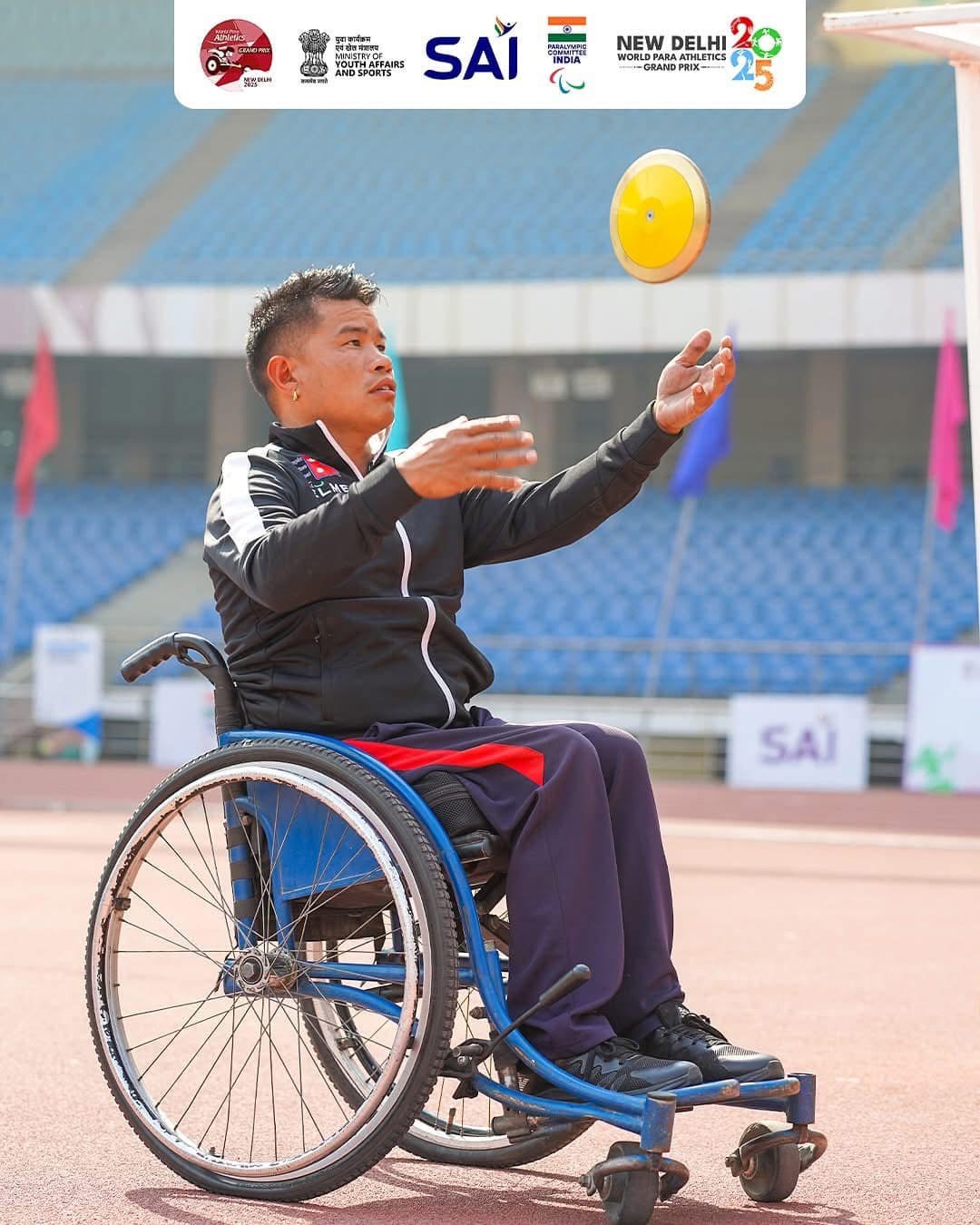
Across town, about seven kilometres north-west of Dasharath Stadium, three more athletes—Himal Aryal, Raju Gurung and Mohan Roka—are training at the Army Rehabilitation Centre near Balaju. They strap themselves into a custom-made metal seat, taking turns launching shot puts, discus and javelins into the open air.
Each of these seven para athletes arrived at this stage through distinct personal struggles—ranging from long public bus commutes to unpaid leave and self-funded diet and equipment. Not to mention the necessity to adapt their routines and techniques to their individual disabilities.
Yet, training without any state sponsorship, they are bound by a shared conviction: they refuse to view themselves as victims. Nepal’s para athletics squad is preparing for Asia’s biggest athletic stage entirely on its own terms, powered by pure self-reliance and an “addiction” to sport.
The Post talked to every member of the squad.
Prabha Angdembe
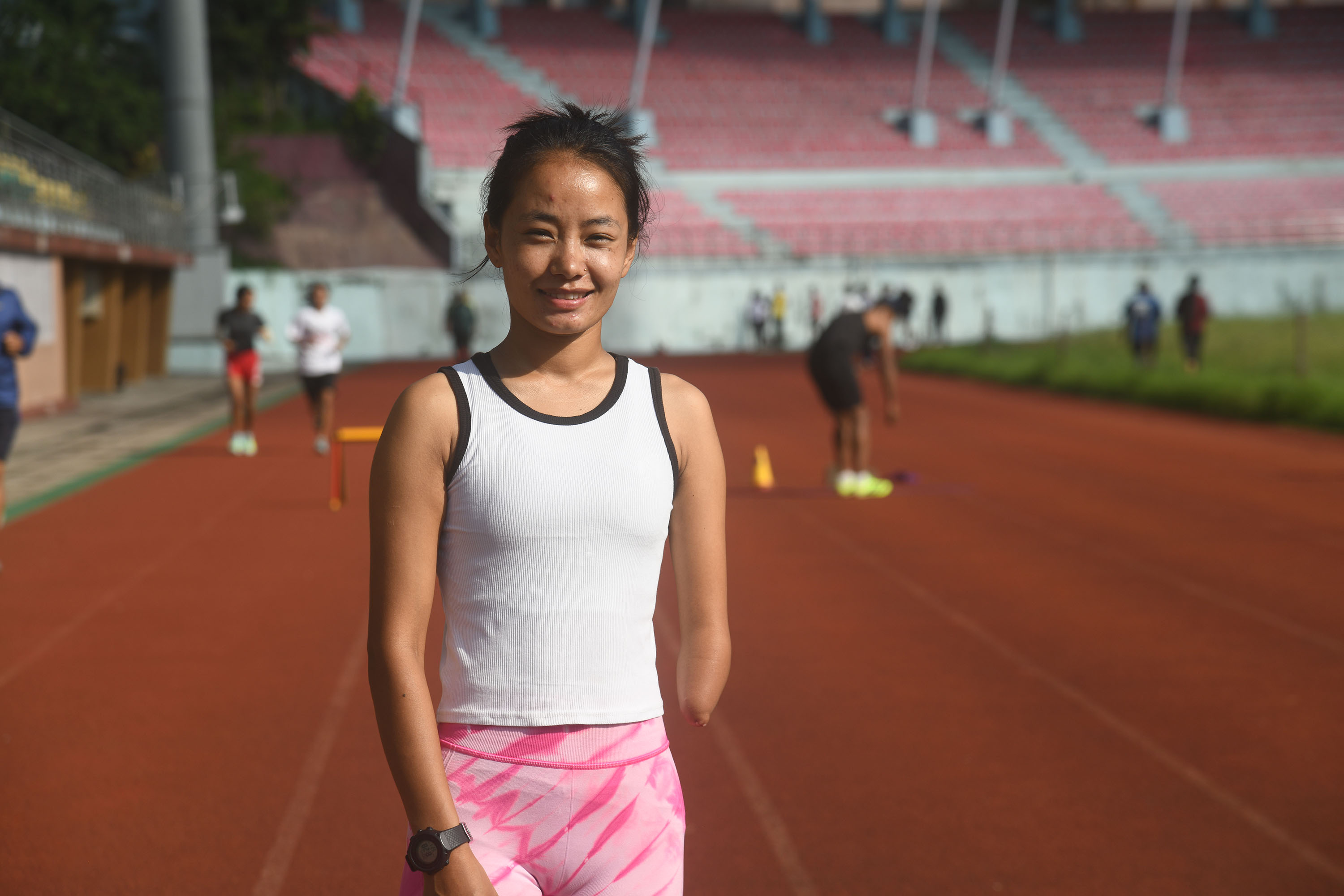
Prabha, who won a silver in long jump at the World Para Athletics Grand Prix last year, was born without a forearm on her left hand. Now in her mid-20s, Prabha has been active in athletics for three years. Alongside athletics, she has also pursued academics and has an LLB degree from Nepal Law Campus.
An aspiring lawyer, Prabha speaks with striking clarity. “I am in no mood to play victim just because the state has not invested in para athletes,” Prabha told the Post as she sat on the track and played with its spikes. “I will improve consistently and prove my worth on the world stage.”
But Prabha could not hold herself from criticising the state. “Able-bodied athletes were provided closed camp training for two years targeting the Asian Games,” she said. “It seems we are not on the government’s radar.”
Shristi Dhewaju
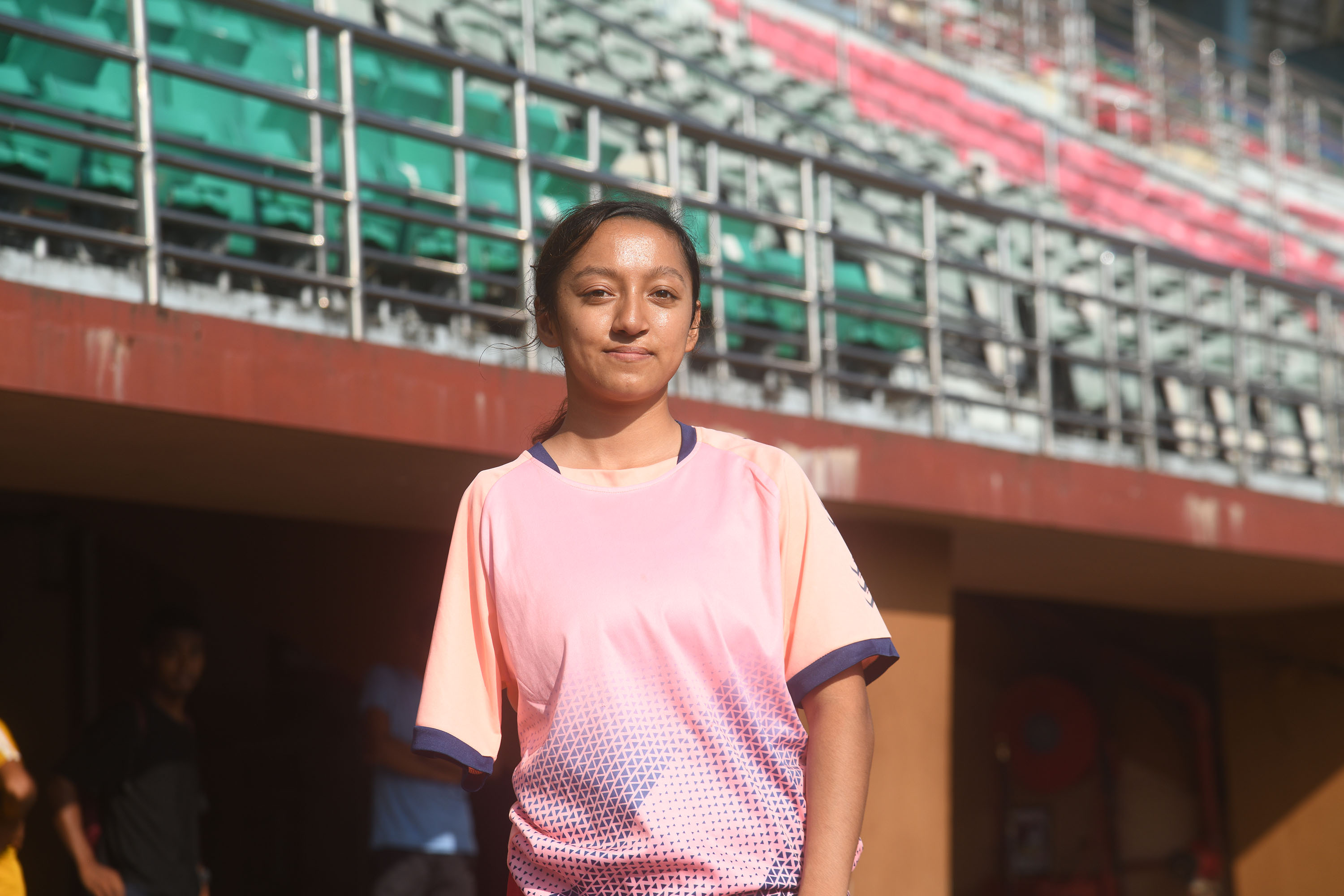
Shristi, who is also in her mid-20s, has had nothing below her right shoulder since birth. Shristi started her athletic life through football. She also played basketball, table tennis and badminton. “I even went to Malaysia for a football event organised for disabled individuals last year,” she said. “Right now, I am seeing a new dream in athletics.”
Shristi was born and brought up in Pokhara, where she is pursuing BBA at Pokhara College of Management. She is currently living in Kuleshwar, Kathmandu, about three kilometres from her training ground in Tripureshwar.
Shristi and Prabha became good friends after they represented Nepal together at the 2026 World Para Athletics Grand Prix in Dubai in February.
In April, Shristi came in third while competing against able-bodied athletes in the women’s 100 metres during the 2nd Pokhara Open Athletics Meet. She finished fourth in the 200 metres. In Dubai, Shristi completed the 100 metres in 14.50 seconds—coming sixth on her international debut—and 200 metres in 30.49 seconds.
“It is going to be my first Asian Para Games,” Shristi said. “I am training hard for it.”
Chet Narayan Khanal ‘Samir’
Samir and Shristi were clocking around 50 metres in approximately five seconds when they were training to improve their sprint. After crossing a make-shift finish line of cones, the fast-and-furious duo ran for a bit far, decelerating themselves, and stopping safely. If you fall on the track, the bruises will be deep.
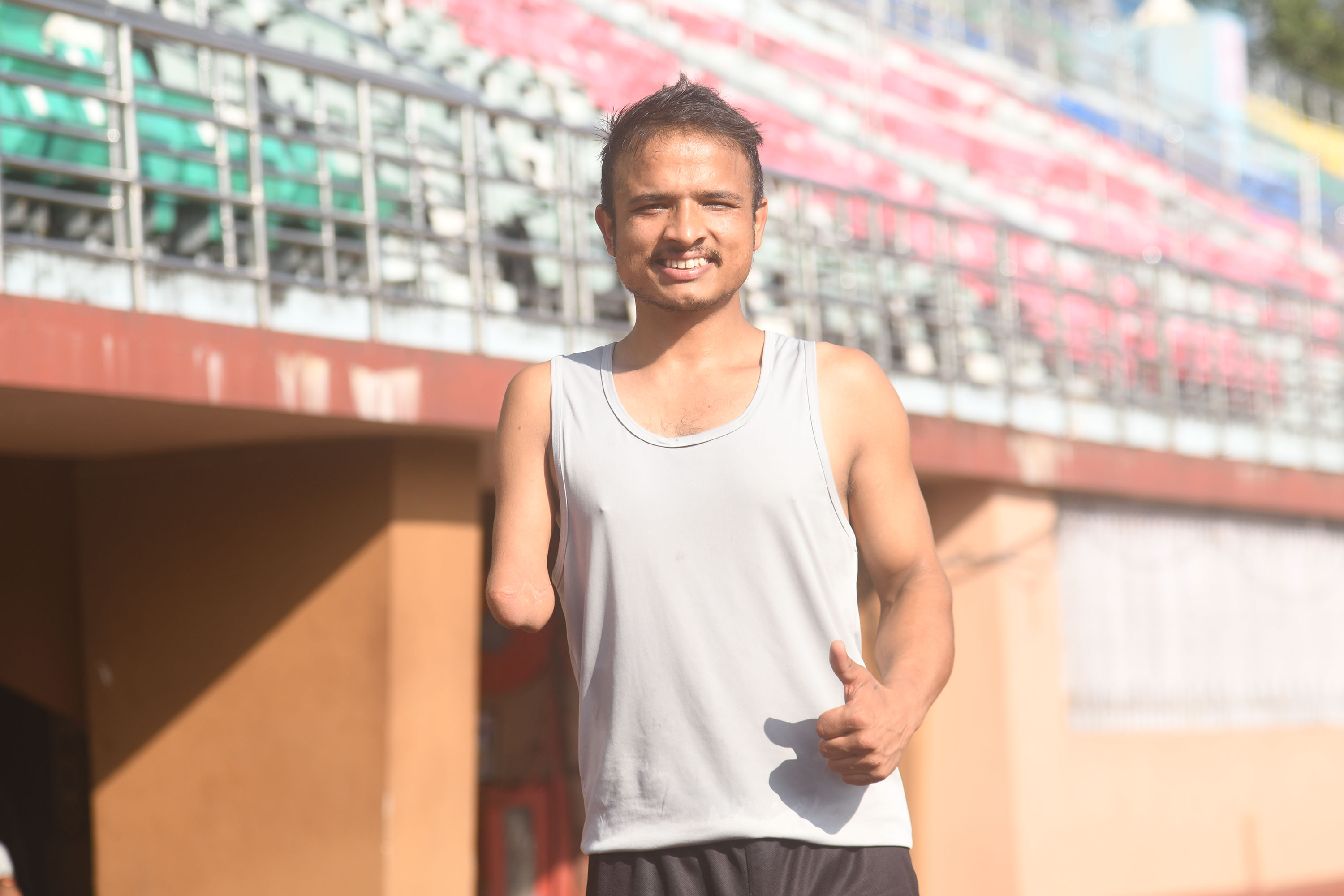
The Asian Para Games will be the first international tournament for Samir. He has been classified in T46, a category for athletes with a unilateral upper limb impairment that affects the shoulder and/or elbow joint of one arm.
Samir was nine when he fell off a tree in his hometown of Bhirkot in Syangja. He received treatment only after regaining consciousness 36 hours after the incident. By then, the doctors had to amputate his right hand below the elbow. He then came to the capital city and studied with the support of the Lalitpur-based St Xavier’s Social Service Centre.
“I played amputee football—under the influence of my hostel mates—for a while before joining athletics,” said Samir, who has taken a two-month leave from a job at a Kathmandu-based travel agency to train. “At the Asian Para Games, I want to have a result I will be proud of.”
Samir has tested himself in national tournaments. It has been three months since he started training intensely for the Asian event.
Samir says he is happy to train at Dasharath Stadium. “There are many athletes and coaches here every morning,” he said. “We can learn from them. And I have good rivals in my teammates—competing with them pushes me forward.”
Nawaraj Karki
Nawaraj does not have much motivation left in him. He says he is fed up with the way para athletes have been treated in this country.
“I was one of the happiest citizens when this new government was formed,” Nawaraj told the Post after his training concluded. “I believed that this government would cater to the needs of para athletes. But I was wrong.”
Nawaraj is a former para taekwondoin. He shifted to athletics a couple of years ago, and has made podium finishes in different national tournaments, including the Nepal Pokhara International Mountain Cross Country Competition in 2024.
“I do not have a job but I am still running for the country, in an empty pocket, and sometimes with an empty stomach too,” Nawaraj said. “Above all that, I have a family to look after.”
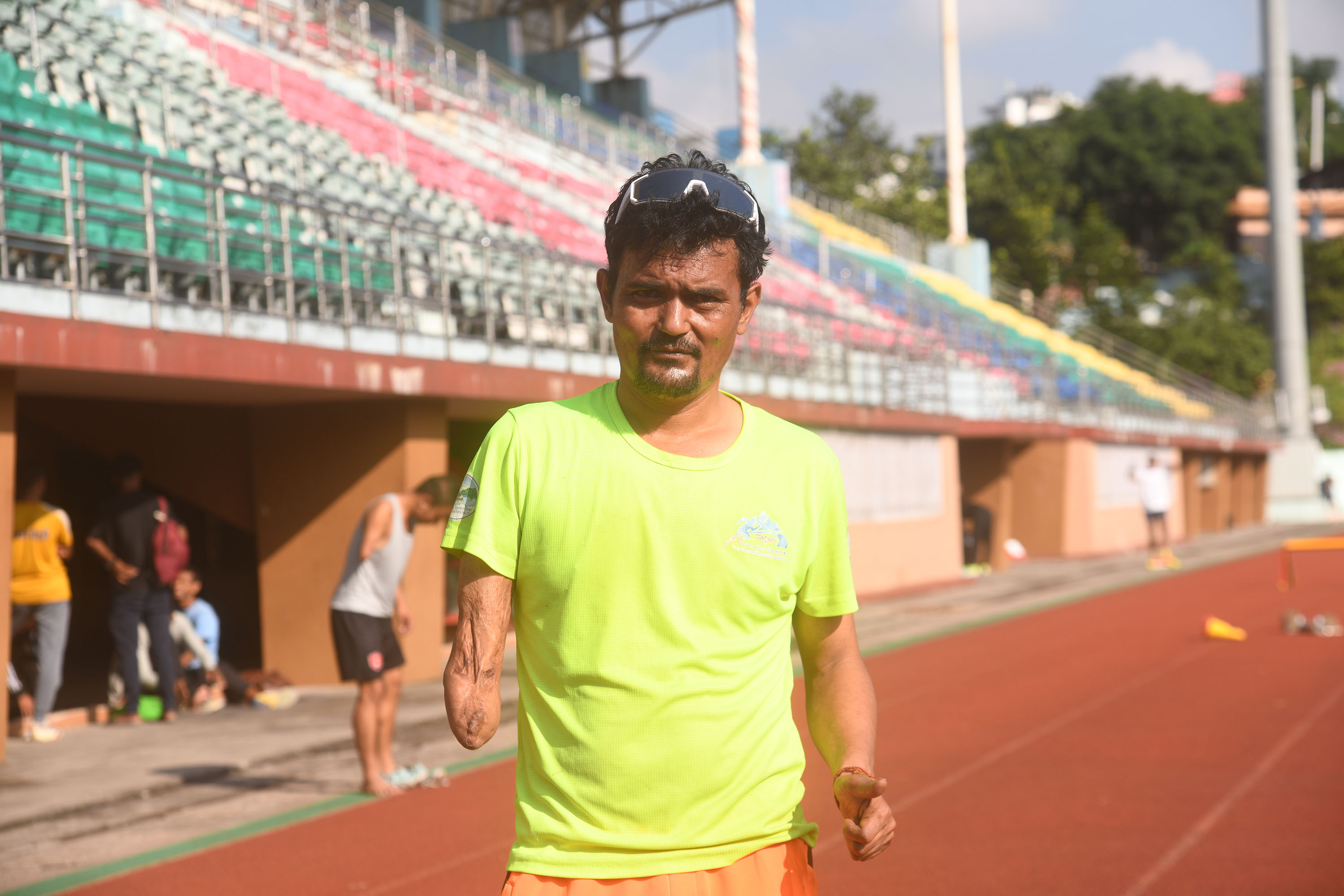
Nawaraj’s right hand extends only up to his elbow. He has injury marks from the elbow to his shoulders which he attributes to an accident but doesn’t elaborate.
Himal Aryal
Himal is the most experienced para athlete out of the seven-member contingent representing Nepal in para athletics in the 5th Asian Para Games.
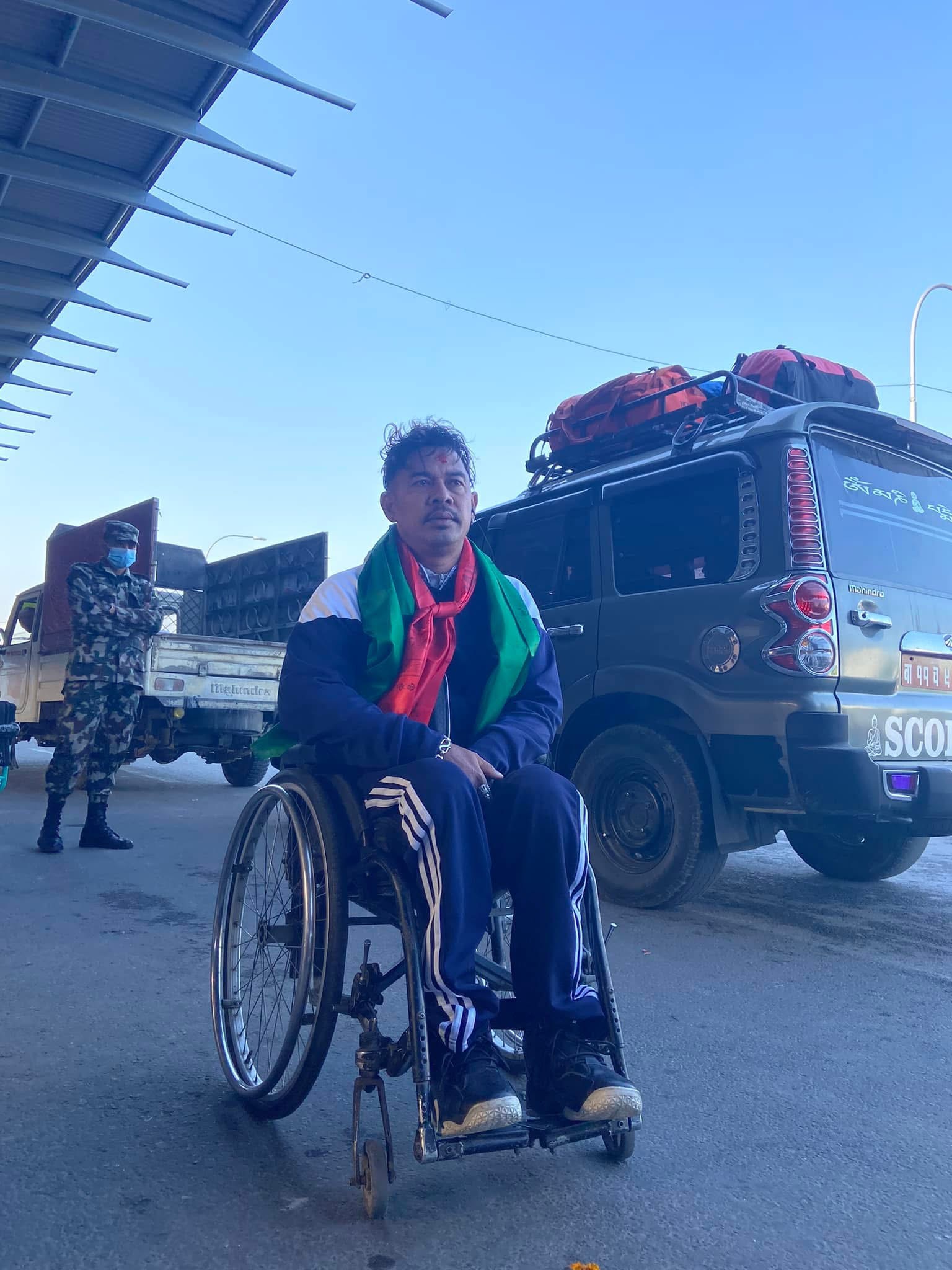
Himal needs a wheelchair to commute. He is built well, with his arms covered in tattoos. “I do not feel anything below my waist,” Himal told the Post, pointing towards his legs. He had come to Dasharath Stadium after completing his training in the Army’s rehabilitation centre.
The rehabilitation centre has been Himal’s home for many years now. He started using a wheelchair after he sustained a spinal injury in an ambush put up by the Maoists in Makawanpur on November 15, 2003. “But I have overcome that tragedy,” said Himal, a former Nepali Army soldier.
Himal added that he has found a new purpose in life through sports. Among the seven-member team that represented Nepal in the 1st Asian Para Games in Guangzhou, China, in 2010, Himal participated as a powerlifter. He was also in powerlifting in the second edition in Incheon, South Korea, in 2014. But in the fourth edition—in 2023 in Hangzhou, China—Himal participated in shooting.
Now, for the fifth edition, Himal is practicing shot put. His best throw in the New Delhi Grand Prix in March was 6.31 metres. The winner of his category threw 10.83 metres.
“Powerlifting took too much investment,” Himal said. “I haven’t left shooting. Right now, shot put is my new passion.” Himal wears many hats: he played wheelchair cricket and is also a wheelchair basketball coach at the Army Rehabilitation Centre. He is also coaching two other para athletes—Mohan Roka and Raju Gurung.
Raju Gurung
Raju, who is in his late 30s, lost seven of his family members from his hometown of Timure, Rasuwa, in the Bhotekoshi flood on August 26.
“My family members and my village, there is nothing left of them,” Raju said as he sat on his modified scooter at Dasharath Stadium. “It was not easy to get over this tragedy, but I want to give my best in this tournament as a tribute to them.”
Raju dedicates his athletic journey to Himal.
“It was because of Himal dai that I joined para sports,” Raju said. “I followed him to the Asian main event in Incheon, South Korea, in 2014. I am still following him.”
Raju met Himal when he returned to Nepal after receiving treatment for 13 months in Qatar, where he was crushed by heavy glass slabs on November 8, 2008. Raju started with wheelchair basketball in 2010. “Now, I am throwing discus,” he said.
Raju added that he needs to train more to challenge world-class athletes.
Mohan Roka
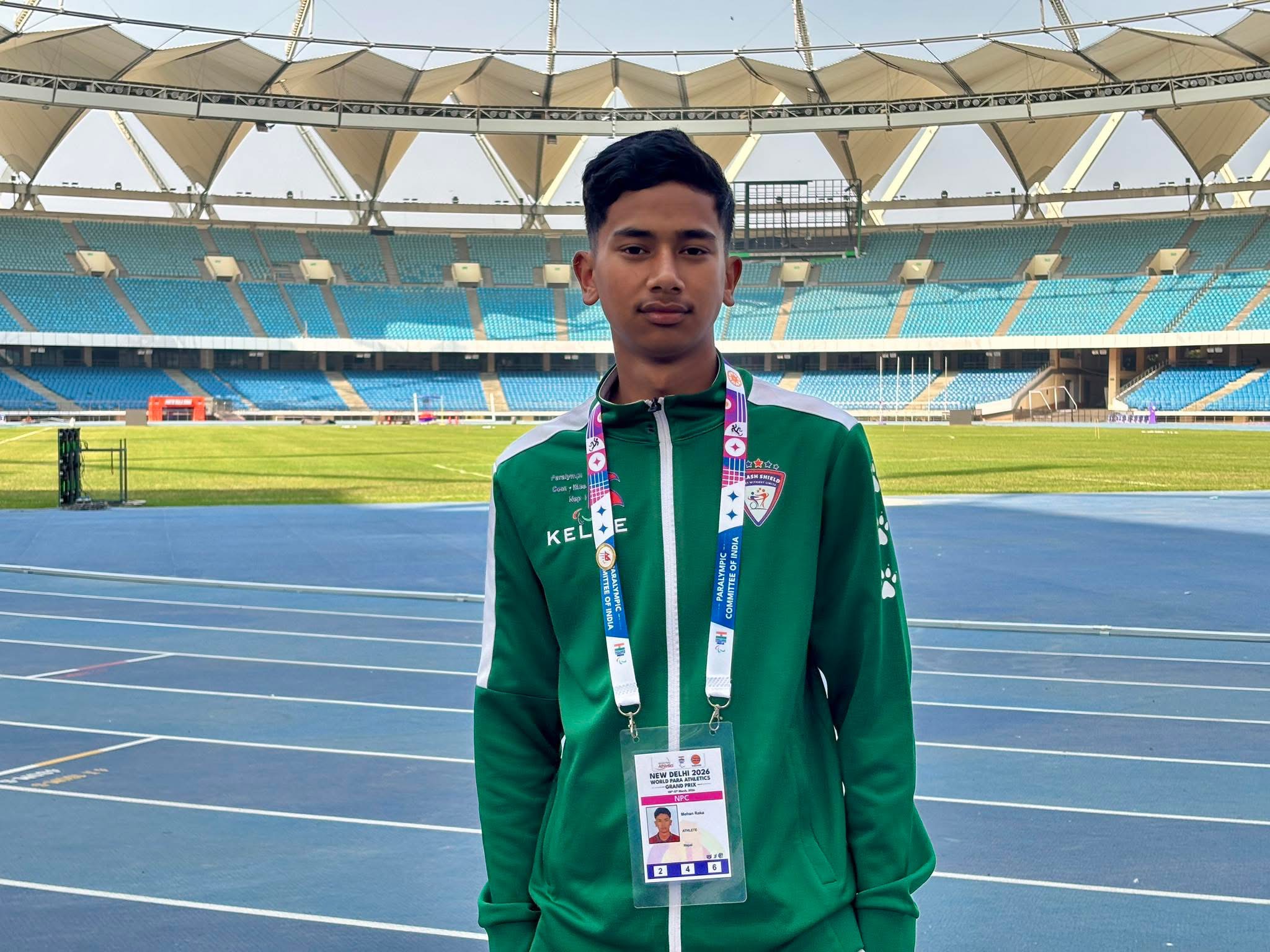
Mohan, 18, is the youngest among the seven Nepali athletes competing in para athletics in Japan. He is participating in javelin throw and trains with Himal and Raju.
It has not been long since Mohan joined para athletics. Around eight years ago, Mohan suffered an accident while returning from his school in Chaurhajari, Rukum West.
“My legs were crushed by a bulldozer. They had to be amputated,” said Mohan, who prefers hiding his prosthetics. “I am enjoying sports.”
But it is not sure how long Mohan can find solace in sports. He has seen how there is no support from the state. He trains on a custom-made iron chair at the rehabilitation centre, in turns with Himal and Raju.
Para athletes competing in shot put, javelin and discus throw are strapped onto an iron chair. Until some months ago, there was no such seat in Nepal for the athletes to train. When Himal went to the Grand Prix in New Delhi in March, he measured the chair and provided the measurement to a welding shop in Kathmandu and had it made.
“Yes, I get discouraged when I see my seniors struggling for support and recognition,” a soft-spoken Mohan said. “But my seniors motivate me with their dedication despite the struggles. I hope to motivate others in the future too.”
Bimala Rana Magar
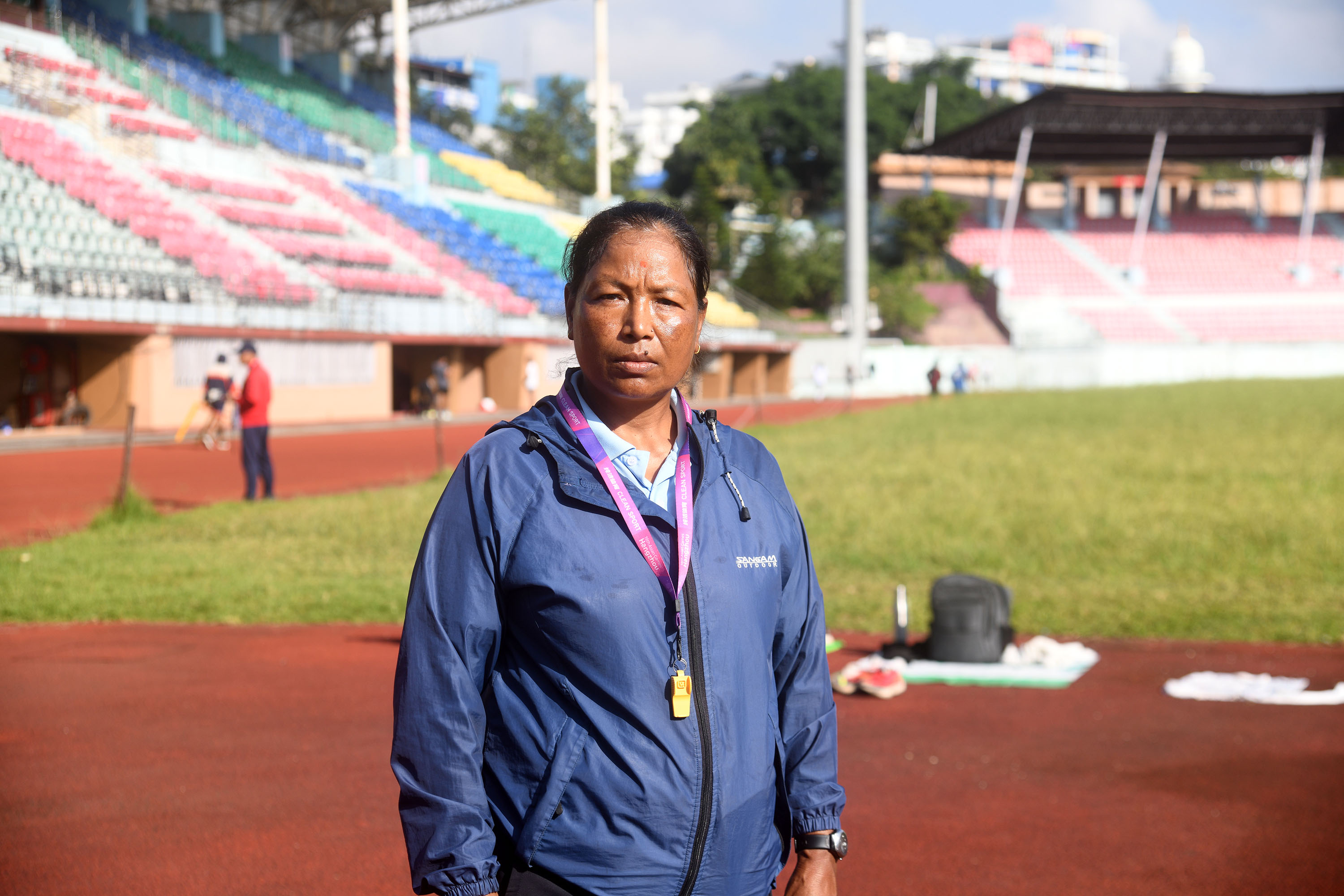
Coach Bimala has two stopwatches hanging by her neck. In her hands are a diary, a pen and a whistle. She wears a blue cap and looks like a true professional.
Bimala is a former runner who represented Nepal in the 1996 Atlanta Olympics. At around 8:30am, when people start leaving the stadium after their training, Bimala begins her most rigorous training for her athletes. She places cones in front of the VIP parapet and trains Shristi and Samir in sprinting. Prabha and Nawaraj, meanwhile, are training for stamina, taking multiple laps of the track.
“The first thing with para athletes is posture and form,” Bimala explains. “As they don’t have a body part, they cannot run straight—their body tilts. Shristi and Samir are finding their form as they are new to the sport. But these athletes work hard and stay disciplined. It is why they keep improving and I keep finding this voluntary job interesting.”
Bimala said that her athletes are completing 100 metres in around 13 seconds. “It is good timing,” she says. “But they could cut it down further with better resources and facilities.”
Nayak Paudel covers sports for The Kathmandu Post. He previously worked at the Post (2018–19) and spent over five years at The Rising Nepal. His reporting spans crime, health, education, and social issues.




 14.58°C Kathmandu