



 16.49°C Kathmandu
Fri, Oct 23, 2026
Money
Floods disrupt livelihoods of 21,400 workers in Nepal: ILO
The UN agency says damage to homes, workplaces, roads, bridges and energy infrastructure could spread employment and income losses far beyond flood-hit areas.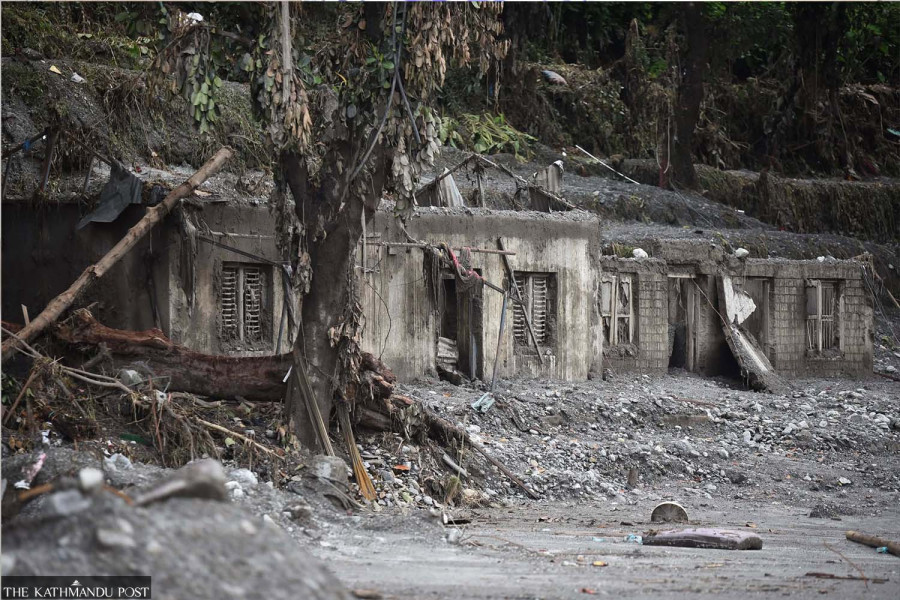
bookmark
Post Report
Published at : October 1, 2026
Updated at : October 1, 2026 18:44
Kathmandu
Catastrophic floods in Nepal have disrupted the employment and livelihoods of an estimated 21,400 people living within four kilometres of the mapped flood footprint along the Bhote Koshi–Trishuli corridor, with the economic fallout likely to extend well beyond the directly affected areas, according to a preliminary assessment by the International Labour Organisation.
ILO’s preliminary rapid assessment comes as the country continues to grapple with the economic damage caused by the August 26 flash flood that swept down the Bhote Koshi–Trishuli corridor from the Nepal-China border, causing a massive loss of life and property.
The destruction of homes, workplaces, roads, bridges and energy infrastructure has disrupted economic activity and workers’ ability to reach jobs, markets and essential services, the assessment said.
Tourism, agriculture, transport and micro and small enterprises are facing significant pressures. Workers such as guides, porters, hotel and restaurant workers, transport operators and agricultural workers may face reduced earnings, interrupted work and difficulties accessing customers, inputs and markets.
“Nepal’s high level of informal employment means that many workers have limited income and social protection buffers,” the ILO said in a statement. “Daily wage, casual and informal workers, own account workers and micro and home-based enterprises can therefore experience income losses quickly when economic activity is interrupted, even where jobs are not formally lost.”
Damage to transport and electricity infrastructure is likely to amplify the initial shock, transmitting the effects of the floods from directly affected households and enterprises to the wider local and regional economy.
The disruption to the Nepal-China trade corridor could also affect enterprises and workers far beyond the flood-affected districts. The Rasuwa and Tatopani border crossings together accounted for around 22 percent of Nepal’s imports from China in 2025-26, while Rasuwa—where the floods severely damaged critical transport infrastructure—handled nearly half of Nepal’s exports to China.
Disruption to these trade flows could transmit employment and income effects across a range of economic activities. The extent of the impact will depend on how long the disruption lasts, the availability and cost of alternative trade routes, and the ability of enterprises to adapt, the assessment said.
As of 24 September, Nepal government reported 1,451 casualties, with 5,786 people still missing and 13,784 rescued. The Rapid Damage and Needs Assessment (RDNA) puts physical damage at about $1.8 billion, economic losses at $883 million, and reconstruction needs at approximately $4.78 billion. The disaster affected some 7,570 houses and 32,933 people, 55 km of roads, 105 bridges, about 1,806 hectares of agricultural land, and 13 hydropower projects, one solar plant and two
transmission lines representing 783 MW of generation capacity.
The most immediate and direct channel of impact on the labour market is the direct loss or disruption of jobs and livelihoods within the flood-affected areas.
At the same time, the flood struck several sectors important for productive employment and local livelihoods: the crossborder trade corridor and the transport and logistics jobs built around it; the Langtang and Kailash tourism economy and its hotels, guides and small enterprises; and a cluster of hydropower projects that had been driving the country's industrial growth and electricity-export ambitions, the ILO said.
Damaged power generation, a severed trade corridor, or lost tourism activity can transmit employment and income effects through supply chains, electricity supply and connected services to workers elsewhere in the country.
This disaster occurred at a time when the economy was only beginning to stabilise. After several difficult years, Nepal had regained a measure of macroeconomic stability: inflation had eased to a record low of about 1.7 percent, foreign-exchange reserves covered more than 18 months of imports, and the immediate crisis conditions of earlier years had receded.
The consequences of these disruptions are likely to be uneven across different groups and workers. Daily-wage, casual and informal workers may face immediate earnings losses when economic activity is interrupted, while own-account workers and micro- and home-based enterprises may have limited savings, insurance or working-capital buffers, the ILO said.
“Internal migrant and foreign workers employed at hydropower, construction and transport sites may face additional vulnerabilities, particularly where they are not captured in residence-based data or local registries.”
Workers and enterprises dependent specifically on the Rasuwa-Langtang corridor may face concentrated seasonal income losses. Women workers may face the combined effects of lost paid work and increased unpaid care responsibilities. Young workers and others displaced from their usual labour markets may face difficulties accessing alternative employment, according to the ILO.
Severe household income losses may also increase the risk of child labour as a negative coping strategy, underscoring the importance of maintaining adequate income protection and continuity of schooling during the recovery period.
The ILO stressed that recovery and reconstruction could help protect livelihoods while creating decent employment. It called for immediate income and enterprise support, alongside employment-intensive reconstruction, job matching and skills development, occupational safety and health measures, stronger social protection and support for resilient enterprises.
“The employment consequences of this disaster will not stop at the edge of the flooded area,” said Numan Özcan, ILO Country Director for Nepal. “Damage to transport links, electricity infrastructure and trade routes can carry the shock through supply chains, markets and connected services, affecting workers and enterprises much farther away.”
He added, “Recovery must therefore protect livelihoods as well as rebuild infrastructure and use reconstruction to create decent jobs and strengthen resilience.”


Most Read from Money
Nepal travel agents threaten to stop selling Thailand trips over visa rules

Why does an hour long flight to Dhangadhi cost more than a flight to New Delhi?
Malaysia rejects Nepal’s demand to open recruitment to all manpower agencies

No school, but a graduation cap for women dairy farmers
Nepal arrests four medical service providers as Malaysia recruitment row deepens
Editor's Picks




E-PAPER | October 23, 2026

×