



 17.6°C Kathmandu

Thu, Oct 22, 2026
Money
2015 earthquake victims waited for a safer home. Then came the flood
A decade later, many families still lack home and land. The government is now preparing to relocate those displaced by floods, but experts warn that livelihoods and social ties must be considered.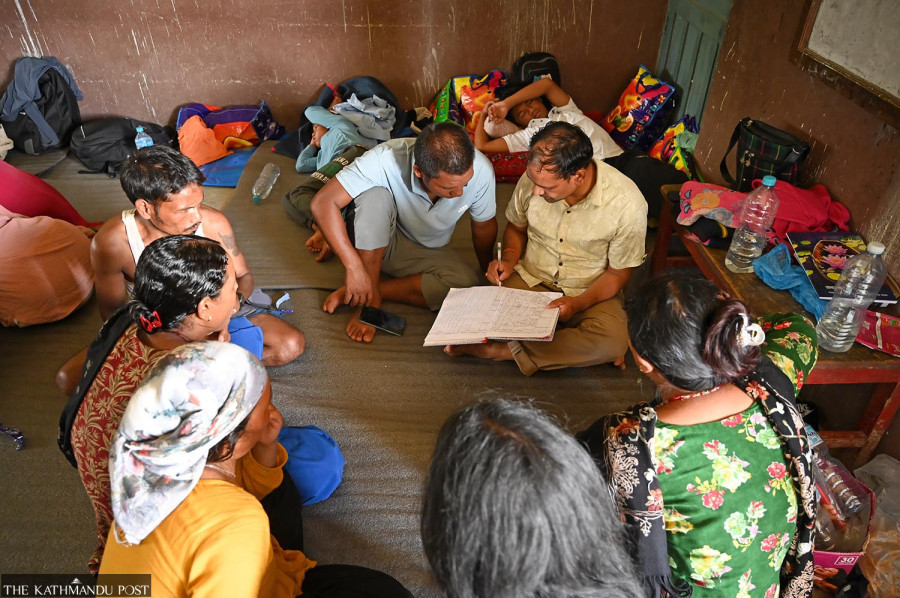
bookmark
Ganga BC & Bimal Khatiwada
Published at : October 1, 2026
Updated at : October 1, 2026 09:28
Kathmandu
Chhegu Tamang has been displaced twice.
The first time was after the 2015 earthquake destroyed his home in Rasuwa. The second came on August 26, when the Bhotekoshi flood swept away his settlement in Khalte—and killed more than a dozen of his relatives.
Now Tamang has no home, no land and few family members left. He has moved from one temporary shelter to another, unsure where he will live or how he will make a living.
After the flood, he first took shelter at Shivalaya Basic School in Rasuwa. He has since been shifted to a holding centre at Pipaltar in Bidur, Nuwakot.
For Tamang, the latest displacement is also a reminder of an unfinished promise.
After the 2015 earthquake, authorities identified his original village as unsafe and promised to relocate families like his. Years of waiting, however, left them living in makeshift shelters close to the river—the same area that was devastated by the August flood.
“We have already been moved two or three times since the flood,” Tamang said. “Instead of being shifted around like a cat switching its sleeping spots, it would be better if we were provided with a permanent settlement.”
His story now sits at the centre of a larger question facing the government: where—and how—should survivors of the Bhotekoshi disaster be resettled?
The then National Reconstruction Authority had offered two options for families seeking to rebuild their homes. Under the first, families willing to move to higher ground above Tiru village would receive Rs300,000 to build a house. Under the second, families would receive Rs300,000 and be advised to purchase land in a neighbouring district or municipality and build their homes there.
Families unable to take either option were told that the government would work out the details and purchase land for them.
As many as 630 households from ward 1 of Uttargaya Rural Municipality had been displaced by the earthquake. Some families chose one of the two options and added their own money to the government grant to buy land in Bogatitar and Shanti Bazar in the district.
But 257 households were too poor to do so, Tamang said.
“We were in such a vulnerable condition that we couldn’t do anything,” he said.
After the affected families asked government agencies to find land for them, they inspected land in the Naubise fields below Bogatitar. But the government considered the land too expensive and told them to look elsewhere.
Eventually, the government purchased 25 ropani and four ana (1.28 hectares) of land in ward 5 of Pahirebesi in Uttargaya in the name of the National Reconstruction Authority. The plan was to provide four ana (127.18 sq metres) of land to each household.
“We thought we would finally be moved there,” Tamang said.
But the National Reconstruction Authority was dissolved and responsibility was handed to the Ministry of Urban Development. For six or seven years, Tamang and others repeatedly travelled to Singha Durbar, the seat of the federal government in Kathmandu, asking officials to move them to a safe place.
“Nobody listened to us,” he said.
With nowhere else to go, the families eventually built makeshift shelters in Khalte, close to the river.
“Government agencies themselves provided us with tarpaulins, telling us to stay there until a permanent settlement could be established,” Tamang said. “Later, we used corrugated sheets provided by various organisations to build huts.”
The delay proved costly.
Preliminary estimates suggest around 400 people in Khalte were caught in the flood. The settlement was only about 100 metres from the river.
“Because the government failed to move us to a safe place in time, a huge loss occurred this year,” Tamang said.
He does not want to return to Khalte or any other location where another disaster could put his life at risk.
Tamang and other survivors are asking the government to find land for them even if it means acquiring privately owned land in Bidur Municipality, Nuwakot.
Purna Bahadur Ghale, 43, from Khalte is also a ward member of Uttargaya Rural Municipality. He had earlier been elected a ward member in 2017.
He is now staying at the holding centre at Shivalaya Basic School in Laharepauwa. He lost seven relatives in the August 26 flood.
Ghale says he survived by a matter of seconds.
“We were earthquake victims in 2015, and we survived then,” he said. “I must have gone to Singha Durbar more than 100 times and asked officials to move us to a safe place. But they kept saying, ‘Yes, yes.’”
His family had moved to Khalte after being displaced from Gogane following the earthquake.
Now he wants the government to provide safe housing and basic support to survivors.
“We are in mourning. We have nothing. The flood has brought us down to zero,” Ghale said.
“It would be good if those who survived the flood could be placed somewhere safe, whether in Rasuwa or Nuwakot. If the government could provide us with some means of livelihood for a while, we could gradually manage things ourselves.”
“We just need some support, including shelter, to get back on our feet for a while,” he said.
Madhav Prasad Aryal, chairman of Uttargaya Rural Municipality, said the government had been preparing to rehabilitate people displaced by the 2015 earthquake, but the flood struck suddenly.
“There was a large settlement in Khalte, and because we could not rehabilitate that area, 75 percent of the residents are missing in the flood,” he said.
“We were trying to relocate the earthquake-affected people of Khalte to Pahirebesi. But half of that place has also been swept away by the flood. Now we have to look for a safe place elsewhere.”
The Bhotekoshi flood swept away around a dozen and a half large and small settlements in Rasuwa, Nuwakot and Dhading districts.
The National Planning Commission has begun work on a Post-Disaster Needs Assessment and a master plan for overall development, including reconstruction of physical infrastructure and settlement development.
Gunakar Bhatta, vice-chairman of the commission, said the assessment would cover productive sectors, social sectors, infrastructure, climate and environment, macroeconomic issues and interrelated sectors.
Along with rebuilding damaged infrastructure, a master plan for settlement development and broader reconstruction will be prepared, he said.
The Ministry of Infrastructure Development is expected to rebuild roads and bridges and reconnect affected areas to the wider transport network before plans for new settlements are finalised.
According to the National Disaster Risk Reduction and Management Authority, Rasuwa and Nuwakot suffered the greatest damage.
The government is now considering different categories of affected families based on the extent of damage to their land and homes.
Arjun Jung Thapa, a member of the National Planning Commission, said those who lost all their property would need to be relocated to new and safe places.
“Those whose entire property was swept away and who have nothing left need to be classified for relocation to a new and safe place,” he said.
But not everyone wants to leave their ancestral areas.
“There are people who do not want to leave the places where they previously lived,” Thapa said. “If there is a safe place nearby, it should be identified and they should be provided a grant to build a safe four-room house.”
The government is considering different levels of assistance for families depending on the extent of damage suffered.
Where some land remains safe, affected families could be supported to rebuild there. Where the remaining land is unsafe, the government could provide land elsewhere or arrange housing for families to live together.
“We will tell them to build their houses in a safe place and live there, while the government will develop the land that was swept away for agriculture or forestry or some other purpose,” Thapa said.
“If the land is unsafe and we cannot tell them to go back and live there, the government itself must identify a safe area and arrange collective housing, or tell them that they can build there themselves with the necessary financial assistance from the government.”
The government is also examining possible sites, including the Trishuli hydropower project camp and forest areas in Khalte, to determine where new settlements could be established.
The authority's preliminary report says around 1.6 million people in 15 local units were directly affected by the flood.
The flood swept away settlements in Rasuwa including Rasuwagadhi, Timure, Syaphrubesi, Hakubesi, Mailung, Khalte, Betrawati Bazar, Dalphedi, Khaidi and Lingphung.
In Nuwakot, settlements in Tupche, Dhunge, Trishuli Bazar, Bidur, Battar, Salletar, Shanti Bazar and Devighat were swept away.
According to preliminary figures, 7,570 houses were completely destroyed. Around 99 percent of the damage occurred in Rasuwa and Nuwakot.
The government has begun mapping settlements that have become uninhabitable for possible relocation. Along with searching for missing people, rescuing affected residents, providing temporary housing, relief and treatment, authorities are preparing plans for permanent relocation.
Dharma Raj Upreti, chief executive of the authority, said the government had begun risk assessment and planning for new settlements.
“The settlements swept away by the flood can no longer be inhabited. The government has already begun working in groups to move those settlements to safe locations,” he said.
“We will soon make public a plan for relocating the displaced.”
The government is also considering moving some communities to other districts and finding vacant land for them.
Nepal has experience with relocating settlements after major disasters, but the results have been mixed.
After the devastating 1993 floods and the 2015 earthquake, settlements in various high-risk areas were relocated.
The entire Laprak settlement of Gorkha was moved to Gupsipakha, where the Non-Resident Nepali Association built 602 houses and developed a model settlement. Another 46 settlements were relocated at the time, according to the Ministry of Infrastructure Development.
But experts say physical relocation alone does not guarantee that displaced families will remain in their new settlements.
The 1993 floods affected around 400,000 people and killed about 1,500 in seven districts. A new settlement was established on vacant land along the Bagmati River in Sarlahi for flood victims.
But many of those relocated eventually returned to their original settlements.
Former home secretary Bhoj Raj Pokharel recalled that a model settlement had been built around the Bagmati River for landless and homeless flood victims.
“But people returned to their old places because their farming and social networks were there.”
He said the government should take people's preferences and livelihoods into account while relocating those affected by the Bhotekoshi flood.
“If displaced people are taken far away from their old settlements, they cannot maintain their livelihoods or access to education, health services, markets, employment and farming,” Pokharel said. “Their needs must be taken into account.”
He suggested providing financial assistance and allowing families to relocate to places convenient for them.
Former prime minister and urban planner Baburam Bhattarai has also warned against simply uprooting Himalayan communities and moving them far from their traditional homes.
“There is a major risk of Himalayan disasters in the coming days from Taplejung to Darchula,” Bhattarai said. “People have been living in these areas for centuries, and their lifestyles, daily lives and livelihoods are unique to those places.”
He said it would not be scientific to move people from risky locations to districts far away.
Instead, he suggested identifying safe areas within the Himalayan and hill regions, including small valleys and upper mountain pastures, and relocating vulnerable settlements there.
Settlements are not merely collections of houses, he said, but are connected to centuries-old communities and cultures.
“It is not appropriate to remove an entire settlement from where it is and take people hundreds of kilometres away, or bring people living in the Himalayan region all the way down to the plains,” Bhattarai said.
“Instead, settlements in risky Himalayan areas should be made safer and better organised.”
He said the Bhote Koshi disaster should be used as a lesson to prepare a regional plan for settlement development.
“After the Bhote Koshi flood, we cannot think only according to our plans and old construction standards,” he said. “We need to take into account the fact that floods can come from much higher levels than we imagined.”
Sushil Gyewali, former chief executive officer of the National Reconstruction Authority, also said settlements should not be moved too far from their original locations.
After the 2015 earthquake, the authority studied around 300 earthquake-affected settlements and concluded that 64 were at risk. It developed 46 settlements as integrated settlements and protected 19 others.
The experience showed that relocating people far away from their original communities was difficult, Gyewali said.
“During post-earthquake reconstruction, we learned that it was not possible to relocate around 50 settlements and take people very far away,” he said.
“Livelihoods, economic and social-cultural relationships, and people’s proximity to their land all matter when relocating them. Therefore, along with physical reconstruction, economic and social rehabilitation must also be addressed.”
He said the shortage of suitable land in Rasuwa could become a major obstacle.
“At that time, we conducted a detailed study of land in Rasuwa. We didn’t find many suitable places; there were only limited options,” he said. “Now, given the overall situation in Rasuwa, the shortage of land itself is a problem.”
The first task, he said, should be to determine whether safe land is available near the damaged settlements.
“Efforts should be made to find nearby safe locations connected to people’s livelihoods and production rather than relocating them far away wherever possible,” Gyewali said.
Govinda Pokharel, another former chief executive officer of the National Reconstruction Authority, said infrastructure planning should go hand in hand with settlement relocation.
“Only after roads are relocated can settlements move uphill,” he said.
For families whose land has been completely swept away, he suggested that the government acquire the unsafe low-lying land and provide an equivalent amount of land in a safe location.
The challenge now is not simply to rebuild houses destroyed by the Bhotekoshi flood, but to decide where people should live, how they can earn a living and how the government can ensure that a temporary response does not become another decades-long displacement.
For survivors like Tamang, the demand is simple: after years of waiting since the 2015 earthquake and another devastating displacement this year, they want a safe place they can finally call home.
“There are no places in Rasuwa where it is possible to live,” said Tamang. “Please don’t send us back to where we lived before. Rather, we would like to live somewhere safe in Nuwakot.”

Most Read from Money
Nepal travel agents threaten to stop selling Thailand trips over visa rules

Why does an hour long flight to Dhangadhi cost more than a flight to New Delhi?
Malaysia rejects Nepal’s demand to open recruitment to all manpower agencies
No school, but a graduation cap for women dairy farmers
Nepal arrests four medical service providers as Malaysia recruitment row deepens
Editor's Picks




E-PAPER | October 22, 2026

×