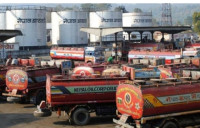
Nepal Oil Corporation has introduced an Enterprise Resource Planning (ERP) system to bring its annual transactions worth around Rs300 billion under a unified digital platform, aiming to make its operations more efficient, transparent and accountable.
With the implementation of the system, more than 1,500 dealers, 60 bottlers and 60 airlines and airline agents will be able to place orders for petroleum products online without having to visit the corporation’s depots in person. Around 800 employees of the corporation are also expected to benefit from the system.
The platform allows users to make digital payments and access their transaction records online, said Pradeep Kumar Yadav, chief of the ERP project at the corporation.
The project, launched to integrate all of Nepal Oil Corporation’s operations into a single digital system, has reached the handover stage. According to the corporation, an assessment conducted by Uniconsult of Kathmandu University found that around 88 percent of the functional requirements had been completed.
“Before 2020, dealers and airlines across the country had to physically carry money to banks, obtain deposit vouchers and then take those vouchers to the respective depots,” Yadav said. “There were even instances of accidents involving people carrying cash because they feared they would not receive fuel if they failed to submit the vouchers on time.”
The new system has eliminated the need to carry physical deposit vouchers to the depots, he said.
“All the Class A banks associated with the corporation have accounts in its name. Customers can deposit money into these accounts through ConnectIPS on their mobile banking applications, and the payment information is then transmitted to our system through Nepal Clearing House,” Yadav said, adding that the system immediately displays the amount deposited.
The corporation is preparing to shift all its payment transactions online, he said.
“The system is being developed in such a way that only tanker trucks, their drivers and assistants will need to visit the depots,” Yadav said.
Rajan Nepal, a computer engineer at the corporation, said the system was introduced to ensure that data entered in one place could be accessed across departments without having to enter the same information repeatedly.
“This is not a system that employees can operate from home. For security reasons, it can only be accessed from computers provided by the corporation within its office premises,” Nepal said.
Previously, the corporation had no way of tracking the loading of tankers and liquefied petroleum gas (LPG) bullet tankers at Indian Oil Corporation (IOC) facilities until drivers provided the information, he said. The corporation has since developed a connection between its system and IOC's platform through coordination with the Indian company.
The ERP project office currently operates from rented premises in Lokanthali, Bhaktapur. The corporation has already invited bids to establish a data centre on the sixth floor of its central office from Baisakh, the Nepali month beginning in mid-April, Nepal said.
According to the corporation, the ERP system has shifted its operations from paper-based and physical processes to an integrated digital platform. It brings together sales, distribution, finance, accounting, procurement, storage and human resource management under a single software system.
Data entered by one department can now be accessed immediately by others, eliminating duplication, improving data accuracy and supporting faster, evidence-based decision-making, the corporation said.
The corporation signed an agreement with Neoteric Neo Software JV on July 19, 2020, following a competitive bidding process under the Public Procurement Act 2007 and Public Procurement Regulations 2007. The agreement set a 36-month project period, comprising 12 months for system development and a further 24 months for implementation and maintenance.
The total contract value was Rs228.7 million, excluding value-added tax.
“The ERP system implemented by the corporation is SAP Business One, developed by Germany's SAP,” Yadav said. “Based on the SAP HANA database, it can process large volumes of data quickly and integrate with other systems, including banking platforms and depot automation.”
Major modules under the project, including sales and distribution, human resource information, finance, asset management, treasury and accounting, have already come into operation, the corporation said. An e-recruitment system has also been introduced to manage employee recruitment online.
The corporation plans to integrate the ERP system with Internet of Things (IoT) and artificial intelligence (AI) technologies to make fuel supply operations more efficient, secure and transparent, Yadav said.
It also aims to connect automated depots to the platform in the future to improve the accuracy and transparency of fuel storage, distribution and accounting.




 16.12°C Kathmandu