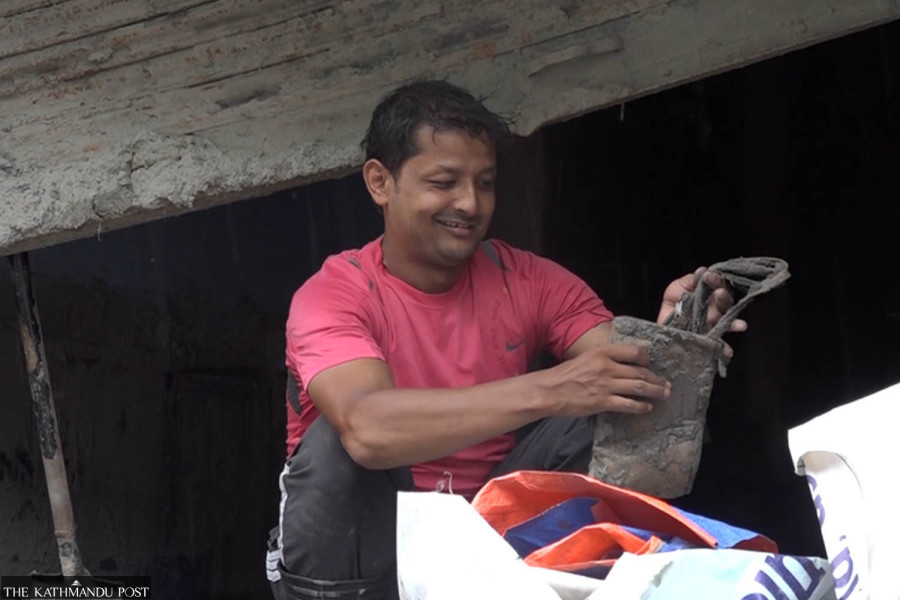
More than a month after the catastrophic floods, people in Nuwakot are combing the wreckage of their homes and shops for documents, photo frames, keepsakes, and anything else they can salvage.Naresh Dangol inspects a bag recovered from his flood-damaged house at Dhunge Bazar in Nuwakot last week. Pankaj Shrestha/TKP
It was pouring down hard at Dhunge Bazar last Thursday, usually a bustling market along the road from Betrawati to Devighat.
Inside the half-open shutter of their shop, Naresh Dangol and his wife were working with rubber boots on, digging through mud, gravel and sand with pickaxes, shovels and hoes.
For the past two weeks, the couple have been working hard each day to clear the thick sludge that filled their home, clothing and cosmetics shop.
The floodwaters twisted and bent the shop’s metal shutter, while mud piled up to the third floor of their house.
The August 26 Bhotekoshi flood, which sent the Trishuli river bursting its banks with extraordinary force, buried a decade of the Dangols’ hard work and lifetime investment, they said, probably worth around Rs3 million, all under thick layers of mud.
As he digs through the debris, Naresh finds a mud-covered ladies’ side bag. The couple have been searching for whatever they can grab from the shop: clothes, bottles of nail polish, strings of beads and other small items they once sold.
“Finding even a small item that we bought with our hard work and money gives us some comfort and more nostalgia,” Naresh said, holding up the muddy bag with one hand. “We’ll wash it, dry it and keep it. Maybe it will be useful later. Even if it isn’t, I can’t bring myself to throw it away.”
He keeps digging because he hopes more things from years of work and investment may still be buried beneath the mud.
The couple ran the shop in their own house, built on six ana (190.8 sq metres) of land. Although they lost their life’s investment, Naresh says he is grateful that all nine members of his family survived the disaster.
“We can start over again. For now, our priority is to find a safe place for the family to live,” he said. “If the government provides concessional loans, the two of us can start the business again. We hope and trust that the government will do something for us.”
Before the flood, Dhunge Bazar was a busy commercial centre serving people travelling between Kathmandu and Rasuwa. It would be filled with tourists heading to Rasuwa and back, a busy petrol pump, and a stand-off buspark waiting for passengers.
The market was lined with multi-storey buildings, hotels, clothing and cosmetics shops, mobile phone and medicine stores, fruit and juice shops, bank branches and large grocery and wholesale outlets. Shops and warehouses occupied the first and second floors of many buildings, while families lived upstairs or rented out the rooms.
After the floods tore through, very little of that market remained. It's full of sand and looks like a desert now, as if there has never been anything.
Inside another mud-filled ground floor, Rojita Pandey was searching around with a torchlight.
She was looking for remnants of Pandey Kirana Wholesale, the family’s grocery store that dates back to her husband’s grandfather. Standing amid the wreckage helplessly, she tried to sound determined to preserve both the history and reputation attached to the shop.
Her family’s connection to the shop goes back generations, and she said she could not simply walk away from a business that had become part of their identity. “Our birth and identity are tied to this business,” she said. “I can’t simply leave behind the work and place that have been part of the family since my father-in-law’s time.”
In Nuwakot, the shop was widely known as Krishna Bahadur Pandey’s legacy as a local merchant. Among the things buried beneath the mud were old utensils, copper vessels and brass water pots dating back to his time. She was searching for any of them that might have survived.
So far, Pandey has recovered a couple of cooking gas cylinders, packets of biscuits and instant noodles, and a few unbroken glass tumblers.
She continues to clear the mud in the hope of finding the old copper and brass vessels.
With the settlement destroyed by the floods, her family is now staying with relatives at Deurali, higher up the hillside.
She claimed the losses at around Rs100 million, including the goods stored in the warehouse, food supplies, gas cylinders and probably Rs3 million in cash.
“There is no point crying or whining now,” she said. “The floods took everything my family had earned through generations of hard work. We have no choice but to start from scratch, even if it means taking on more debt and working more hours.”
Across the flood-hit areas of Nuwakot and Rasuwa, residents are scouring through the ruins for whatever remains of their lives.
They clear thick layers of mud from their homes, searching for important documents, old photographs, personal keepsakes, schoolbooks and the tools and belongings they depended on to earn a living.
For those who have lost almost everything, even the smallest object recovered from beneath the mud can become a source of hope, dignity and a reason to start all over again.
Maiya Gajurel had been inside her fruit and juice shop when the flood struck that morning.
She had left her job at NIC Asia Laghubitta Bittiya Sanstha Ltd in January and invested Rs1.5 million of her own money, while taking out a Rs2.3 million loan, to open the shop.
When the flood hit, her husband arrived on a scooter and hurriedly took her to safety. The couple then fled towards higher ground.
“Later that evening, when the river had calmed a little, we came back to the shop by a longer route to see if anything had survived,” she said. “But we saw that nothing was left.”
Days later, while clearing the mud, she found a crate of bottled water still sealed in its plastic packaging.
Her eyes welled up with tears. Leaning against the shop’s shutter post, she gently touched the mud-covered crate.
“Everything is gone, but this one thing survived,” she said. “I’ve been under so much stress that I feel like I might become mentally ill. But when I see people who have lost family members, I tell myself that at least we survived. We can work hard and rebuild.”
Shankar Singh Marsangi and his wife, Sangita, had lived along the Shubhaghat riverbank in Gerkhutar for 12-13 years. They lost everything in the flood.
The floods suddenly swept into the settlement, triggering a frantic scramble for safety. Shankar said the only things he managed to keep were the mobile phone in his pocket and the old clothes he was wearing.
“When I see the few things I managed to save, I feel empty,” he said. “They bring back everything that happened that day.”
Shankar worked as a construction contractor. The floods swept away the shuttering materials and other construction equipment he used for building houses.
“Thirty-five chickens we kept at home, the cash I had withdrawn from our savings group, and all our household belongings were washed away,” he said. He estimated his property losses at around Rs1.5 million.
Yet even after losing almost everything, Shankar said he was relieved that the 13 people who worked with him survived.
The workers, from Nepalgunj and Salyan, were given money for transport so they could return home after the flood.
He wants his workers to spend Dashain and Tihar with their families before returning to work.
For 38-year-old Radhika Adhikari, who returned from Kathmandu to look after her in-laws and young children, the survival of her study notes and her father-in-law’s wheelchair has brought some relief.
The family lives close to the river and still spends nights in fear. Amid that anxiety, finding a few things that carry years of memories has offered her some comfort, particularly her study notes and her father-in-law’s wheelchair.
“My notes from online and in-person classes from 2023 to 2025 are priceless. Years of hard work are preserved in a single notebook,” she said. “Finding them, along with my father-in-law’s wheelchair, has given me a lot of relief.”
As residents struggle to recover their belongings, volunteers have been working through the mud alongside them.
A team of 20 volunteers led by Kaman Ghale, founder of Heimat Public English School in Bhalche of Kispang Rural Municipality, has spent the past 17 to 18 days helping residents clean their homes and recover belongings buried under the mud.
With support from Heidi Wiederkehr and Marcus Wiederkehr of Switzerland, the volunteers have been clearing mud from houses in markets across Nuwakot and recovering gold, copper utensils, documents, gas cylinders and machinery from workshops.
The team pays for its own tools, boots, gloves and food and carries out the work without charge.
Ghale recalled finding gold buried in the mud while clearing the home of flood victim Ashok Sah.
“We felt that cleaning a victim’s home and helping families recover the things that matter to them was more meaningful than simply distributing relief,” Ghale said. “We will continue providing the service free of charge for at least another month.”
In the settlements buried under mud, he said, the work is about more than clearing soil and debris.
Residents are trying to recover pieces of their past: old memories, family histories, identities and anything that survived from their past.
For many, the search continues as they recover their belongings one item at a time.
Aarya Chand is a reporter at The Kathmandu Post covering social issues. Before moving to the social beat, Chand was an intern covering culture and lifestyle for the Post.




 20.07°C Kathmandu