Repeated Tatopani closures deepen uncertainty for traders
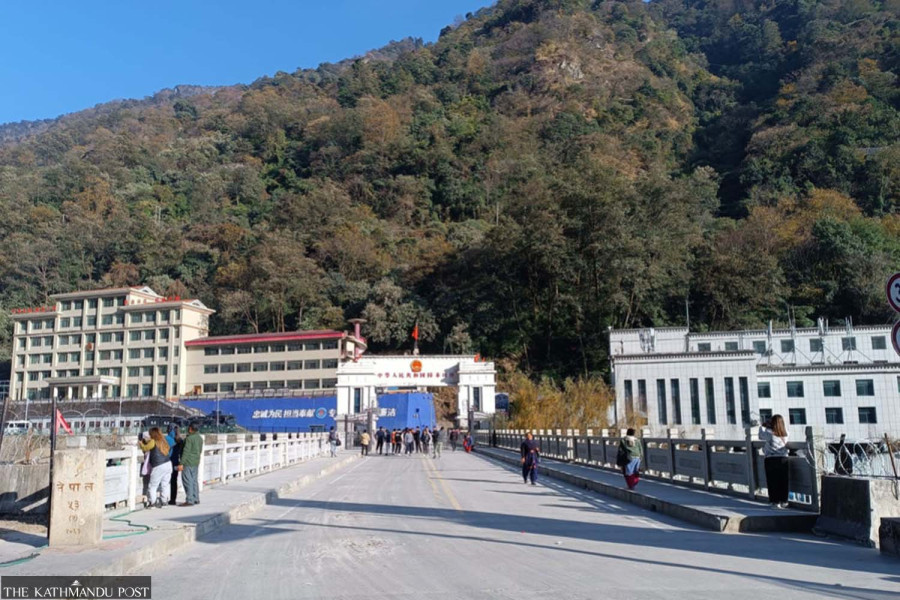
The latest shutdown has stranded more than 45 containers in China, while years of disruptions have caused heavy losses for traders and businesses. The border point had only recently resumed limited operations after remaining shut for nearly three weeks in August as landslides repeatedly blocked the Araniko Highway. Post File Photo
The Tatopani border crossing, once the largest international port between Nepal and China, has been shut for commercial traffic again for an indefinite period.
The latest closure, imposed on August 29 following the Rasuwa floods, has once again disrupted businesses and communities on both sides of the border, as closures following the 2015 earthquake and during the Covid pandemic did before it.
Before the devastating Bhotekoshi floods, Nepal conducted trade with China through three northern crossings—Tatopani, Rasuwa and Korala. The floods then caused extensive damage in Rasuwa and Nuwakot, including the destruction of customs, immigration and police facilities in Timure, further disrupting trade through the northern border.
Tatopani, which links Kathmandu with Khasa in Tibet, is geographically closer to the capital than Rasuwagadhi. The Kathmandu-Khasa distance is about 124 km, compared with roughly 164 km between Kathmandu and Rasuwagadhi. Traders say goods brought from Shigatse take 12 to 15 days to reach Kathmandu via Khasa. Shigatse is also about 30 km closer to Tatopani than to Rasuwagadhi.
Despite its geographic advantage, local representatives and traders say China’s handling of the Tatopani crossing has repeatedly fallen short of expectations.
Kumar Shrestha, ward 2 chair of Bhotekoshi Rural Municipality, said Nepali traders and residents of the border area have faced uncertainty over the crossing for years. They have raised questions over everything from the Chinese security and inspection gate installed in the middle of the Miteri Bridge to structures currently being built along the border.
“There have been instances of China closing it during earthquakes, the 2016 Bhotekoshi flood and the Covid pandemic, citing one reason or another. It feels as though China has been quietly pushing us around,” Shrestha said.
The 2015 earthquake and subsequent aftershocks devastated the area’s infrastructure. Houses collapsed, residents fled, and many people were killed after being trapped under rubble. The closure of the border by China during that emergency displaced many people living in the border area.
A flood in the Bhotekoshi river (in Sindhupalchok, different from the Bhotekoshi in Rasuwa) on July 5, 2016, further devastated Liping, a border market that had only begun recovering from the earthquake. A landslide at Chepsang, between Khasa and Kuti in Tibet, blocked the river and sent a flood downstream that washed away 80 homes in the area. Locals say the crossing was also closed at the time, even as people needed urgent assistance and rescue.
Since then, the crossing has been disrupted repeatedly. A monsoon landslide in 2017, the Covid pandemic and other incidents have all affected operations. In 2020, the local administration in Nyalam county advised people against conducting trade through Tatopani, citing the risk of the Kyanyong Lake, about 35 km above Khasa, and Chho Lake near Kerung bursting.
The crossing was also closed in January-February 2021 for repairs to the Miteri Bridge, followed by further disruptions caused by monsoon landslides, floods and other incidents, according to traders.
The Tatopani crossing was completely shut for nearly three weeks from mid-July after repeated landslides blocked the Araniko Highway, bringing cross-border trade with China to a halt. Limited traffic resumed in early August.
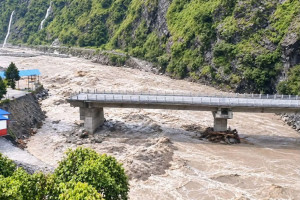
The situation deteriorated again after the devastating Bhotekoshi flood in Rasuwa on August 26. Three days later, China announced closure of the Tatopani crossing for both imports and exports until further notice, citing the risk of landslides on the Nepali side of the border.
The latest closure has left more than 45 containers carrying ready-made garments, machinery and other goods stranded in Nyalam and surrounding areas on the Chinese side, according to traders.
Sindhupalchok Chief District Officer Shashidhar Ghimire said the crossing remained open for tourists even though commercial customs operations had been suspended.
“The Chinese side again closed the Tatopani crossing until further notice after the Rasuwa floods,” Ghimire said. “There is uncertainty over when the crossing will reopen.”
The latest disruption is part of a longer pattern that traders say has imposed heavy financial losses on businesses dependent on the crossing.
During the winter of 2020-2021, snowfall in Khasa and Nyalam halted the movement of containers. Traders said apples and other goods transported in open trailers were left exposed to snow, causing them to rot or deteriorate and resulting in substantial financial losses.
The border was also closed twice during the pandemic and hundreds of containers were stranded on the Chinese side, leaving Nepali traders with losses running into millions of rupees.
Raj Kumar Basnet, former president of the Sindhupalchok Chamber of Commerce and Industry, said China had repeatedly shut the crossing citing earthquakes, floods, landslides, snowfall and the pandemic.
“There is a pattern of the border being closed whenever Nepal faces a problem and reopening only when conditions are favourable,” Basnet said.
After the 2015 earthquake, hundreds of containers carrying goods remained stranded for months along the Khasa-Tatopani road. Some were buried by landslides, while others were damaged by rainwater.
“Traders could not even easily reach their own goods,” Basnet said. “A lot of goods rotted or expired, and many traders were forced out of the business altogether.”
Four years after the 2015 earthquake, Tatopani was reopened only for imports into Nepal, but not for exports from Nepal to China. Traders say the crossing has never since returned to full capacity. Restrictions on the number of containers allowed to enter have continued to constrain trade.
According to trader Dorje Lama, exports from Tatopani to China have remained almost stalled since the Covid pandemic.
“Imports also face various problems, while exports have become almost non-existent,” Lama said.
The latest disruptions have also shifted more trade towards the Korala crossing in Mustang.
Rajesh Bhandari, an executive committee member of the Nepal Himalaya Trans-Border Commerce Association, said traders had increasingly turned to Korala after the flood devastated Rasuwagadhi and China closed Tatopani.
“But the situation there is also difficult,” Bhandari said. “The customs office has sent additional staff because of the increased workload, but quarantine services are being run from tents. Internet connectivity at the customs and quarantine facilities is also poor. We are fed up with these problems.”
Business groups have accused the government of failing to do enough to keep the northern trade routes operational. The Sindhupalchok Chamber of Commerce and Industry, the Nepal Himalaya Trans-Border Commerce Association and other business organisations recently issued a joint statement criticising what they called government neglect of the northern crossings.
They accused the government of focusing primarily on revenue collection rather than finding long-term solutions to facilitate trade.
“Traders have shifted to the Korala crossing,” said Buddha Raj Basnet, president of the Sindhupalchok Chamber of Commerce and Industry. “After the nearby crossing, which had only just reopened, was shut again by China, traders are fed up and losing large amounts of money every day. When will the government finally see our problem?”




 20.85°C Kathmandu