Domestic Airline Liability Bill set for Friday passage, proposes $100,000 passenger compensation
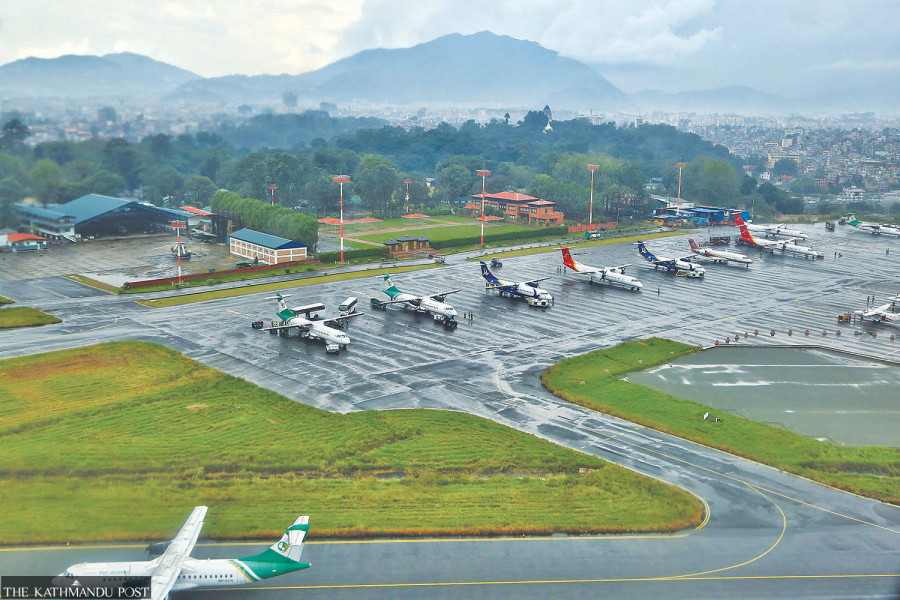
The bill, unanimously endorsed by a parliamentary committee and tabled in the National Assembly on Thursday, seeks to overhaul insurance provisions in Nepal’s domestic airline industry. Post file photo
The much-touted Domestic Airlines Liability Bill has moved closer to becoming law after the National Assembly’s Legislation Management Committee unanimously endorsed it on Thursday and tabled it in the upper house for approval.
The bill is expected to be passed by the National Assembly at its meeting on Friday after discussion, Krishna Bahadur Rokaya, chairperson of the Legislation Management Committee, told the Post.
The proposed law would require domestic airlines to pay up to $100,000 if a passenger suffers serious injury, disability or dies in an accident during boarding, a flight or disembarkation. The proposed ceiling is five times the current minimum compensation of $20,000 for passengers.
The bill was registered at the National Assembly on July 30.
Rokaya told lawmakers on Thursday that the committee discussed the bill extensively over five sittings before endorsing it. The committee has made some amendments to the draft, including a provision requiring airlines to publicly disclose their insurance coverage and a 120-day window for passengers or their families to file compensation claims following an accident or loss.
The bill also provides for penalties if airlines fail to settle claims within the stipulated period.
The legislation seeks to overhaul Nepal’s domestic aviation liability and insurance regime and bring the country’s aviation laws closer to international standards, years after Nepal ratified the Montreal Convention 1999.
Nepal became a party to the Montreal Convention on December 15, 2018. However, the country did not have a specific legal framework governing compensation and liability in the domestic airline industry.
The draft legislation was first prepared in 2019.
Although the Montreal Convention governs liability for international air travel, the proposed law seeks to bring Nepal’s domestic aviation liability framework closer to global norms by clearly defining airlines’ responsibilities in cases involving accidents, delays, baggage loss, and flight disruptions.
The bill establishes passengers’ rights and carriers’ obligations while introducing comprehensive provisions on compensation, cargo liability, insurance coverage, and circumstances under which airlines may be exempt from liability.
Under the proposed law, domestic airlines would be liable to pay up to $100,000 if a passenger suffers serious injury, disability or dies in an accident during boarding, the flight, or disembarkation. In the event of a passenger’s death, the compensation would be paid to the deceased’s nearest legal heir.
The minimum compensation for the death or injury of a passenger on a domestic flight in Nepal is currently $20,000. For crew members, the minimum compensation is typically $40,000 per person.
By comparison, the Montreal Convention currently sets airline liability at up to $202,500 for passenger death or injury on international flights. The liability limit was last revised on December 28, 2024.
The Montreal Convention follows a two-tier liability system. Under the first tier, airlines are strictly liable for proven damages up to $202,500 and cannot contest liability unless the passenger contributed to the injury. For damages exceeding that threshold, there is no upper limit. Airlines remain liable for the full amount unless they can prove that the accident did not result from their negligence or was caused solely by a third party.
The bill also requires airlines to provide necessary medical treatment to passengers who suffer non-fatal injuries or disabilities. In the event of a fatal accident, airlines must arrange for the return of the deceased’s body to the family and provide advance payments to cover immediate funeral and transportation expenses.
The legislation introduces specific obligations regarding flight delays and cancellations. Airlines would be required to notify passengers with valid tickets at least three hours before a revised departure time if a scheduled flight is delayed or cancelled.
If a flight is overbooked or a ticketed passenger cannot be accommodated, the airline must either arrange a seat on another carrier operating to the same destination at a similar time, provide an alternative means of travel at no additional cost, or issue an immediate full refund.
The draft also sets compensation limits for baggage loss and damage.
Airlines would be required to compensate passengers up to $20 per kilogram, subject to a maximum of $5,000, for lost or damaged checked baggage, with payments made in Nepali currency.
For unchecked baggage carried into the cabin, compensation of up to $400 would be payable for loss or damage.
The bill also covers cargo liability. Airlines would be liable for up to $20 per kilogram for lost or damaged cargo unless the shipper had declared a higher value in writing. Carriers would be responsible for losses arising from negligence by the airline, its employees or authorised agents.
The bill also requires compensation for delayed cargo deliveries. Cargo would be considered undelivered if it failed to arrive within three days when no delivery deadline had been agreed upon. It would be deemed officially lost if it were not delivered within 15 days of the scheduled date or within 30 days of acceptance where no delivery period had been specified.
The proposed legislation specifies situations in which airlines would not be held liable. These include delays or cancellations caused by adverse weather, natural disasters, airport or air traffic service disruptions, and security restrictions imposed by government authorities.
Similarly, airlines would not be liable if injuries resulted from a passenger’s gross negligence or a pre-existing medical condition, provided they could produce evidence to support the claim.
The bill also introduces provisions governing third-party liability arising from aircraft accidents.
It proposes mandatory insurance coverage based on aircraft weight, requiring $25 million for aircraft weighing up to 10,000 kilograms, $35 million for aircraft weighing between 10,001 and 35,000 kilograms, and $60 million for aircraft exceeding 35,000 kilograms.
Passengers seeking compensation for injuries or medical expenses would have to file claims with the airline or its authorised agent within 120 days along with required documents.
If the airline rejects the claim, the passenger would be entitled to file a lawsuit in the appropriate court within 35 days of receiving the airline’s decision.
The draft also introduces the principle of unlimited liability in certain cases. Compensation for injuries or disabilities would be determined according to the severity of the harm, the loss of income, and the long-term impact on the victim’s earning capacity.
The government would also be required to review compensation limits every five years and adjust them to account for inflation and prevailing market conditions. Any revisions would have to be published in the Nepal Gazette, the government’s official publication of laws and notices.
Sangam Prasain is Business Editor at The Kathmandu Post, covering tourism, agriculture, mountaineering, aviation, infrastructure and other economic affairs. He joined The Kathmandu Post in October 2009.




 18.18°C Kathmandu