



 22.73°C Kathmandu

Thu, Oct 22, 2026
National
China proposes upgrading Korala as international trading point as Nepal insists on Tatopani reopening
Nepali authorities have requested the Chinese side to reopen Tatopani urgently to allow for merchandise from the north to reach Kathmandu for the festivals.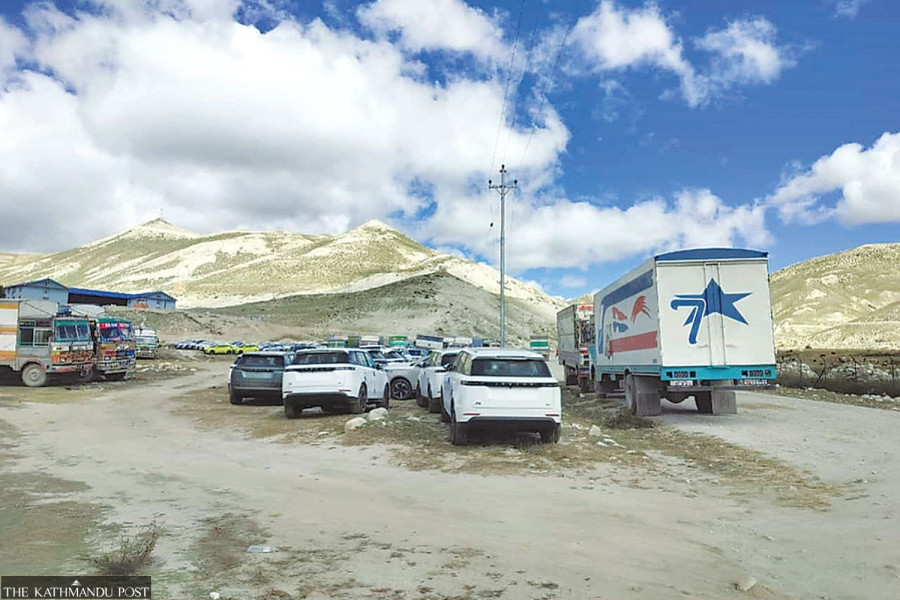
bookmark
Anil Giri
Published at : October 1, 2026
Updated at : October 1, 2026 20:35
Kathmandu
A flash flood in the Bhotekoshi river on August 26 swept away the Kerung-Rasuwagadhi border crossing, the only all-weather trading route between Nepal and China at the time of the disaster.
Almost all infrastructure on the Nepali side, including roads, bridges and buildings in Timure Bazar, was destroyed. With Nepal’s three major trading points with China affected by floods and landslides, officials on both sides are now looking for viable alternatives and reassessing the country’s northern transit corridors.
The disruption has assumed greater urgency with the major festivals of Dashain and Tihar approaching, as prolonged closure of the border points could disrupt imports and push up consumer prices.
Kerung had acquired particular importance after China upgraded the crossing to an international border point in August 2017, with the aim of developing it into a major trade gateway linking China with South Asia. The devastating flood has now disrupted that plan and prompted Beijing to explore alternatives, including Korala in Mustang.
“The Chinese have proposed to us the development of Korala as an international border point,” Laxmi Niraula, Nepal’s consul general in Lhasa, told the Post over the phone.
“Since the Tatopani crossing has also become an on-and-off route due to difficult geographical terrain, frequent floods and landslides, they have identified Korala as another viable option to develop as an international border point.”
An international border point allows the movement of both goods and people.
China began discouraging the use of Tatopani after the 2015 earthquakes and instead promoted Korala, according to Rabi Saiju, a former joint secretary who was closely involved in several rounds of Nepal-China trade and transit negotiations.
“That is why it is natural that the Chinese would push for the development of Korala, but it has multiple issues,” said Saiju.
Following the 2015 earthquake, China also restricted cargo movement through Tatopani. Although the crossing continued to handle limited cargo, movement of people was not permitted. Until the recent flood, Kerung-Rasuwagadhi was the main northern crossing through which both goods and people could move.
“Sooner or later, the Chinese will develop the Kerung border point because they have invested heavily on their side of the border. But in the winter season, it is difficult to trade via Korala. So it is a seasonal trading point, which is not feasible for us,” Saiju said.
“Second, transportation costs and logistics through this route are almost double those of Tatopani and Kerung. Why should we allow goods to come through a route that makes them more expensive?” he said.
Niraula said Nepal could seek Chinese assistance to develop the necessary infrastructure at Korala, but the crossing would still face significant seasonal constraints.
“If we make requests through diplomatic channels, the Chinese will develop infrastructure on both sides. But it is not an all-weather crossing point like Kerung-Rasuwagadhi and Tatopani,” Niraula said.
“The border point is also affected by snowfall for at least three to four months, during which bilateral trade would be significantly affected,” he said.
Following the closure of the Tatopani crossing after the Bhotekoshi floods, Chinese authorities diverted some goods bound for Nepal towards the Korala crossing in Mustang.
Trade between Nepal and China has largely come to a standstill after the closure of the northern border crossings.
With Dashain and Tihar approaching, the government has stepped up efforts to reopen the crossings, particularly Tatopani, as traders have been forced to reroute Chinese imports through sea routes accessed via India, causing delays and additional costs.
“We have told the local Tibetan government that snowfall at Korala can block the road, that landslides have already blocked roads at various locations, and that the Tatopani border crossing is the more convenient alternative,” Niraula said.
“They have responded that they will convey this proposal to Beijing,” he said.
Niraula said Nepal had also communicated to the Tibet Autonomous Region government that there were no major obstacles on the Nepali side that would prevent the reopening of the Tatopani crossing.
“For now, Tatopani is the most suitable border crossing. We are making vigorous efforts to bring it back into operation,” he said.
Chinese officials have also indicated that there would be no major problem operating the Tatopani crossing if the road on the Nepali side is in good condition.
A joint Nepali-Chinese team inspected the Tatopani crossing on Monday to assess the situation on the ground. Nepali officials subsequently informed their Chinese counterparts that the road was operational and that blockages at several locations had already been cleared.
A Department of Roads official who was part of the field visit said there were only minor landslides at some locations along the Araniko Highway and no immediate indication of recurring major landslides along the route.
The fourth phase of upgrading the Dhulikhel-Tatopani road is also under way with Chinese government support.
The private sector has also urged China to reopen the Tatopani crossing without delay. The issue was raised during a recent meeting between Anjan Shrestha, president of the Federation of Nepalese Chambers of Commerce and Industry, and Chinese Ambassador Zhang Maoming.
As alternatives to Kerung-Rasuwagadhi and Tatopani, Nepal and China have agreed to develop additional trading points, including Korala, Hilsa and Kimathanka.
However, trade through Hilsa and Kimathanka remains constrained by inadequate infrastructure on the Nepali side.
“Kimathanka is a good option,” Niraula said.
“On Hilsa, besides infrastructure bottlenecks, snowfall is also an issue. From the logistics perspective, it is another difficult terrain,” he said.
Nepal has already proposed constructing an integrated check post and inland container depot at Korala. However, there has been little progress so far, according to a Nepali official.
“Our effort is to resume trade via Tatopani, which is comparatively stable and has fewer problems related to snowfall and logistics, including customs, immigration and security,” the official said.
The joint Nepali-Chinese team that inspected Tatopani on Monday included Foreign Ministry Joint Secretary Ramkaji Khadka and officials from the Ministry of Finance and the Department of Roads, along with officials from the Chinese Embassy.
The team visited the crossing to assess the possibility of reopening it ahead of Dashain and Tihar and before the onset of winter.
A similar team is expected to visit Korala next week to assess the ground situation and the existing infrastructure, according to officials. The date has yet to be finalised.
China abruptly closed the Tatopani crossing several days after the Bhotekoshi flood, without publicly providing a reason. Nepal has since been pressing Beijing to reopen the crossing as traders have been forced to route goods through longer and more expensive alternatives.
“We are expecting a positive response from the Chinese side as we have already made a request for reopening the Tatopani border,” a foreign ministry official said.
“Since there is a week-long holiday in China and the decision has to be taken in Beijing itself, we have to wait a few more days,” the official said.
According to Nepali officials, the main obstruction to transportation at present is on the Nepali side rather than the Chinese side.
During Monday’s field visit, officials from various agencies discussed ways to ease transportation by removing sporadic blockages along the Nepali section of the highway.
“There are no major problems for trucks to pass through our territory, at least for now, if there is no further rainfall,” an official who participated in the field visit said.
“Based on this conclusion, we have requested the Chinese side to reopen the Tatopani border as soon as possible so that the transportation of goods, particularly food and fruits coming from China, does not face further delays,” the official said.
Any prolonged delay could result in deterioration of perishable food and fruit items in transit, officials said.
According to Saiju, China is likely to continue developing Kerung in the long term, given its strategic investment and the broader objective of connecting the Chinese market with South Asia.
“After the 2015 earthquake, the Chinese started moving westward and decided to slow down movement through Tatopani and give priority to Korala. But we have a sentimental attachment to Tatopani because it is the first border point with China linked by road,” Saiju said.
“So we requested them not to shut it. Then they opened it for limited cargo facilities but did not allow people to cross,” he said.
Since Korala is effectively unusable for several months during winter, Nepal should focus on fully reopening Tatopani, said Saiju, who was involved in negotiating the Trade and Transit Agreement with China in 2016.
“We have to press them,” he said.
During multiple rounds of negotiations with Chinese officials, Saiju said Nepali officials had found that the proposed Nepal-China cross-border railway, for which the final feasibility study has been completed, was being considered in the broader context of access to India and Bangladesh.
“They are looking at the South Asian market by bringing the railway via Nepal,” Saiju said. “So sooner or later, the Chinese will develop Kerung.”
“But our focus should be on building robust infrastructure on our side. We have to invest in our infrastructure keeping in mind the vulnerability to natural disasters. We should not always rely on others,” he said.
“We have to develop the infrastructure, we have to invest in it, and we should also look into the economic aspects of the infrastructure. Our infrastructure should be resilient, but it should also contribute to and translate into economic opportunities,” Saiju added.
Anil Giri
Anil Giri is a Chief Sub Editor covering diplomacy, international relations and national politics for The Kathmandu Post. Giri has been working as a journalist for more than two decades, contributing to numerous national and international media outlets.


Most Read from National

Flood sweeps away houses, bridges in Gorkha

What to know about the US trial over Mamta Kafle’s disappearance

Torrent of black mud and rocks engulfs settlements along Budhigandaki

From blankets to handmade dolls, two foreign women bring comfort to flood survivors

Budhi Gandaki flood washes away three bridges in Gorkha
Editor's Picks




E-PAPER | October 22, 2026

×