Palpa’s Dhaka cloth weaves its way from festive gifts to tourist keepsakes
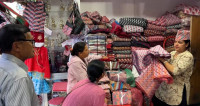
Growing demand for Dhaka products as gifts for brothers and relatives during Tihar is helping sustain a traditional craft that embodies Nepal’s cultural identity, even as local production and employment decline. The practice of buying Dhaka products as gifts has been gaining popularity among domestic and foreign tourists visiting Palpa, contributing to rising sales. During Tihar, the demand is particularly strong. Madhav Aryal/TKP
Bindu Dhakal of Tansen Municipality-1 bought several Dhaka products, including traditional caps, shawls, blouses and handbags, to give as gifts during Tihar. She also regularly sends Dhaka-made items to relatives as presents. This year, too, she chose products made from the traditional Palpali fabric for her brothers.
“I always choose Dhaka products as gifts,” she said. “In the past, there were mainly blouses, caps and shawls. Now, a much wider range of Dhaka products is available.”
Tara Bahadur Pun Magar, who had travelled to Palpa from Baglung, also bought a variety of products made from Dhaka fabric. His purchases included caps, shawls, waistcoats, blouse fabric and handbags. He said he visits Tansen every year during Tihar to buy Dhaka products before travelling to Rupandehi, where his sister lives, to receive tika from her.
“Rather than spending time thinking about what to give my sisters, I simply take them products made from Dhaka,” he said. He also sends such gifts to friends living abroad and encourages visitors to Palpa to buy Dhaka products.
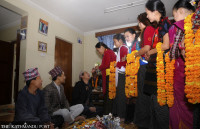
The practice of buying Dhaka products as gifts has been gaining popularity among domestic and foreign tourists visiting Palpa, contributing to rising sales. During Tihar, the demand is particularly strong. Alongside the Newar community's Mha Puja and the Hindu festival of Bhai Tika, sisters give their brothers seven-coloured tika and marigold garlands, often accompanied by a traditional Dhaka cap.
The gift does more than adorn a brother's head. It also represents Nepali identity and a sense of attachment to Palpali Dhaka, a traditional textile associated with the district.
As a result, Tansen's markets become busier during Tihar, with customers looking for Dhaka caps, blouses and other products, said Sita Bhandari, a trader in Silkhantol.
Sales of Palpali Dhaka generally pick up after Dashain and remain strong until Tihar.
“Business is better during Dashain and Tihar than at other times of the year,” she said. Some customers now specifically seek handwoven Dhaka products, although many prioritise buying something as a gift over the quality of the fabric, she added.
Another trader, Gyanu Karki, said demand for caps, blouses, shawls, handkerchiefs, purses, waistcoats, bags and ties had increased. She also runs the Karki Dhaka Kapada Udhyog, whose products are sold in the local market.
Manojraj Sharma Poudyal, proprietor of Poudyal Dhaka Kapada Udhyog in Barudkhan, Tansen-4, said customers increasingly preferred handwoven Dhaka products.
“I have noticed a rise in customers looking for handwoven Dhaka fabric,” he said. “Alongside caps and blouses, people are increasingly buying various products made from Dhaka as gifts.”
Shops selling Dhaka products in Tansen begin receiving more customers from Dashain onwards. Sisters visit the shops to select good-quality caps for their brothers. The growing number of domestic tourists buying Dhaka products as souvenirs and gifts has also boosted sales, said trader Rajesh Bhattarai.
Hari Rayamajhi, proprietor of Saraswati Dhaka Kapada Udhyog, said sales of Dhaka products were particularly good during Tihar. Demand for caps, shawls, handkerchiefs, purses, waistcoats and bags rises during the festival, he said. The increase in domestic tourist arrivals after Dashain has also helped business.
“Dhaka products sell throughout the year, not just during Tihar,” he said.
According to Rayamajhi, both domestic and foreign tourists buy Dhaka products as gifts. Business has been somewhat affected this year by the Bhotekoshi floods, although wholesale and retail transactions have remained fairly good since Dashain.
Schools, cooperatives, organisations and local government offices also purchase Dhaka products. Prem Karki of Swadeshi Vastra Kala Bikri Bhandar said sales increased as visiting groups often bought the products during their trips to Palpa.
A declining traditional industry
The history of Dhaka production in Palpa dates back to 2015 BS (1958-59), when Ganeshman Maharjan, husband of Purnamaya Maharjan, brought a handloom to Tansen and began weaving the fabric there.
Now 88, Purnamaya has been associated with the Dhaka industry since its early days.
“Palpali Dhaka caps used to carry much greater significance,” she said. “During the Panchayat era, wearing Dhaka caps was extremely common.”
She said production of Palpali Dhaka had declined over the years. She has also long complained that fabric produced elsewhere is being sold in the market under the Palpali Dhaka label, undermining the identity of the original product.
Sagar Man Maharjan, ward chairman of Tansen Municipality-6, said the Palpali Dhaka cap was closely associated with Nepali identity. Demand for the fabric extends beyond cities across Nepal, with buyers also seeking it abroad.
Palpali Dhaka products are supplied not only within the district but also to Kathmandu, Pokhara, Butwal, Narayangadh, Bhairahawa, Dang and Bhaktapur, among other cities.
At one time, Dhaka production was one of Palpa's major industries and provided employment to more than 10,000 people. The number of people working in the sector has since fallen sharply.
According to the Cottage and Small Industries Office, only around 1,000 people are currently employed in the Dhaka industry. More than 24 Dhaka industries are operating in Palpa, while over 200 women earn an income by weaving the fabric on handlooms installed in their homes.
The Palpali Dhaka Industry Association estimates the sector's annual turnover at at least Rs100 million. However, only nine industries have registered as members of the association.
Despite growing demand for handwoven Dhaka products, production and employment have not returned to their former levels. Business operators say Palpali Dhaka is struggling to compete with fabric produced in eastern Nepal and areas near the Indian border, which has captured a share of the market.
They also warn that products manufactured elsewhere are being sold using the Palpali name and identity, creating an additional challenge for preserving the authenticity and reputation of the district's traditional textile.




 21.12°C Kathmandu