Nepal’s EU air safety delisting plan at risk as aviation bills stall
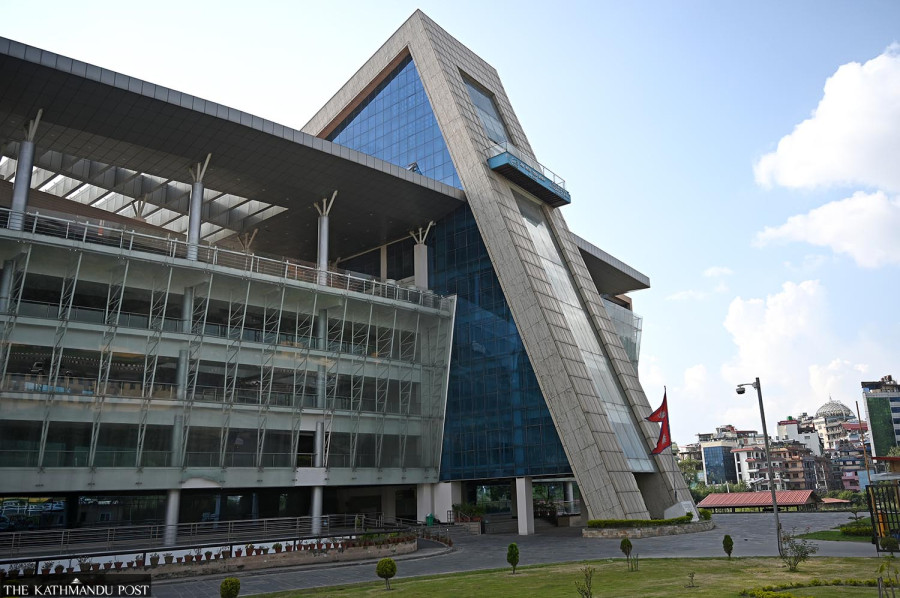
The delay in forwarding two bills to split aviation regulation from service provisions has jeopardised the government’s mid-January 2027 target to get Nepal off the European Commission’s air safety list. The office of the Civil Aviation Authority of Nepal, opposite the Tribhuvan International Airport gate at Sinamangal, Kathmandu. Angad Dhakal/TKP
Nepal’s plan to get off the European Commission’s Air Safety List by mid-January 2027 is at risk after two crucial bills aimed at ending the conflict of interest in the country’s civil aviation system reached the lower house of Parliament only a few hours before it was prorogued on Friday.
The delay in passing the bills has put the government’s own timeline for getting Nepal removed from the European Union’s air safety list in jeopardy.
Finance Minister Swarnim Wagle, while presenting the budget on May 30, had set a mid-January 2027 deadline for splitting the Civil Aviation Authority of Nepal into separate regulatory and service-provider entities. Successive governments have included the reform in their budgets, but none has implemented it. This was the first time the Balendra Shah administration had set a specific deadline.
Nepal has remained on the European Union’s air safety list since December 2013 because of shortcomings in aviation safety oversight, a measure that has affected the country’s travel and tourism industry.
According to an official at the Ministry of Culture, Tourism and Civil Aviation, the Civil Aviation Authority of Nepal Bill and the Air Service Authority of Nepal Bill were approved by the finance ministry and sent to the Law Ministry nearly two months ago.
“Now that Parliament has been prorogued, we have to wait for the next session in winter to get the bills discussed and passed. There is no possibility for Nepal to get out of the air safety list as per the plan announced in the budget,” the official said.
The delay is significant because Nepal plans to invite the International Civil Aviation Organisation’s Universal Safety Oversight Audit Programme, or USOAP, in May next year.
The audit assesses a country’s ability to provide effective and consistent safety oversight by examining whether it has implemented the critical elements of a safety oversight system.
According to officials at the Civil Aviation Authority of Nepal, the country must finalise and “freeze” its legal and regulatory documents six months before the audit. The documents will then be reviewed by the ICAO mission to assess Nepal’s progress.
“As Nepal has not passed the bills, the audit will study the old legislation and other documents,” the officials said. “This means no progress, which means Nepal’s plan to get out of the air safety list by mid-January will remain unattainable.”
According to ICAO requirements, countries must completely revise and “freeze” their relevant legal and regulatory documents six months before an audit. The period is known in aviation as the “freeze period”.
Four to six months before an audit, countries are also required to upload updated civil aviation regulations, procedural guidelines and self-assessment checklists to ICAO’s Online Framework.
ICAO auditors review these documents before conducting an on-site inspection. Changes made after the documents are frozen can affect the audit plan and make it harder to demonstrate that new rules have been implemented in practice.
ICAO also requires records and evidence showing that the rules have been implemented for a period before the audit. Once key documents have been submitted, the civil aviation authority cannot make further amendments until the on-site audit is completed.
A top official at the civil aviation body, who wished to remain anonymous, said they plan to request an extension of Nepal’s audit.
“We have made progress in many areas. The implementation of the new laws—which envision separation of the regulatory and service-provider functions—will add new impetus to the audit. This will pave the way for the global aviation watchdog to remove Nepal from the air safety list,” the official said. “So, an extension of the ICAO audit is necessary.”
The European Commission also considers the ICAO audit an important source of information in assessing Nepal’s aviation safety oversight.
In 2022, the United Nations aviation watchdog formally asked Nepal to separate its civil aviation regulator from its service-provider functions. The institutional separation has been under discussion for nearly two decades.
The government first announced the proposal in its Three Year Interim Plan for 2007-08 to 2009-10. The plan said that, following a study on strengthening the civil aviation body as a service provider, airport operator and regulator, the government would consider implementing feasible recommendations from the report.
Since then, successive periodic plans, policies and annual budgets have prioritised separating the civil aviation body. The reform, however, has never been implemented.
ICAO said in its Nepal audit draft report that the separation was needed to “ensure a clear separation of authority between the service providers, operators and the regulatory authority”.
It was the first time ICAO had explicitly called for functional separation, making the reform a high-priority item in Nepal’s aviation safety agenda.
The Shah government had also promised aviation reforms amid a series of plane crashes.
Nepal has recorded 109 air crashes in its seven-decade aviation history, with aviation experts repeatedly pointing to regulatory shortcomings and delays in separating service provision from safety oversight.
Upon assuming office, Law, Justice and Parliamentary Affairs Minister Sobita Gautam pledged to accelerate the legislative process. Gautam was appointed on March 27 this year, and subsequently consulted ministries while prioritising the drafting of 45 bills, including the two civil aviation bills.
During her first stint as a lawmaker, Gautam had been among the strongest advocates for legislation to dismantle the civil aviation authority’s dual role as both aviation regulator and operator of airports and air navigation services.
“But the law ministry held the draft bills for two months, delaying their registration in Parliament,” according to officials at the civil aviation body.
In May, European Union Ambassador to Nepal Véronique Lorenzo said the EU and Nepal shared the objective of restoring confidence in Nepal’s aviation sector and that progress on safety reforms was necessary for Nepal to be removed from the EU list.
Speaking at a press meet during a visit by EU member states’ heads of mission to Nepal, Lorenzo said the new government had repeatedly raised the issue of the safety list.
“I have never been asked so many times about the air safety list as with the new government,” she said. “Every single minister, in every meeting we have, raises this issue, and I think this is great because it means there will be progress.”
Lorenzo, however, clarified that the EU had never specifically demanded that Nepal legislate a split between its aviation regulator and service provider.
“The European Union has never asked for a legislative change to split service provision from regulation,” she said. “What it has insisted upon is the independence of each function to avoid conflicts of interest.”
She said an assessment conducted in 2023 found that Nepal had not made sufficient progress to be removed from the safety list. The findings led Nepal’s civil aviation authorities to prepare a corrective action plan, but implementation has remained slow.
“Over the last two-and-a-half years, there has been hardly any progress under this corrective action plan, and this is what needs to be addressed,” Lorenzo said.
Under the proposed legislation, the Air Service Authority of Nepal would become a public institution responsible for operating, managing and developing airports, as well as providing air navigation and air traffic management services.
It would construct, upgrade and maintain airports and related infrastructure, prepare long-term development plans, introduce modern technologies, promote environmental sustainability and improve service delivery at domestic and international airports.
The chairperson of the authority will be an expert appointed by the government, while the joint secretaries of the Ministry of Culture, Tourism and Civil Aviation, the Ministry of Finance and the Ministry of Home Affairs will serve as ex-officio members.
In addition, the government will nominate two experts as members, including at least one woman, while the managing director will serve as the member-secretary.
To qualify for appointment as chairperson or a nominated member, a person must have completed a postgraduate degree and possess technical expertise in fields such as aviation, air traffic control, or airport construction or operation.
Although the authority itself will be responsible for the core operation and management of airports, the proposed law allows it, with government approval, to contract out services to government, non-government or private entities to make service delivery more effective.
In such arrangements, contracts may be awarded directly to government agencies, while private and non-government entities must be selected through a competitive process to ensure transparency.
If any suspicious activity is detected that could potentially obstruct flight operations, an authorised official of the authority may, after giving prior notice, enter another person’s private property in the presence of security personnel and a local representative.
However, if immediate action is required to prevent an accident or carry out emergency repairs, the official may enter the property at any time without prior notice, with a report to be submitted afterwards.
The managing director, who will serve as the chief executive of the authority, will be appointed through open competition on the recommendation of a selection committee led by the tourism ministry secretary. The candidate must hold a postgraduate degree and have at least 15 years of work experience in civil aviation. The term will be four years.
To ensure the authority can meet and manage its long-term financial obligations, all employees appointed after the law comes into force will be covered by a contributory pension system for their post-retirement benefits, in accordance with prevailing law.
When the existing Civil Aviation Authority of Nepal is divided into two bodies, its permanent employees will be adjusted into the new service-provider authority. Employees wishing to move to the regulatory body will have to apply within 60 days, and the ministry will make placements based on seniority and work performance, ensuring that their remuneration is not reduced.
Employees who cannot or do not wish to be adjusted may be offered voluntary retirement. If there is a shortage of technical employees, personnel from the civil service may also be deputed.
For the development and expansion of major infrastructure such as airports, the authority may, with government approval, enter into joint investments with domestic or foreign investors in accordance with a business plan. This provides broader financial authority for the construction and operation of airports through public, private or public-private partnerships.
The Civil Aviation Authority of Nepal will be the regulator. The minister for culture, tourism and civil aviation will serve as chairperson. The joint secretaries of the Ministry of Culture, Tourism and Civil Aviation and the Ministry of Finance will serve as members, while the director general of the authority performs the duties of member-secretary.
To guide a technical sector such as aviation, the government will nominate one expert as a member who has completed a postgraduate degree from a university and has at least 10 years of experience in an aviation-related field, such as flight operations, maintenance, air traffic control, aviation communications or airport operations.
The director general will function as the chief executive of the authority. The director general will be appointed on the recommendation of a selection committee from among gazetted first-class employees of the government or employees working at the 12th level of the authority. The director general will serve a four-year term and may be reappointed.
Sangam Prasain is Business Editor at The Kathmandu Post, covering tourism, agriculture, mountaineering, aviation, infrastructure and other economic affairs. He joined The Kathmandu Post in October 2009.




 18.61°C Kathmandu