Nisikhola flood-displaced move to relatives’ homes with resettlement uncertain
Over 300 residents face housing and educational crises in Baglung and Parbat following the late September flash floods and landslides along the Nisikhola and Kaligandaki rivers. More than 300 residents in Nisikhola have been directly affected, with five casualties reported in the area, including four members of a single family. Prakash Baral/TKP
The flood-displaced families in Nisikhola, Baglung, started moving to their relatives’ homes as their resettlement remains uncertain.
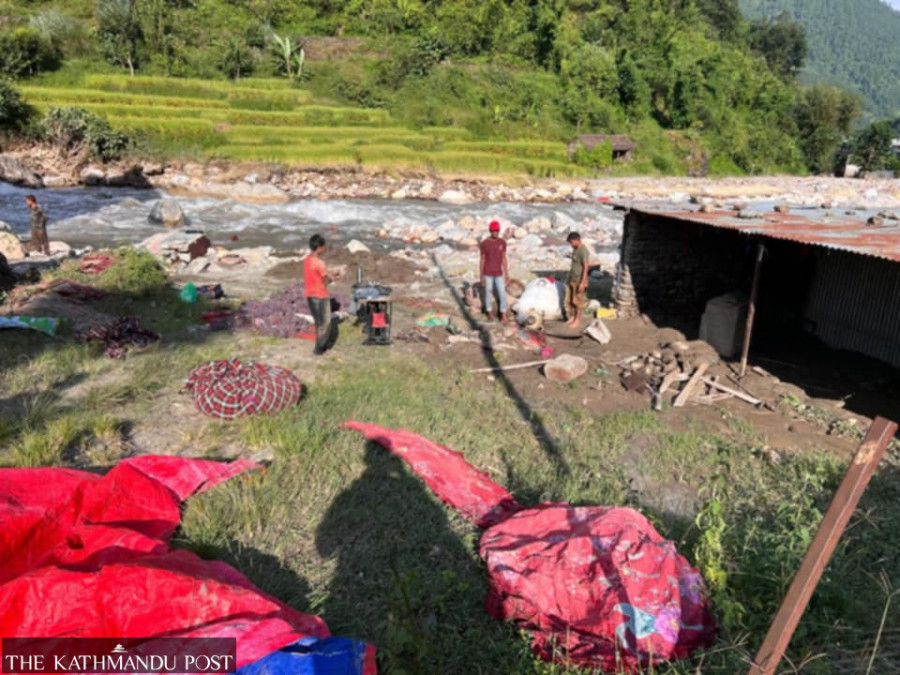
Sheltering in local schools and ward office buildings for days after catastrophic flash floods devastated the Jhiwakhola area, the displaced families have dispersed to seek refuge with relatives. The biggest Hindu festival of Dashain is around the corner but local authorities have yet to initiate concrete plans for their resettlement and rehabilitation.
The flood that struck Nisikhola Rural Municipality-4 early on September 27 wiped out 35 houses and rendered another 25 houses completely uninhabitable. More than 300 residents in the local unit have been directly affected, with five casualties reported in the area, including four members of a single family.
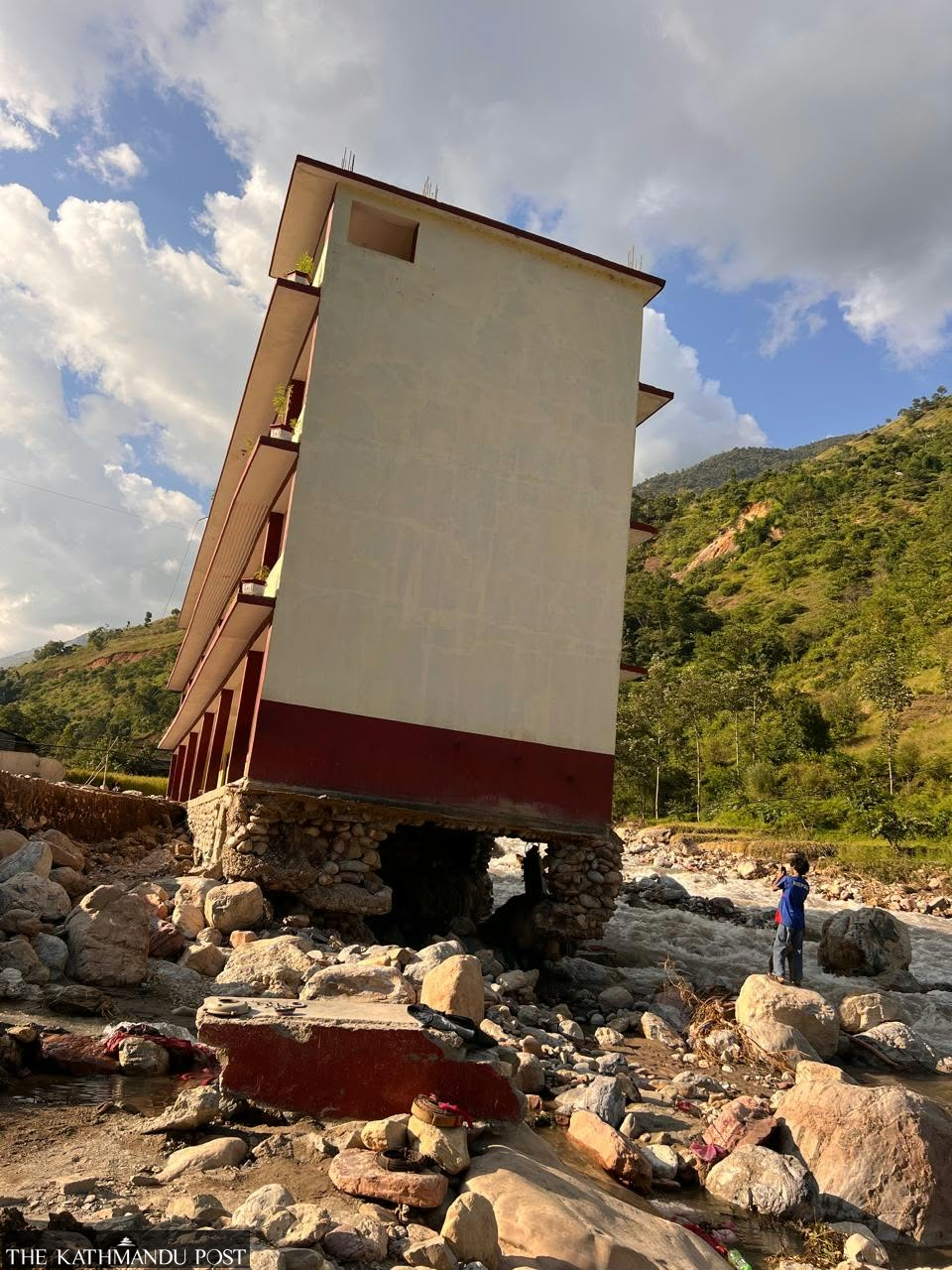
In Jhiwakhola, the main commercial hub of Nisikhola Rural Municipality situated around 120 kilometres west of the district headquarters, has been ruined by the floods. The concrete structure of Little Rose Boarding School stands severely damaged. Despite the onslaught, the school building remained upright, which locals credit with preventing even catastrophic destruction.
“If this building had collapsed, it would have blocked the river or diverted the main torrent directly into the market area, uprooting dozens more families,” said Tikanidhi Paudel, the war chair of Nisikhola-4.
“We are in a situation where we have to feel relieved that the damage was not even worse, but repairing this level of destruction will take years.”
Paudel added that limited budget allocations at the ward and rural municipal levels have made it difficult to manage even basic relief distribution and temporary shelter arrangements.
According to the District Disaster Management Committee (DDMC), the intensity of the flood escalated dramatically after a major landslide triggered on September 25 at Kanabaggar deposited debris into the river, swelling its flow with mud and boulders.
Chief District Officer in Baglung Krishna Prasad Acharya, who chairs the DDMC, stated that managing the aftermath in Nisikhola presents a severe challenge.
“We have collected statistics on damage from all district offices and forwarded our report to the central government,” said Acharya. “An integrated, multi-agency strategy is required for permanent relocation and structural recovery.”
The infrastructure damage across the district is yet to be assessed in full detail. Aside from private residences, the floods washed away three drinking water projects, two irrigation schemes, and two micro-hydropower plants, while heavily damaging the Area Police Office at Jhiwakhola.
According to Division Road Office Baglung Chief Hari Prasad Sharma, permanent restoration of the Baglung section of the Mid-Hill Highway alone will require an estimated Rs800 million.
Transport connections remain severely hit. The Maldhunga bridge over the Kaligandaki river, which links Baglung to the district headquarters and national road networks, suffered structural failure, cutting off vehicular movement.
Surya Bahadur Gharti, chairman of Nisikhola Rural Municipality, acknowledged that the local government is struggling to address the long-term housing crisis.
“With major national festivals approaching, these families have been left stranded. We have appealed directly to the Gandaki provincial government and the federal government for immediate financial and logistical intervention,” said Gharti.
Former rural municipality chair Taranath Poudel explained that displaced victims were initially housed at Janajibaraj Secondary School and Prabha Secondary School, where temporary food and lodging were arranged. Some groups, including the Karma Flights organisation and regional diaspora groups from Butwal and Kathmandu, have dispatched the first phase of relief materials.
“Because local markets in Jhiwakhola and Burtibang still have supplies, we are requesting donors to provide cash aid rather than shipping physical relief goods, which cannot easily cross the damaged bridge at Maldhunga,” Paudel said.
For many survivors along the riverbanks—including settlements in Nisikhola, Bhalkot, Jhiwakhola, Jhimpa, Kanabagar, and Jugjakhola—the destruction was instantaneous.
Little Rose Boarding School damaged by flooding in Jhibakhola, Nisi Khola Rural Municipality-4, Baglung. Prakash Baral/TKP
“We never imagined such a disaster would strike,” said Dil Kumari Regmi, a local resident who lost her property. “The flood wiped out our house, farmland, and belongings in seconds. With no home to sleep in and no land to stand on, we have effectively been turned into squatters.”
Regmi said that because residents had observed the landslide at Kanabagar two days prior, many remained vigilant and evacuated their homes during the night, avoiding a much higher human death toll.
Children in Parbat’s Lasti worried after floods sweep away books, stationery
The disaster’s impact extends into neighbouring Parbat district, where flooding along the Kaligandaki river swept through the settlement of Lasti in Jaljala Rural Municipality-8, leaving school children facing an uncertain academic future.
At Shiva Secondary School in Lasti, over 40 students lost their textbooks, school uniforms, and bags when floodwaters damaged their homes on the night of September 27.
Sulabh Thapa, a student at Shiva Secondary School, lost all his educational materials and household belongings. Following the passing of his father, his mother Bimala works as a daily wage labourer and is unable to purchase new books.
Similarly, Laxmi Malla Thapa, a teacher at the same school who is in her postpartum period, lost her home and farmland. She is currently taking shelter at a neighbour's house alongside her husband Arjun and their three sons.
“The examinations are approaching, but our books are gone,” said Diwas KC, a grade 10 student at the school. “Even when we go to the market, textbooks are out of stock in the middle of the academic session.”
While the government authorities and organisations have delivered grain sacks and tarpaulins to Lasti, local residents express concern that educational needs are being overlooked. Children including Diwas BK, Reman BK, Nikita Shah, Kritika Acharya, Bina KC, and Udaya BK have spent afternoons digging through sand and river debris at the site of their destroyed homes, searching in vain for missing textbooks.
Amrit Sapkota, the headmaster of Shiva Secondary School, confirmed that at least 35 students at the institution lost all their educational supplies.
“We are in the middle of the academic session, and procuring replacement textbooks is a major hurdle,” said Sapkota. “For these children, even losing a single pencil or eraser hampers their ability to resume learning.”
Sapkota added that while the school building itself suffered minor mud inundation, classes remain suspended out of consideration for displaced parents. “We plan to reopen by Monday at the latest, once we consult further with the guardians,” he said.
Commuting to the school has also become hazardous. A suspension bridge over the Kaligandaki river was swept away, forcing students and teachers traveling from Dhodeni in Baglung to take a two-hour detour instead of their usual five-minute walk.
Haribikas GC, ward chief of Jaljala-8, reported that the flood in Lasti destroyed 25 houses and buried another 46 under thick mud and debris. “Residents are staying with neighbours on higher ground because entering the ruins poses severe safety hazards,” said GC.
“Many have no alternative land holdings and are urging the government through the ward office to provide safe, permanent relocation options.”




 20.45°C Kathmandu
.jpg)