Nepal’s SAFF dream ends as Bangladesh reach third straight final
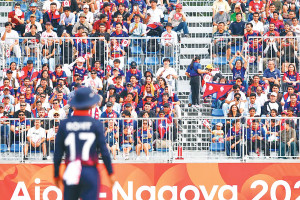
Bangladesh capitalise on a chaotic injury-time moment to secure a 2-1 semifinal victory over Nepal and keep their title defence alive. Bangladeshi players console Nepali players after defeating the hosts 2-1 in the final of the SAFF Women’s Championship at Dasharath Stadium in Kathmandu on October 30, 2024. Post File Photo
The last time Nepal were denied an entry to the final of the SAFF Women’s Championship was during the fourth edition hosted by India in Siliguri from December 26, 2016, to January 4, 2017. The second time was on Wednesday, when the South Asian tournament returned to India—only for the second time—for the eighth edition, which kicked off in Goa on May 25.
Nepal were knocked out of the semifinal on January 2, 2017, by India. They bowed out from the semifinal on Wednesday after losing 1-2 to Bangladesh.
Except for the two semifinal knockouts, Nepal have finished as the runner-up of the tournament in six editions, losing four times to India and twice to Bangladesh. And as it has been, Nepal women’s football team’s hunt for their maiden international title continues.
On the other hand, Bangladesh, fresh from a historic debut at the 2026 AFC Women’s Asian Cup in Australia in March, moved ahead for a SAFF Women’s Championship threepeat.
Winning the SAFF Women’s title in three consecutive editions sounds like a huge achievement. It is.
But the bars have been set higher in the tournament by India with a “five-peat”. India won the SAFF Women’s title successively from the first edition in 2010 to the fifth in 2019. And the last two—the sixth in 2022 and the seventh in 2024—have belonged to Bangladesh.
Nonetheless, despite establishing themselves as the powerhouse and champion of women’s football in South Asia for the past five years, the Bangladeshi team was said to be going through internal conflict after they arrived in Goa. It was a positive for Nepal as they were looking for areas to exploit against Bangladesh.
The rumours felt true when the match kicked off at the Jawaharlal Nehru Stadium. Bangladeshi players were not linking up. To make it clearer, Nepal had a chance to score the first goal in less than a minute.
With the clock nearing the first 40 seconds of the match, Saru Limbu would have scored with just a touch on the ball, which had bounced off a poor clearance from a Bangladeshi defender at the edge of the six-yard box. And the ball was secured by goalie Mile Akter, who was heroic with the gloves.
After the win, Bangladesh’s head coach Peter Butler accepted that the team was struggling of late as they were surrounded by controversies. “But I believed in my players. I knew they would perform when it mattered,” Butler said in the post-match press conference. “I knew the match against Nepal was going to be tough. But my team has the qualities to become the champions again.”
There was only one instance when Akter was dissatisfied with herself. It was in the 23rd minute when Gita Rana gave Nepal the lead. Rana had capitalised on a poor clearance from a Bangladeshi defender when she was at the opponent’s box for a corner kick.
Akter did not allow Nepal to score after that.
One of Akter’s best saves came in the 36th minute, when Nepal’s midfield maestro Preeti Rai, who had joined the squad after missing the group-stage fixtures, attempted a long-range shot. Akter managed a tipping save, pushing the ball just above the crossbar.
In turn, Bangladesh took a similar examination against Nepal’s goalkeeper Anjila Tumbapo Subba, who is also the captain, when the game was in injury time, and the first half was near its conclusion.
However, there was a slight change to the shot, as it came from the corner spot via Ritu Porna Chakma. Subba tried pushing the ball, which was curling in, but it reached the back of the net after kissing her fingertips.
It was a similar scenario for both Subba and Chakma. It was in the final of the 2024 SAFF Championship. The score was level (1-1). And in the 81st minute, left-footed Chakma attempted a cross from the left flank, but it curled outside, and Subba could not push it over the crossbar. It was the goal that made Bangladesh the defending champions.
On a high after equalising, Bangladeshi players seemed to have found their rhythm when they came in for the second half.
But Nepal were prepared too. Some minutes into the second half, Rekha Poudel was in a 1v1 situation with Akter. Poudel just pushed the ball towards the frame as Akter came forward, but the ball rebounded off the goalpost.
Akter also saved Bangladesh when Rai found Dipa Shahi in the penalty area with a long cross in the 90th minute.
Subba was also making some good saves—especially in the 78th minute—bouncing back off the earlier mistake.
With six minutes of added time, neither team wanted to take any risks. They were rather ready to decide the odds in penalties.
But with only a few minutes remaining, everything changed for Nepal when the heads of defenders Bimala BK and Hira Kumari Bhujel collided while clearing the ball in 90+3 minutes.
Other Nepali players paused for a brief moment, expecting the referee to blow the whistle and stop the play to attend to head injuries. FIFA laws instruct referees to stop play immediately for head injuries, as they could be serious.
However, the referee did not blow the whistle, and Bangladeshi players capitalised on it. A pass for Sagorika inside the six-yard box saw the ball get in with deflections off Puja Rana and Rai.
A couple of minutes passed as BK was moved out on a stretcher while Bhujel resumed with a bandage on her forehead. Similarly, there was time wasted by Bangladeshi players. As a result, the match was concluded after the end of 103 minutes.
“The referee should have stopped the play,” Nepal’s head coach Nabin Neupane said after the loss. “But they gave an advantage to Bangladesh. Something matters more than wins and losses in football, and it is the lives of the players.”
BK was rushed to Victor Hospital. “Doctors have suggested a surgery,” ANFA spokesperson Suresh Shah said. “The surgery will take place on Thursday.”
For Nepal, it was another painful chapter in a story that has repeated itself too often. As Bangladesh moved within one victory of a third consecutive SAFF title, Nepal were left to reflect on another missed opportunity and continue their long wait for a first major international trophy.
“Still, it was not the main reason that we lost. We could not score despite creating chances,” Neupane added. “Bangladesh had trained in Thailand for this tournament. They are investing in the team, and it is yielding results. The Nepali team expects the same from the stakeholders.”
Bangladesh are facing India, who defeated Bhutan in the other semifinal, for the title on Friday.




 23.39°C Kathmandu