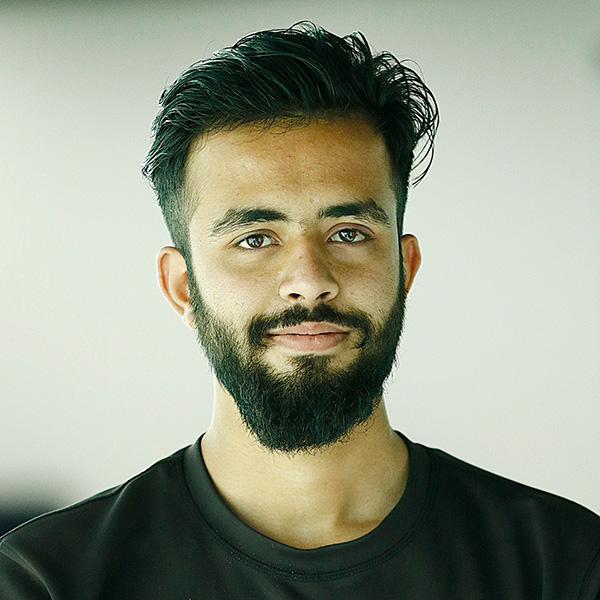
‘There is still fire in me’: How Abhishek Bastola is battling administrative neglect to keep Nepal’s tennis dream alive
Despite dominating domestic tennis for a decade, playing in the Davis Cup and many big tournaments, Abhishek Bastola continues to fund his own global journey as official support remains non-existent. Nepal’s top tennis player Abhishek Bastola (left) with 24-time Grand Slam champion Novak Djokovic when the legend was in California for the BNP Paribas Open-Men’s Singles in March last year. Courtesy of Abhishek Bastola’s Facebook
On October 25, 2023, while competing at the Davis Cup in Isa Town, Abhishek Bastola was battling more than just Qatar’s top player, Mubarak Alharrasi—he was also fighting a fever and a runny nose. Frequently reaching for his towel between points at the Bahrain Tennis Federation court, Bastola displayed remarkable grit to win the match in straight sets.
After a brief half-hour break—spent refueling on fruit he’d brought from his hotel—Bastola returned to the court, teaming up with Aki Zuben Rawat for a doubles match against Alharrasi and Rashed Nawaf. The physical toll finally caught up with him; as soon as the match ended, Bastola collapsed.
“I vomited all over my t-shirt,” Bastola recalls. He returned to his hotel to wash the poor-quality garment himself, as it was one of only two he had for the entire tournament. “I had to wear that same shirt for my match the next day.”
Bastola and Rawat were then accompanied by Pradip Khadka and Ritik Rana. It was the first time that Nepal participated in the Davis Cup, dubbed the World Cup of tennis, organised annually by World Tennis.
The following day, Nepal faced Yemen, where Bastola swept aside then-Yemen No 1 Ghassan Al-Ansi in straight sets. He maintained his momentum throughout the tournament, overcoming a second-set stumble to defeat Abdulla Faaih Fazeel—the Maldives’ top-ranked player—on October 28, 2023.
There are currently 160 countries in the Davis Cup. The countries have been divided into five groups—Groups I and II consist of top countries, while those in Groups III, IV and V fall in the lower levels.
Nepal competed in Group V during their 2023 debut. With three singles victories that year and a matching performance in 2024—defeating top players from Guam, Brunei, and hosts Bahrain—Bastola was instrumental in securing Nepal’s promotion to Group IV.
Despite his pivotal role, Bastola was surprisingly excluded from the national squad last year. In his absence, Nepal failed to win a single match and was promptly relegated back to Group V.
“I don’t know the exact reason for my exclusion last year,” Bastola says with a wry grin from his current training base in China. “But one thing was certain: the Nepal Tennis Association didn’t want me on that team.”
For Bastola, this exclusion was not a new experience. Rather, it was a familiar disappointment for an athlete long accustomed to being denied both institutional support and professional opportunities.
“I have been participating in global events without a single penny—either from the state or the NTA,” Bastola, who has represented Nepal in over 20 countries, told the Post during a phone interview following his Friday evening training session. “Neither my travel, accommodation nor gear have been supported… In fact, the only official recognition I received at home after my historic Davis Cup victories was a Thakali dinner.”
Bastola is currently in Tianjin, China, for an event under the Men’s World Tennis Tour. Bastola is the only Nepali to be playing in the tour of World Tennis, the global governing body of tennis formerly known as the International Tennis Federation (ITF). He has an ITF Ranking of 1,270.
To qualify for the UTR Pro Tennis Tour, a player must rank among the top 3,000 globally. And Bastola is the only Nepali to fall under the standards to date.
His first serve
Bastola, now 28, first picked up a racket as a young child in his hometown of Pokhara. He began by following his father to the local courts, where the elder Bastola played the sport recreationally.
Yet, his passion for the sport wasn’t immediate.
“I was quite good at cricket and now feel I could have excelled in almost any sport I chose,” says Bastola, reflecting on his naturally athletic childhood. “But I found solace in tennis because of its steep learning curve. It’s far more demanding than it looks—you have to maintain absolute focus and grind through matches for hours.”
That dedication paid off quickly. By age 15, Bastola was already dominating Nepal’s domestic circuit, and by 17, he was representing his country on the international stage at the 2014 Asian Games in Incheon, South Korea.
“It may be because my parents were athletes themselves that they have done everything they can, and even beyond, to help me fulfil my hunger in tennis,” Bastola said. “They are the only ones who made me what I am today. I remember my father allowing me to do wall practice at our garage when I was a child.”
His parents, Anuj Kumar Bastola and Padma Bastola, were former national badminton players who met and fell in love on the badminton court before getting married.
To the US
By the end of his adolescence, Bastola had outgrown the domestic circuit. He was practically unbeatable at home, yet he found himself at a crossroads, yearning for a challenge that could match his ambition. This search for higher-level competition eventually led him to the United States in 2018.
His early success, including representing Nepal at the 2014 Asian Games in Incheon at just 17, paved the way for his next chapter. These accolades earned him a full scholarship to Saint Mary’s College of California, where he balanced the rigors of academia and elite sport, graduating with a degree in Business Administration in 2020.
“I competed in the NCAA Division 1 for college,” he says. “It is the highest level of competitive college athletics in the United States.”
For the past six years, Bastola has been striving to establish himself as a full-time touring professional, yet the climb to profitability in pro tennis remains brutal.
“It is virtually impossible to earn a proper livelihood from tennis unless you are ranked in the world’s top 100,” Bastola explains. “When millions are competing globally, reaching that bracket is extremely tough.”
Opportunities and support denied
Bastola vividly recalls the stinging frustration surrounding the 2019 South Asian Games, an event Nepal was preparing to host on home soil.
“I was in Kathmandu then. And I wanted to compete at the South Asian level as a medal was in sight,” he remembers. “But I had to play the qualifier, which I would have easily won. The qualifier was not organised unless I was in Nepal. It was organised once I reached the US.”
Bastola alleges that the NTA intentionally manipulated the schedule to block his participation. “It was a deliberate move to make way for someone else—that is simply how sports administration functions in Nepal,” he adds.
He was equally devastated when he was not taken to the Davis Cup last year.
And a similar scenario was about to repeat this year as well. “I was almost denied a spot in the 20th Asian Games taking place in Japan in September,” he says.
Undefeated on domestic courts for nearly a decade, Bastola qualified as Nepal’s No 1 at the 18th and 19th Asian Games in 2018 and 2023, respectively. But he had to fight off the court to get a slot for the 20th edition.
“The NTA asked me to return to Nepal to play selection trials to be eligible for the 20th Asian Games. I declined because it would have been a waste of critical time and training,” Bastola said. “I am competing globally—in fact, I am the only Nepali tennis player doing so—and there is no one in Nepal who can beat me. When I asked if the NTA would cover my travel expenses for trials, they refused.”
Unwilling to miss the Asian Games, Bastola took his case directly to senior national sports authorities, explaining his situation and track record. Officials eventually exempted him from flying back for trials. And he is currently spending out of his pocket to participate in the events in India and China, all so that he can reach Japan at his current peak and put up a good fight against far better opponents.
“The association [NTA] has always worked for the benefit of the players. Abhishek is no exception,” says Manohar Das Mool, who was elected as the president last year. “We know how good of a player Abhishek is. But he also needs to follow the rules. If we had any problems with him—despite him keeping accusing the association—why would we be taking him to the upcoming Asian Games?”
Regarding further support, the association gets a Rs300,000 budget annually from the National Sports Council, Mool says. “What can we do with that amount?” he questions. “We hope Abhishek keeps growing as we want him and all our players reach greater heights and we have been trying it by managing extra resources and funds.”
The dream of playing at a Grand Slam
Currently, world’s No 1 Jannik Sinner has the highest Universal Tennis Rating (UTR Rating) of 16.40 among pro men, followed by Carlos Alcaraz (16.31) and Alexander Zverev (16.15).
In the UTR Rating, all players are rated on the same 1.00-16.50 point global scale based on daily match results. Bastola has a UTR Rating of 12.07.
“The UTR Rating is the best way to measure yourself against all other players regardless of their age or skill level,” says Novak Djokovic, a 24-time Grand Slam champion.
Bastola has also traded shots on court with Djokovic when the legend was in California for the BNP Paribas Open-Men’s Singles in March 2025. “I was then recruited as a hitting partner for the participating players like Djokovic to train,” he recalls with a sense of big achievement. “I felt extremely lucky then. I also met Alcaraz then. And I am glad I could click pictures with them.”
Meeting Djokovic and Alcaraz firsthand only reinforced Bastola’s ambitions.
“I have always aimed to compete at the highest levels, but meeting two of the best in the game gave me extra motivation,” he said. “Still, I constantly wonder how far I can realistically reach while doing this all on my own.”
For Bastola, the ultimate goal remains qualifying for Grand Slam main draws—the Australian Open, Roland Garros, Wimbledon and the US Open.
Asked what it would take for him to reach those heights and put Nepal firmly on the global tennis map, Bastola pointed to administrative reform: the national association needs leadership driven by authentic passion for the game and real investment in player development.
“I always speak up when I feel there is something wrong. And it has only backfired in terms of the support and recognition I deserve,” Bastola told the Post. “But I won’t change. I will keep moving forward to becoming the best player I can. There is still a lot of fire in me.”
Nayak Paudel covers sports for The Kathmandu Post. He previously worked at the Post (2018–19) and spent over five years at The Rising Nepal. His reporting spans crime, health, education, and social issues.




 20.12°C Kathmandu