Ani Choying’s new role brings old controversies to the fore
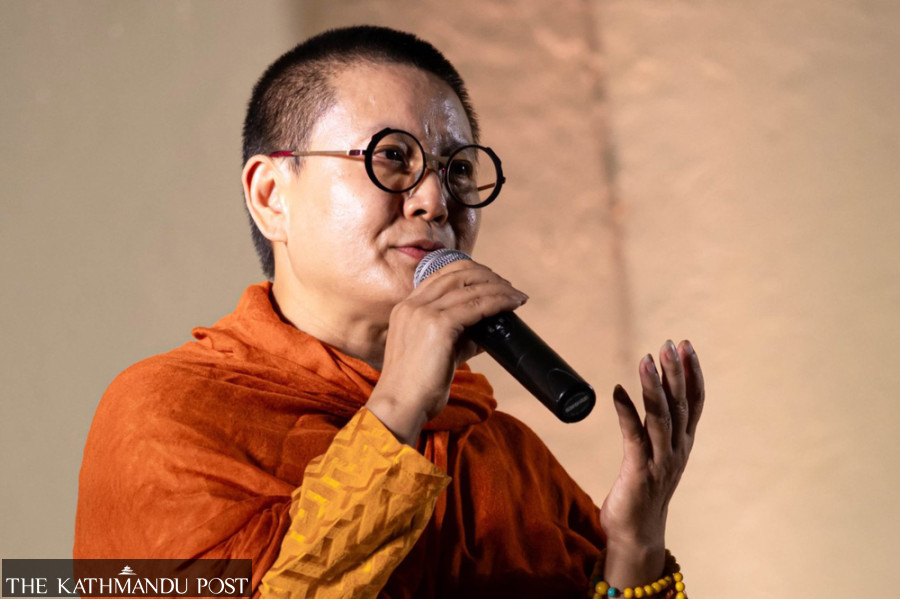
The government has appointed the Buddhist nun and singer to lead the Lumbini Development Trust despite unresolved questions over her citizenship and a money-laundering investigation dating back to 2018.Ani Choying Drolma. Post File Photo
The appointment of Buddhist nun and singer Ani Choying Drolma as vice-chair of the Lumbini Development Trust has renewed scrutiny of her citizenship and a money-laundering investigation that authorities have yet to formally conclude.
The Cabinet appointed Drolma on October 16 to fill a position that had remained vacant for nearly five months. Critics say the government should have resolved the outstanding questions before appointing her to public office.
Government sources say the Department of Money Laundering Investigation began examining Drolma’s financial transactions in 2018, while questions about her citizenship emerged in 2019. A senior department official said the financial investigation had neither been formally closed nor was it active at present.
“Once an investigation begins, a case is closed if nothing is found, while prosecution follows if irregularities are detected,” the official said. “But the investigation into Ani has neither been formally closed nor is it currently active.”
The citizenship inquiry also stalled after Kathmandu police sought records from the District Administration Office. An officer who worked at the police office at the time said the investigation was left unfinished after senior officials directed that it should not proceed.
The government has now appointed Drolma to the trust’s leadership without resolving either matter.
The controversy over Drolma’s citizenship dates back to 1989. On May 31 that year, she obtained Nepali citizenship by descent, naming Kanchha Bahadur Lama as her father. Certificate number 314 was issued in the name of “Chhoing Dolma Moktan Lama”. She obtained a duplicate certificate on November 10, 2009.
The issue resurfaced in December 2019, when Praman Singh Lama, the son of the man named as her father, filed a complaint with the Kathmandu District Police Range questioning how she had obtained citizenship in his father’s name.
Praman Singh said he was surprised to learn that Drolma had obtained citizenship in 1989 by naming Kanchha Bahadur Lama as her father. His father, he said, had lived at Chapali Bhadrakali in ward 6 of then Kathmandu (now Budhanilkantha Municipality) and died in 1982.
“I am surprised to hear that Ani Chhoying Drolma obtained citizenship in 1989 in the name of Kanchha Bahadur Lama, who died in 1982,” the complaint said. “I have no knowledge of how or on what basis she obtained citizenship, and I have no family relationship with her.”
Following the complaint, then police inspector Yamlal Banjade wrote to the Kathmandu District Administration Office seeking a copy of Drolma’s citizenship certificate. In its response on December 29, 2019, the office said it did not retain photocopies of duplicate citizenship certificates. It instead sent a photocopy of the register containing the original citizenship record.
The investigation went no further.
Drolma’s autobiography, Phoolko Aankhama, first published in 2011, has since become a focus of scrutiny. Originally written in French and later translated into Nepali, the book says she was born in Bauddha, a settlement in northeastern Kathmandu. She describes the area as resembling “a small world of those who had left Tibet” in Nepal and says her parents left their homeland in the mid-1950s.
“It was a time when Chinese Communists, who had invaded Tibet, began killing and imprisoning those who refused to submit to them,” the book says. “Although my parents came from Kham, in the east, they were from different villages.”
Drolma writes that her parents and other relatives first travelled to India, where her parents met.
Senior advocate Dinesh Tripathi said the account raised questions about how Drolma had qualified for Nepali citizenship by descent.
“She may have made a valuable contribution to society and may be a good singer. But those aren’t the criteria for appointment to public office,” Tripathi told Kantipur. “Having written in her autobiography that her parents came from Tibet, that account could become significant evidence in court if a case is filed.”
Tripathi said the government should address the outstanding questions before making such appointments. He argued that anyone holding public office must have legally acquired Nepali citizenship.
“Citizenship by descent requires a clear link to Nepal through one’s parents and previous generations,” he said.
Authorities have yet to take fresh action. Senior Superintendent of Police Dilip Ghimire, chief of the Kathmandu District Police Range in Bhadrakali, said police had found no formal complaint concerning Drolma.
“We haven’t found any complaint so far,” he told Kantipur.
Kathmandu Chief District Officer Ishwar Raj Paudel said the authorities would not launch an investigation solely on the basis of media reports.
“We can’t investigate simply because something has appeared in the media. We haven’t taken up the matter at this point,” he said.
A money-laundering investigation left unresolved
The financial investigation began before the citizenship controversy. In May 2018, the Financial Information Unit of Nepal Rastra Bank, which monitors suspicious financial activity, examined deposits into Drolma’s account at the then Mega Bank after the source of the funds could not be established.
The unit referred the transactions to the Department of Money Laundering Investigation, which froze the account and began an investigation.
Records showed a series of deposits by Hong Kong residents identified as Liang Chung Hang and Jiori. On May 9, 2018, $579,980 was deposited into the account, followed by $539,980 the next day and $529,980 on May 11. The three transfers totalled $1.649 million.
Kantipur Daily previously reported that the transactions were considered suspicious and prompted the investigation. Authorities also raised concerns that the funds had entered Nepal without the required approvals or disclosure. The amount was worth about Rs200 million at the prevailing exchange rate. Authorities stopped the transfers and blocked an attempt to bring in a further sum worth more than Rs180 million.
In July 2018, Nepal Rastra Bank formally asked the department to investigate the transactions.
An official involved in the investigation at the time said pressure began after the account was frozen.
“Jeevan Prakash Sitaula was the department’s director general at the time. Then prime minister KP Sharma Oli pressured him not to investigate Ani and to release the account. When Sitaula refused, he was transferred to Koshi province,” the official said.
Rup Narayan Bhattarai subsequently became director general. On January 12, 2020, Nepal Rastra Bank sought an update from the department on the investigation.
The official said Bhattarai also faced pressure to unfreeze the account and that a letter issued by the department during his tenure later became the basis for lifting the freeze.
“On January 22, 2020, the department wrote that the investigation into Ani was still ongoing and that a definitive conclusion could be reached only after it was completed,” the official said.
According to the official, Nepal Rastra Bank subsequently interpreted the response as grounds to unfreeze the account. The official maintained that the transactions still warranted investigation.
Oli’s role has also come under scrutiny in connection with the case. Shortly after becoming prime minister, he brought the Department of Money Laundering Investigation, which was under the Finance Ministry, under his direct control.
In July 2018, two months after Drolma’s funds were frozen, she pledged Rs10 million towards Oli’s programme to replace improvised cable crossings, known as tuin in Nepali, with safer alternatives. She announced her contribution on the Nepal Television programme “Janata Sanga Pradhanmantri” (The prime minister with the people).
The department has yet to decide whether to resume the investigation.
“We haven’t said that we’ll not investigate Ani’s case. But we aren’t investigating it either at present,” a senior department official said.
Drolma rejects allegations
Drolma has declined to respond directly to questions about her citizenship. In a video statement posted on social media, she said allegations concerning her citizenship, money laundering and the Rs180 million transaction were intended to defame her.
“I’m being portrayed as a criminal. I know that I’m innocent, that there’s nothing wrong in my heart and that I haven’t betrayed my country,” she said.
Drolma added that she had earned considerable recognition by the age of 55 and could easily obtain citizenship in another country if she wanted to.
“Let me make this clear: I’ll serve this country. I’ll pursue my spiritual practice here. I consider myself fortunate to have been born in this sacred land where the Buddha was born,” she said.
Responding to the financial allegations, she said anyone could visit the Department of Money Laundering Investigation in Kathmandu to check whether a case had been filed. She also pointed to Nepal Rastra Bank’s office in Baluwatar as a place where people could seek to verify the facts. She said she remained resolute but was concerned by the allegations.
Since 2000, Drolma has run Arya Tara School in Pharping, Kathmandu, for nuns.
Protests over appointment
Protests against Drolma’s appointment have intensified. Demonstrators gathered at Maitighar in Kathmandu on Monday, demanding that the appointment be revoked. On Tuesday, protesters burned an effigy of Tourism Minister Khadak Raj Paudel in Lumbini.
Police in Rupandehi arrested Akram Khan and Wajuddin Musalman, coordinators of the Save Lumbini Campaign, over their involvement in the protests. Police accused them of disturbing public order.
Khan said the campaign was formed to oppose Drolma’s appointment and began organising protests on October 17.
He argued that the trust should be led by someone with an unblemished record who understands local concerns and is committed to Lumbini’s development, protection, and promotion. He also called for an impartial investigation into questions about Drolma’s citizenship and the source of the money transferred from abroad.




 15.9°C Kathmandu