Supreme Court justices, top officials drawn into Inam’s growing ‘nexus’
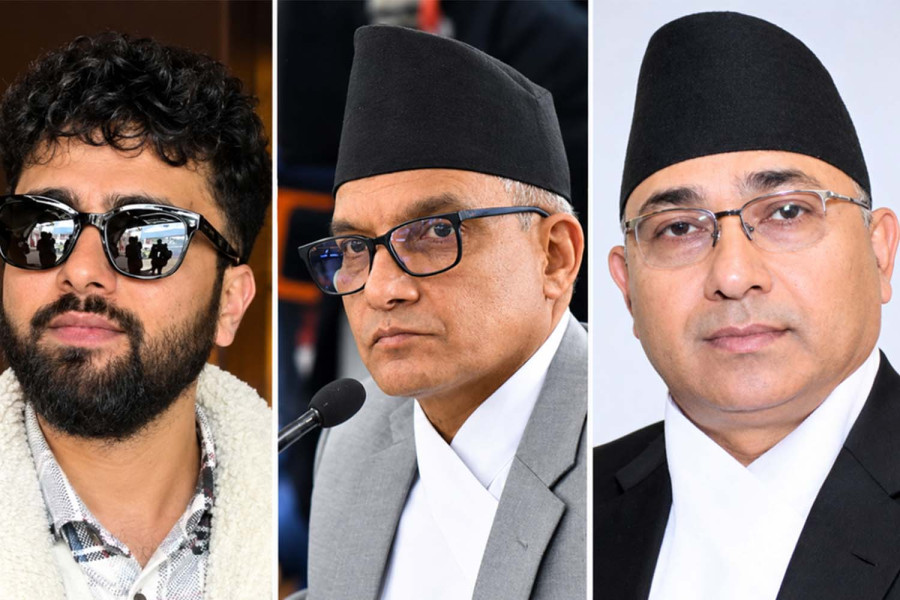
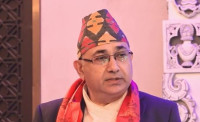
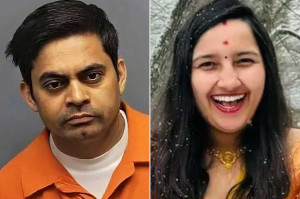
Messages and alleged financial records linked to Inam Sapkota have prompted calls for an independent probe into Chief Justice Manoj Kumar Sharma and Justice Hari Prasad Phuyal. From left, Inam Sapkota, Chief Justice Manoj Kumar Sharma and Justice Hari Prasad Phuyal.
The investigation into Inam Sapkota, an alleged fixer arrested on September 27, is widening as details of his links with influential figures emerge. Information made public on Thursday points to communications between Sapkota and Chief Justice Manoj Kumar Sharma concerning financial transactions, as well as exchanges with Justice Hari Prasad Phuyal about a case sub judice in the Supreme Court.
Sapkota’s links with former chief justice Cholendra Shumsher Rana, several former judges and dismissed Armed Police Force Additional Inspector General Banshiraj Dahal had surfaced earlier. Investigators say the inquiry is expanding after they found that serving judges and justices, senior Nepal Police and Armed Police Force officers, lawmakers and senior government officials had also been in contact with him.
The latest disclosures have brought Chief Justice Sharma and Justice Phuyal under scrutiny. On Thursday, the Nepali daily Naya Patrika published details of conversations between Phuyal and Sapkota, including exchanges concerning the case of Rohit Gupta, a former director of Himalayan Reinsurance.
Separately, details circulating on social media refer to deposits allegedly made into bank accounts in Nepal and the United States in connection with Sharma and Bishwaraj Pokharel, a Rastriya Swatantra Party lawmaker and former Nepal Police AIG. The posts refer to deposits totalling 198,333 in unspecified currency over three months—January, November and December—and a request to deposit a further $7,500.
The disclosures have prompted calls for an investigation into the justices. The Nepal Bar Association has issued a statement demanding a probe. “Sensitive matters of this nature must be investigated through a process that is evidence-based, impartial, credible and transparent,” the association said. “Those holding public office who are linked to highly sensitive reports concerning the judiciary must observe their respective codes of conduct. The situation also demands that senior office-holders demonstrate a high degree of ethical responsibility.”
The association called for legal action if wrongdoing is established, regardless of the position or status of those involved. If the allegations are not substantiated, it said, the findings should make that clear and protect the reputations of the individuals concerned as well as the standing of the institutions involved.
“Allegations and details reported in the media cannot be treated as the final truth or proof that any individual has committed wrongdoing,” the statement said. “Everyone must be guaranteed an impartial investigation, an opportunity to present their account and due process under the law. However, when serious questions are raised publicly about the conduct of the judiciary’s top leadership and judges, it would be inappropriate to dismiss them as mere media reports.”
Calls for an independent investigation
The controversy has also raised questions about how allegations of misconduct against Supreme Court justices can be investigated.
The Judicial Council can initiate preliminary inquiries and conduct investigations through a probe committee when complaints are filed against district and high court judges. The process is different for Supreme Court justices, for whom the constitution links removal from office to impeachment under Article 101.
Under Article 101(2), at least a quarter of the serving members of the House of Representatives can register an impeachment motion against a justice on grounds including serious violations of the constitution or law, misconduct, incapacity or failure to discharge official duties honestly.
An 11-member Impeachment Recommendation Committee in the House examines the grounds for the motion and can recommend impeachment after an investigation. An impeachment motion must be passed by at least a two-thirds majority of all serving members of the House.
Article 101(8) also makes it clear that removal through impeachment does not prevent legal action for offences committed while in office.
Former Supreme Court justice Balaram KC said an investigation was necessary because justices had failed to observe their code of conduct, which bars them from meeting people who appear to be intermediaries seeking to influence judicial proceedings.
“As soon as reports emerged of meetings and conversations with intermediaries, statements appeared in what looked like a hurried attempt to defend themselves. That was also wrong. Justices should speak through their judgments, not issue statements to defend themselves,” said KC.
KC said Parliament should form a high-level committee to investigate the matter. He also said the Supreme Court could initiate its own inquiry.
KC argued that Nepal’s judiciary should treat the allegations with comparable seriousness. He proposed that the chief justice establish an inquiry empowered to investigate the allegations, including those concerning the chief justice himself. The committee, he said, could include serving judges, representatives of the Nepal Bar Association, former judges, and members of civil society.
Top Bahadur Singh, president of the Former Judges Forum, blamed the current controversy in part on the way judges had been appointed. “The top judiciary was compromised by appointments that favoured party loyalists and political connections over proper scrutiny,” Singh said.
The details published about Phuyal include WhatsApp exchanges in which Sapkota sent the justice a screenshot concerning a habeas corpus petition filed in connection with a Special Court order to remand Rohit Gupta in custody.
In a message beginning with “Good morning”, Sapkota wrote: “Please stop this, sir. The prime minister is also interested in this. Please dismiss it outright.” Later Phuyal tried calling on WhatsApp, but Sapkota did not answer. Phuyal later replied that he had seen the message only after reaching home.
In a subsequent message, Phuyal told Sapkota that a division bench including him had that day found insufficient grounds to keep Gupta in detention and ordered his release on a bail of Rs20 million. Phuyal then proposed meeting Sapkota the following day at the Hotel Himalaya (Pulchowk). Sapkota agreed.
After the exchanges became public, Phuyal acknowledged that he had replied to Sapkota’s messages and met him. Asked why the meeting took place at a hotel, Phuyal said rumours were circulating about possible impeachment proceedings against justices. He added that Sapkota had sent messages claiming to convey the prime minister’s concerns and that some judges had acknowledged meeting him.
Despite the exchanges, Phuyal also heard a habeas corpus petition concerning Sapkota, who was in custody. Sapkota’s wife, Kabita Pandey, had taken the petition to the Supreme Court. On October 9, a bench comprising Phuyal and Sunil Pokharel dismissed it.
Phuyal described the details published on Thursday as only half the story. Phuyal said he got acquainted with Sapkota through a senior official who was a relative of his. When that person began discussing a court case, Phuyal said he grew suspicious.
According to Phuyal, he and the others then informed the secretariat of Prime Minister Balendra Shah, after which Sapkota was arrested. He also said that he and several other justices had met Sapkota at the Hotel Himalaya during a subsequent meeting. After becoming suspicious of him, Phuyal claimed, they passed all the information and communications they had to the prime minister’s secretariat.
Chief justice denies links to financial transactions
The details circulating online concerning Sharma relate to alleged financial transactions. Besides Sharma, the details name Pokharel, the lawmaker elected from Okhaldhunga and a former Nepal Police AIG; and Banshiraj Dahal, an AIG of the Armed Police Force.
The government has already dismissed Dahal over allegations that he exchanged information with Sapkota. The action followed Dahal’s late-night visit to former chief justice Rana after police detained Rana and took him to the Kathmandu Valley Crime Investigation Office. A committee was formed to investigate Dahal before he was dismissed.
The material concerning the alleged deposits names the three officials and directs that money be sent to a Bank of America account held by Niranjan Pande, a relative of Sapkota living in the United States. It includes the account number. The messages also offer the option of deposits to be made in Nepal, using a Sanima Bank account held by Sapkota’s wife, Kabita Pande.
The message requesting the deposits appears to carry the official seal of the Nepal Police Crime Investigation Department’s Digital Forensics Lab.
Sharma has denied any involvement with Sapkota or the people and transactions described in the material. “I have no involvement with the individuals or circumstances with which my name has been linked,” Sharma said in a statement. “I don’t know these people. I have had no direct or indirect contact with them, and have never met them.”
Although Sharma rejects the allegations, the details circulating publicly appear to have been retrieved by the police from Sapkota’s mobile phone. The material itself appears to be old, though it only recently came to light.
Investigation widens after Sapkota’s arrest
The details concerning Sharma and Phuyal emerged after police took control of Sapkota’s phone. The detention of former chief justice Rana on September 27, with police saying he was being taken into custody for his protection, has since been followed by a series of controversies involving the judiciary.
Police are investigating communications between Sapkota and senior officials. He remains in custody as the investigation continues. Investigators also found links between him and Deepak Bhatta and Sulav Agrawal, who are themselves in custody. Sapkota was detained at the Tribhuvan International Airport while attempting to travel to India.




 14.37°C Kathmandu