Former chief justice Rana’s midnight detention leaves the chain of authority unexplained
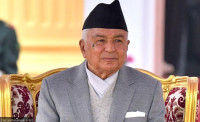
Police say they acted over a ‘security threat’, but have not identified it or explained why a crime investigation team was sent to take the former chief justice from his home.Former chief justice Cholendra Shumsher Rana. Post file photo
It was past midnight when plainclothes officers arrived at former chief justice Cholendra Shumsher Rana’s home in Maharajgunj, Kathmandu.
Rana and his family were asleep. Armed Police Force personnel guarding the gate initially stopped the officers. The police said they had come to take the former chief justice with them.
Within an hour, Rana was out of his home and on his way to a police office.
The reason given to him was a security threat.
Rana asked why, if he was in danger, the police could not simply reinforce the security already protecting his residence. The officers insisted that he accompany them. They did not show his family an arrest warrant or tell them what offence he was accused of committing.
Twelve hours later, at around 2 pm on Sunday, police released him to his family without filing a case.
What happened in those 12 hours — and who decided that it should happen — remains unexplained.
A senior police source told Kantipur that discussions about Rana began after Prime Minister Balendra Shah and his political adviser Kumar Ben returned from their US visit. The two had been in New York, where Shah delivered a speech at the 81st session of the United Nations General Assembly on Friday morning. According to the source, pressure on the police to take Rana into custody began on Saturday evening.
By around 12:30 am Sunday, a team from the Kathmandu Valley Crime Investigation Office, led by DSP Yograj Khatiwada, was at Rana’s residence.
Police have since described the operation as a security measure. But they have not identified the threat, said when they first learned about it, disclosed what information prompted the operation, or explained why a crime-investigation unit was used to remove a protected former chief justice from his home.
Nor have they publicly established who authorised the operation or under what legal authority Rana could be taken from his home and held elsewhere for 12 hours.
The senior police source said police began to feel the pressure on Saturday evening. The source did not say exactly who initiated the discussions or whether any written instruction was issued.
A retired Nepal Police inspector general said there had long been an established practice for handling cases involving the detention of a serving or former senior constitutional or public figure. Such decisions, he said, would normally be discussed among the political and police leadership before any action was taken.
“In the past, when there was a need to take a serving or former senior constitutional or public figure into custody, the home minister or the prime minister would call the attorney general and the IGP for discussions, reviewing both the positive and negative aspects of doing so,” the retired inspector general said. “Only then did they take the person into custody.” He added, “But in this incident, it does not appear that even a basic discussion took place about the possible reactions to keeping a former chief justice in custody.”
The former Inspector General of Police (IGP) said IGP Dan Bahadur Karki also appeared to have been under pressure.
“No matter how much pressure there is on an issue, the leadership always informs the political leadership about the risks and tells them whether something will or will not hold up in court,” he said. “But when the pressure becomes intense, the police leadership becomes helpless and is forced to implement it.”
The police have not said whether the home ministry was involved in the decision, whether the IGP authorised the deployment, or whether any government authority issued a written instruction.
Karki would not say whether he had come under pressure, but his remarks suggested that the decision was beyond his control.
“I did try to raise the issue of due process,” he told Kantipur, without providing further details.
At Rana’s residence on Sunday morning, after the police identified themselves and said they had come to take the former chief justice, the security personnel asked them to contact Rana’s personal security officer. The PSO came to the residence from his home.
By then it was already around 1 am. The police told Rana that he faced a security threat and had to go with them. Rana asked that additional security personnel instead be deployed at his home. The team insisted that he accompany them.
According to a family source, the officers said the threat came from some Gen Z leaders and other groups. Rana was confused and said he would change his clothes before leaving.
“But they said, ‘Nothing will happen, just come as you are,’” the family source said. “When they said they would discuss everything once they reached the office, he felt that he now had to go.”
Police then took him away, telling the family that he would return shortly.
“They neither gave us an arrest warrant nor told us anything about the charges,” a family member told Kantipur.
Several hours after Rana was taken away, officers at the Valley Crime Investigation Office told journalists that a complaint had been filed against him “regarding certain matters”. They did not provide details of the alleged complaint.
At around 9 am, SP Rameshwar Karki told Kantipur that Rana had instead been brought to the office because of a security threat.
“He is staying in a safe place,” Karki said. He did not identify the source of the threat.
Asked whether Rana would be released that day, he said: “He will be released. This is not about filing a case or anything like that.”
At around 2 pm, he was released to his family.
SSP Santosh Khadka, head of the Valley Crime Investigation Office, said Rana had been kept there only for his security.
“We kept him only for his security,” Khadka said. “After appropriate security arrangements were made, he has already left the office.”
After his release, officers said Rana did not immediately return home and was staying elsewhere under police surveillance.
But police have not explained what security arrangements were made during the 12 hours, who designated the location as safe, or what changed sufficiently for Rana to be released to his family that afternoon.
The police have repeatedly cited a security threat but have not described it.
They have not said when they first learned of the alleged threat, who reported it, whether it was based on intelligence or a specific warning, or whether any formal threat assessment was carried out before officers were sent to Rana’s home.
The distinction matters because Rana was already a protected former chief justice.
Under the government’s Special Persons Security Management Procedure, former chief justices receive round-the-clock security.
Former Chief Justice Om Prakash Mishra said that if police had information about a threat, additional personnel could have been deployed at Rana’s residence.
“I don’t see any reason why there should’ve been a security threat against a former chief justice,” Mishra told Kantipur. “Even if there was one, additional security personnel could have been deployed at his residence.”
A retired IGP said that when there is a genuine security threat, the normal response is to strengthen protection around the person.
“When there really is a security threat, the person concerned reports it, and the responsibility for providing security lies with the Security Directorate at [Nepal Police] headquarters,” he said.
He said the use of the crime investigation office indicated that the incident did not appear to be solely about security.
“Saying that he was brought in because of a security threat is simply something that was said when there was nothing else to stand on,” he said.
It also remains unclear why the Crime Investigation Office was involved.
The Valley Crime Investigation Office is responsible for investigating serious crimes in Kathmandu Valley. Yet police now say Rana was not taken there in connection with a criminal case but because of a security concern.
The police have not said who decided that the office should handle the situation, who authorised the deployment, or why the security directorate responsible for protecting senior public figures was not used instead.
The team was led by DSP Khatiwada, but police have not publicly identified the superior officer who instructed him to go to Rana’s residence. That leaves unresolved whether the crime investigation office was acting on instructions from its own leadership, police headquarters, the Home Ministry or another government authority.
The circumstances also leave Rana’s legal status during those 12 hours unclear.
If he had been arrested, police have not identified the offence or shown the family an arrest warrant. If he was not arrested, they have not explained under what authority police could remove him from his residence and keep him elsewhere for roughly 12 hours.
Former Supreme Court justice Balaram KC said there was no reason to take Rana from his home in the middle of the night.
“Since he was a person already under the surveillance of security personnel, there was no need to take him into custody at night,” he said.
Hemant Malla Thakuri, a former chief of the Central Investigation Bureau, said security concerns alone did not justify keeping someone at a police office overnight.
“First of all, when detaining someone of the stature of a former chief justice, there are procedural requirements—there has to be an arrest warrant, and it must be clearly stated why the person is being detained,” he said.
“Secondly, even on the basis of a security threat, there is no practice of keeping someone at a police office throughout the night.”
The uncertainty over Rana’s status was compounded when a National Human Rights Commission (NHRC) team went to the Valley Crime Investigation Office after learning that he had been taken there.
The team was not allowed to meet him.
Police had been keeping Rana in the office of SSP Khadka and restricting outside visitors. A former senior police official said the decision to keep Rana at the crime investigation office and prevent outside access was difficult to reconcile with the claim that he was being held only for his protection.
Police, however, said they were unaware that the NHRC team had attempted to meet Rana.
The incident prompted further concern from the rights body, which had sought to establish the circumstances under which the former chief justice had been taken into police custody.
By Sunday afternoon, the immediate operation was over. Rana had been released to his family and police said no case would be filed.
But the decision that set the operation in motion remains opaque.
A senior police source has pointed to pressure from the Prime Minister’s Office, but the precise chain between that pressure and the deployment remains unclear. The government has not publicly said whether the Prime Minister’s Office authorised the operation, whether the Home Ministry was involved, what the IGP knew or approved, or who within the police hierarchy made the final operational decision.
Nor has anyone publicly explained why a crime-investigation unit was chosen to carry out what police describe as a protective-security operation.
Those gaps are particularly significant because no former chief justice had previously been taken into police custody in the Supreme Court’s 70-year history.
Rana was the 29th chief justice. He became chief justice in January 2019 and was suspended after an impeachment motion was registered against him in February 2022.
The impeachment remained unresolved for a prolonged period. Earlier this month, a Constitutional Bench led by Chief Justice Manoj Kumar Sharma dismissed four writ petitions concerning the matter, holding that the basis for the impeachment against Rana had ceased to exist.
Rana retired in December 2022 while the impeachment process remained unresolved.




 14.79°C Kathmandu