



 16.53°C Kathmandu

Sun, Oct 25, 2026
Sports
NPL set to kick off with bigger stars and Rs1.5 billion in sight
The third season brings bigger international stars, a new DRS system, and increased prize money as the T20 franchise league expands its commercial ambitions.
bookmark![]()
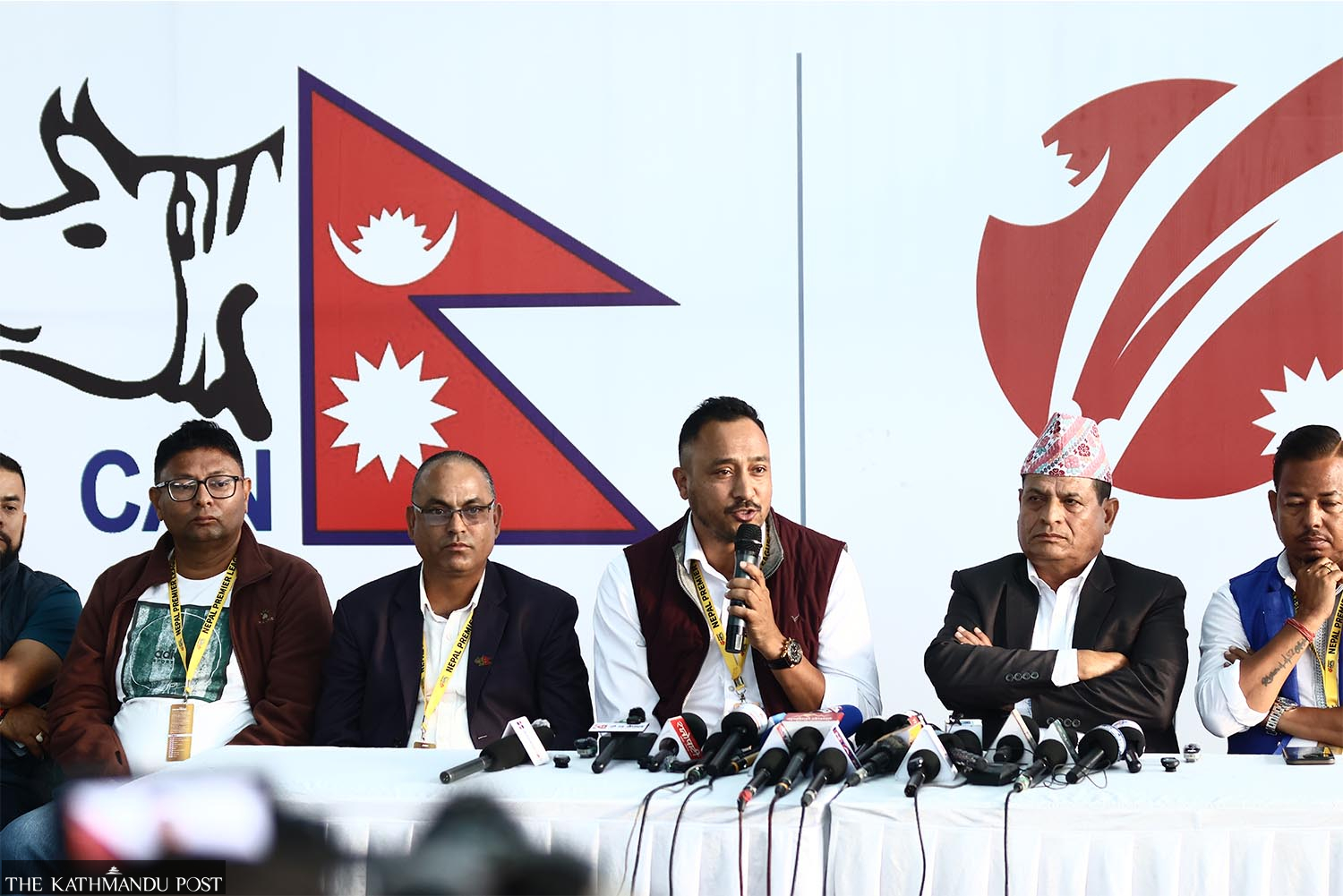
CAN officials at the press conference organised in Kathmandu on Sunday Hemanta Shrestha/TKP
Yagya Banjade & Binod Pandey
Published at : October 25, 2026
Updated at : October 25, 2026 16:53
Kathmandu
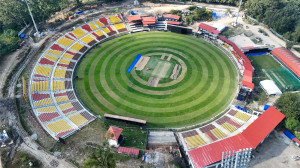
The third season of Nepal Premier League, one of the biggest international sports events to be ever hosted in Nepal, is set to kick off on Monday at the TU International Cricket Stadium in Kirtipur, Kathmandu.
The T20 franchise cricket league is growing both on and off the field—and this season is set to be the biggest it has ever been.
On the field, the arrival of global cricketing icons alongside the introduction of the decision review system—DRS—has increased the standards of the tournament.
Off the field, the revenue is increasing exponentially.
Speaking at a press conference at the TU International Cricket Ground on Sunday, CAN’s treasurer Padam Khadka informed that the NPL will generate over half a billion rupees in its 26-day-long event.
“This season, we expect to earn Rs200 million from sponsorships and above Rs700 million from ticketing and broadcasting,” Khadka said. “Throughout the one month of the tournament, we expect that NPL’s turnover will be Rs1.5 billion.”
The NPL had a turnover of Rs1 billion in its inaugural season. Last year, the amount saw a moderate increase.
At a time when the broader Nepali economy remains subdued, the massive inflow of capital via NPL is expected to provide much-needed momentum into domestic markets. Beyond stimulating economic activity, the tournament serves as a catalyst for job creation, consumer spending and private investment, offering a psychological boost to the business community.
As the tournament approaches, commercial buzz is palpable across the Capital. Surging hotel bookings, robust sales of team merchandise, extensive corporate branding and heightened involvement from major business houses are injecting enthusiasm into the national economy.
“While transaction volumes grow higher each year, the real priority is sustainability,” Paras Khadka, CAN’s secretary, said during Sunday’s press conference. “Strictly speaking as a sporting property, the NPL has evolved into a full-fledged industry,” he added. “But we still need substantial investment in infrastructure. While we have met our targets in every successive season, proving we are on the right track, securing long-term viability requires a lot more work.”
During the first two seasons, average expenditures for individual franchise teams ranged between Rs80 million and Rs100 million. This year, average franchise costs are projected to touch Rs150 million.
Stakeholders attribute the sharp increase to relaxed restrictions on signing marquee international players. Even at a conservative estimate of Rs150 million per team, total franchise spending will reach Rs1.2 billion.
With the NPL gaining official recognition from the International Cricket Council, the tournament has attracted some of the biggest names in world cricket, with franchises paying salaries commensurate with their international stature.
In the inaugural season, Karnali Yaks reportedly paid more than Rs100 million to sign Indian star Shikhar Dhawan. Salaries for other international stars, including Australia’s David Warner, South Africa’s David Miller, West Indies’ Andre Russell and Bangladesh’s Shakib Al Hasan, have also reportedly been comparable to Dhawan’s.
CAN’s operational expenses have also scaled up compared to last year. Driven by the introduction of the DRS alongside expanded promotional and branding campaigns, CAN’s expenditure will hover around Rs300 million, industry insiders estimate, up from roughly Rs210 million last year. Combined expenditures from CAN and the franchises push total direct turnover past the Rs1.5-billion mark.
With the increase in revenue, CAN has also announced a rise in prize money for the third season.
The winner of the third season will bag Rs15 million, up from Rs10 million in the first two seasons. Similarly, second, third and fourth-placed teams will walk away with Rs8 million, Rs4 million and Rs3 million, respectively.
Financial expert and former banker Anil Keshary Shah says that the NPL is providing a profound stimulus to the national economy.
“By successfully executing the first two editions, Nepal proved its capacity to host international-grade cricket tournaments,” Shah said. “The growing financial turnover—climbing from last year’s Rs1 billion benchmark—is a direct reflection of the NPL brand’s equity. It provides a vital lifeline to revitalise an economy that has remained sluggish for quite some time.”
Shah added that the tournament has catalysed a localised sports ecosystem spanning jerseys, footwear and athletic gear.
“From the Himalayas to the Tarai, the country is gripped by cricket fever,” Shah said. “The proliferation of cricket academies and the rising aspirations of youth contribute significantly to economic activity. With ICC sanction, the NPL has secured international legitimacy. Growing domestic popularity, fueled by spectator engagement, will broadcast a positive message worldwide.”
Franchises have to cover players’ salaries and allowances, accommodation, meals, healthcare and training, among other expenses. The CAN has set a salary cap for domestic players, allowing each franchise to spend a maximum of Rs9 million on 14 players, including Rs2 million for the marquee player. A team typically spends Rs5 to 6 million to accommodate its players at a high-end hotel for a month.
Similarly, organising the NPL requires heavy capital outlay from CAN, alongside substantial investments from franchises covering player retainers, accommodation, daily allowances, medical care and training facilities.
Franchise stakeholders estimate that spending on Nepali players will cap at around Rs11 million per team, while foreign player acquisitions will absorb roughly Rs30 million to Rs40 million. Increased international recruitment and aggressive promotional campaigns have pushed budgets higher across the board.
Sandesh Katwal, chief executive officer of Lumbini Lions, said that rising costs reflect expanded rosters.
“We have already signed six foreign players and are in the process of bringing in more, which has driven up costs,” Katwal said. “While franchises operated at a loss in previous years, rising revenues mean we expect to break even or turn a profit this season.”
During the inaugural NPL, CAN and team owners had accepted that they had taken the risk of accepting loss during the first couple of seasons.
Katwal noted that both brand associations and revenue streams have expanded significantly. Lumbini Lions have partnered with nearly two dozen brands this year, resulting in a substantial increase in sponsorship income, he said.
Similarly, Kathmandu Gorkhas’ chief operating officer Shrawan Singh said that operational expenses are expected to reach roughly Rs150 million, up from Rs110 million last year.
“Bringing in global names like David Warner has naturally elevated our operating costs,” Singh said. “However, revenue has grown parallelly by 20 to 25 percent.”
Making its financial audit of the second edition public on April 6, CAN reported a net profit of Rs92.12 million—marking a sharp increase of Rs67.47 million over the inaugural edition. In its first season, CAN had posted a net profit of Rs24.65 million.
During the second season, CAN generated a total revenue of Rs473.60 million against operational costs of Rs219.60 million. This left CAN with a pre-revenue-sharing gross operating income of Rs253.99 million.
This massive influx of commercial activity arrives as Nepal’s formal financial system sits on an idle loanable fund liquidity pool of roughly Rs1.6 trillion amid subdued credit demand. Although private-sector credit growth posted a modest 7 percent expansion in the first two months of the current fiscal year, economic analysts argue that the NPL’s multi-million-rupee ecosystem is providing a much-needed stimulant to a sluggish economy.
With Siddhartha Bank continuing as primary tournament sponsors under five-year deals, CAN reports that the total roster of corporate partners backing this year's tournament will approach two dozen brands.
Siddhartha Bank CEO Rameshwar Prasad Bashyal noted that successful global leagues extend far beyond competition, serving as vital vectors for tourism, investment, employment, entertainment, and international branding.
“We see that exact potential in the Nepal Premier League,” Bashyal said. “The arrival of world-class players has drawn international media attention. It plays a massive role in focusing global sports communities, analysts, and tourists on Nepal, leaving a lasting positive footprint on our hospitality and tourism sectors.”
Ticket sales alone are projected to yield over Rs110 million—well above last year’s roughly Rs80 million intake. Benefiting from upgraded venue infrastructure, CAN has established tier-based ticket pricing mapped to specific seating blocks and match fixtures.
General and premium tickets for league-stage matches cost Rs500 and Rs1,000, respectively. During the eliminator and final, general tickets will cost Rs1,000 and premium ones Rs2,000.
With teams entering the final phase of preparations, public excitement has translated into brisk ticket sales and hotel bookings from out-of-town fans. The NPL fever has electrified not just the sports fraternity, but retail commerce, the entertainment sector and the broader economy. At a time when critics argue that state investment in sports remains inadequate, the NPL stands as a self-sustaining commercial counterweight.
Yagya Banjade
Banjade covers government finance, banking, capital markets, and the economy for Kantipur Daily.
Binod Pandey
Binod Pandey is a sports reporter for the Kantipur Publications.


Most Read from Sports
Editor's Picks

What to know about the US trial over Mamta Kafle’s disappearance
NPL returns with bigger ambitions and global recognition
What’s new in the Nepal Premier League’s third season?

After Nepal’s recent disaster, it wants to test whether COP31 can deliver climate justice

Why does an hour long flight to Dhangadhi cost more than a flight to New Delhi?
E-PAPER | October 25, 2026

×