Lumbini Development Trust leadership row revives scrutiny of appointment process
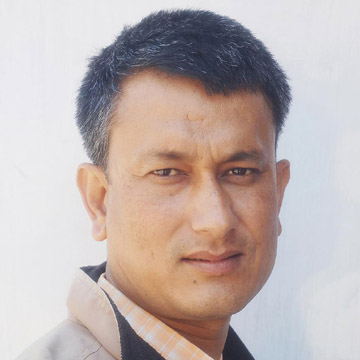
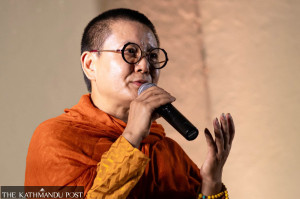
The appointment of Ani Choying Drolma has sparked protests, renewed scrutiny of past controversies and raised questions about the government’s selection process at the birthplace of Buddha. Photo: Courtesy of Lumbini Development Trust
Protests have erupted over the appointment of Ani Choying Drolma as vice-chair of the Lumbini Development Trust, the body responsible for developing, managing and protecting the birthplace of Gautam Buddha.
The government appointed the Buddhist nun and singer on October 16, prompting the Save Lumbini Campaign and other groups to demand that the decision be revoked and a qualified local candidate considered instead. Demonstrations have taken place in Lumbini and Kathmandu, where protesters gathered at Maitighar. In Lumbini, campaigners also burned an effigy of the tourism minister, leading to the arrest of two activists who were later released.
The protesters have questioned Drolma’s Nepali citizenship by descent and the source and transparency of about $1.649 million reportedly transferred from Hong Kong to her bank account in 2019. Drolma has rejected the allegations as an attempt to defame her, insisting she is innocent and remains committed to serving Nepal. She has urged people to verify the financial claims with the Department of Money Laundering Investigation or Nepal Rastra Bank, while declining to address questions about her citizenship directly.
The dispute has revived a longstanding debate over appointments to the trust, with local residents arguing that the leadership should prioritise people who understand Lumbini’s religious significance, heritage and development needs. Controversies surrounding previous vice-chairs have also fuelled calls for a more transparent selection process and greater local representation. The latest protests, which have now reached the federal capital, have raised concerns among tourism and heritage stakeholders about the impact of the dispute on Lumbini’s global image.
For more than a decade, local residents have argued that the trust’s leadership should include people who understand Lumbini’s significance and the concerns of its communities. Appointments to senior positions have repeatedly drawn criticism, with the latest dispute over Drolma’s appointment bringing those concerns back into focus.
The Lumbini Development Committee was initially established in 1970 following UN Secretary-General U Thant’s visit to Lumbini, before being formally structured by the government in 1975 to oversee the site's preservation and development.
Ten years later, the government enacted the Lumbini Development Trust Act 1985, transforming the committee into the statutory Lumbini Development Trust, with then-King Birendra serving as chief patron and his brother, the erstwhile prince Gyanendra Shah, as chairman.
Following the restoration of democracy, the Act was amended so that the Minister for Culture, Tourism and Civil Aviation serves as chairman, responsible for appointing the trust's vice-chairperson.
The position initially attracted limited attention. According to the trust, Surya Bahadur Shakya became vice-chair in 1991. By 2015, 14 people had held the post, but public interest remained relatively low.
That changed after the government led by Sher Bahadur Deuba appointed local resident Awadhesh Kumar Tripathi to a five-year term in November 2017, without a monthly salary. Tripathi later lost the position after the government changed, but was reappointed by the government led by KP Sharma Oli on July 26, 2018.
Tripathi, who served for nearly six years and was again a contender for the post, was seen by residents as someone who could improve access to the trust and strengthen local involvement. But his tenure left some disappointed.
During his tenure, an international conference hall and Buddhist meditation centre with the seating capacity for 5,000 was built at a cost of Rs630.8 million, reportedly in violation of the master plan. The facility began leaking before it was handed over.
Tripathi also faced controversy over land leased to Siddhartha Enterprises. Part of a plot leased to the International Crane Foundation for 50 years in 1994 was reportedly set aside and rented to the company.
During his tenure, then-finance minister Bishnu Prasad Paudel had allocated Rs7 billion to implement the Lumbini master plan amid funding shortages. Although an international tender was expected, the budget was divided into four contracts, each worth less than Rs1 billion.
Tripathi was succeeded by former lawmaker Lharkyal Lama, appointed by then-prime minister Pushpa Kamal Dahal on July 26, 2023. Lama faced allegations concerning the use of false citizenship and passport documents, as well as complaints to the Commission for Investigation of Abuse of Authority alleging abuse of office, illegal amassing of wealth and a lifestyle inconsistent with his official income.
He was arrested on March 13, 2016 after 14 rounds of ammunition were found in his bank locker. He spent 11 days in police custody—nine days in connection with the ammunition case and a further two days over a foreign employment-related case.
The Office of the Auditor General also questioned the transparency of expenditure by the trust and the accounting of donations and offerings received from donors during Lama’s tenure.
Another controversy arose over a proposed 99-year lease of 82 hectares of land in the Ramgram stupa area of Nawalparasi West to Singapore’s Moksha Foundation for commercial development. The deal was halted after objections were raised over the process.
The Save Lumbini Campaign staged protests against the proposal. The controversy surrounding Lama’s appointment had also prevented him from immediately taking up his duties in Lumbini.
Questions over the trust’s leadership
Under the law, the vice-chair serves a five-year term. The Lumbini Development Trust Office Bearers Regulations, 2001, originally designated the vice-chair as the trust’s executive head. A Cabinet decision in 2017 changed the arrangement, removing the vice-chair’s executive role.
Under the regulations, the vice-chair presides over executive committee and council meetings in the chair’s absence. The vice-chair is also responsible for implementing executive committee decisions and exercising general supervision, inspection and monitoring of the trust’s activities.
The trust’s member-secretary holds the executive position. Its main mandate is to protect and develop historical and archaeological sites in Lumbini, Kapilvastu, Devdaha and the Ramgram stupa area. The broader goal is to connect local communities to the heritage sites through livelihood opportunities and promote peace and spiritual tourism.
Dipak Raj Joshi, former chief executive officer of the Nepal Tourism Board, said appointments to the trust should prioritise candidates capable of promoting Lumbini’s international standing.
“Someone who can raise Lumbini’s international profile should be appointed,” he said. “Protests over an appointment can undermine tourism promotion. Repeated controversies over appointments also send a negative message.”
The Save Lumbini Campaign began pressing for local representation as soon as vacancies arose. Its coordinator, Akram Khan, said the campaign had taken its demands to Kathmandu, calling for a transparent selection process that gave priority to local people.
Khan said the campaign had repeatedly met culture, tourism and civil aviation minister Khadak Raj Paudel to present its demands, but the government had ignored them. Campaigners also approached the minister during his visit to Lumbini to seek appointments to vacant positions.
“The minister did not take our demands seriously,” Khan said. “That is why we were forced to resort to burning his effigy.”
Police arrested Khan and Baniyuddin Musalman on Monday night over the burning of the minister’s effigy at Parsa Chowk in Lumbini. Both were released on Tuesday afternoon.
Nepali Congress General Secretary Pradip Paudel criticised the arrests in a Facebook post on Tuesday, saying the government had detained citizens instead of addressing concerns over a controversial appointment to an institution of national and international importance.
“The government’s conduct in detaining citizens in the middle of the night, taking their statements and then releasing them is indefensible,” he wrote. He added that popularity alone was not enough to qualify someone to lead the trust.
“Qualifications, institutional capacity, public credibility, moral character and accountability must also be considered,” Paudel said. He argued that the government could not justify the appointment or explain its selection criteria without answering the public questions raised about Drolma’s citizenship and financial dealings.
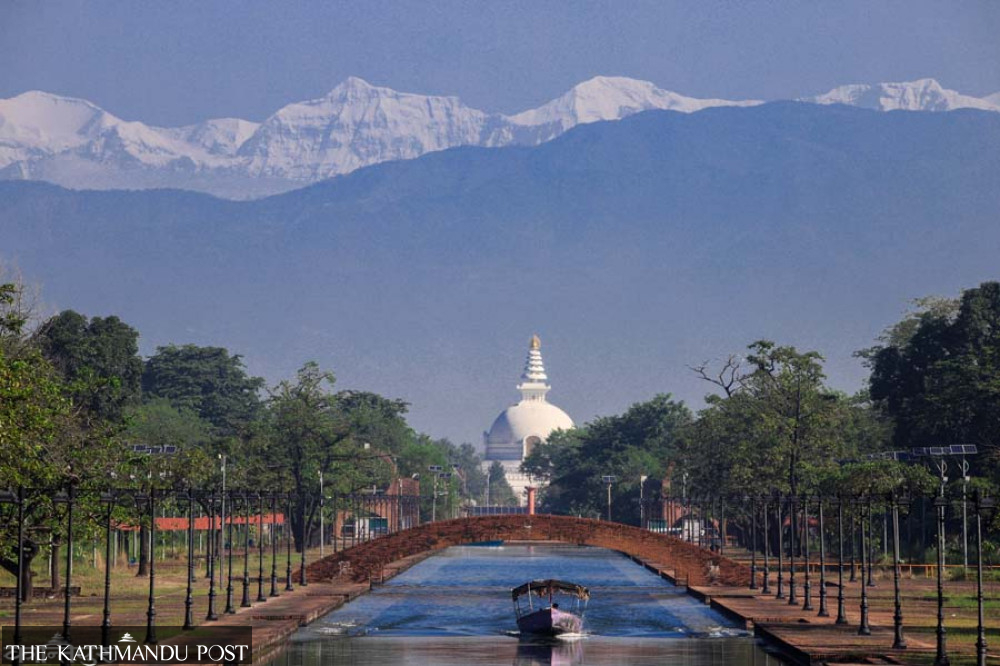
Post file photo
The campaign has continued to organise public meetings, press conferences, protest rallies and sit-ins, demanding that the appointment be revoked. It says questions over financial transparency, possible money laundering and the legality of her citizenship make her appointment unsuitable for an institution of Lumbini’s international and spiritual significance.
Drolma’s response draws further criticism
Drolma’s appointment has also attracted support on social media, with well-wishers congratulating her and wishing her success in the role. The online debate has increasingly turned hostile, with some users targeting those who support her. Drolma has warned that the growing polarisation could lead to ethnic or religious tensions.
In a video message lasting 12 minutes and 22 seconds, posted on Monday, she said she had faced and overcome many obstacles and criticisms throughout her life. While acknowledging that people had the right to disagree in a democracy, she urged them to observe limits in how they expressed their opposition.
She dismissed allegations concerning her citizenship, finances, money laundering and the Rs180 million transaction as baseless, saying the relevant government authorities could be approached for clarification on all the allegations against her.
However, her remarks implying that protesters were being paid to take part in demonstrations in exchange for “meat and rice” drew widespread criticism on social media.
“People could use the money spent on protests to feed themselves for a while, celebrate Dashain and Tihar or buy gifts for their families,” she said. “But if irresponsible actions lead to an unfortunate incident, they will have to bear the consequences of that sin for ever.”
Senior advocate Dinesh Tripathi, who has joined the protests, rejected the implication that Lumbini residents were demonstrating because they lacked food. He said he had not expected such an undignified remark from a Buddhist nun.
“Her ‘meat and rice’ comment has insulted Buddhists,” Tripathi said. “She must withdraw the statement immediately and apologise.”
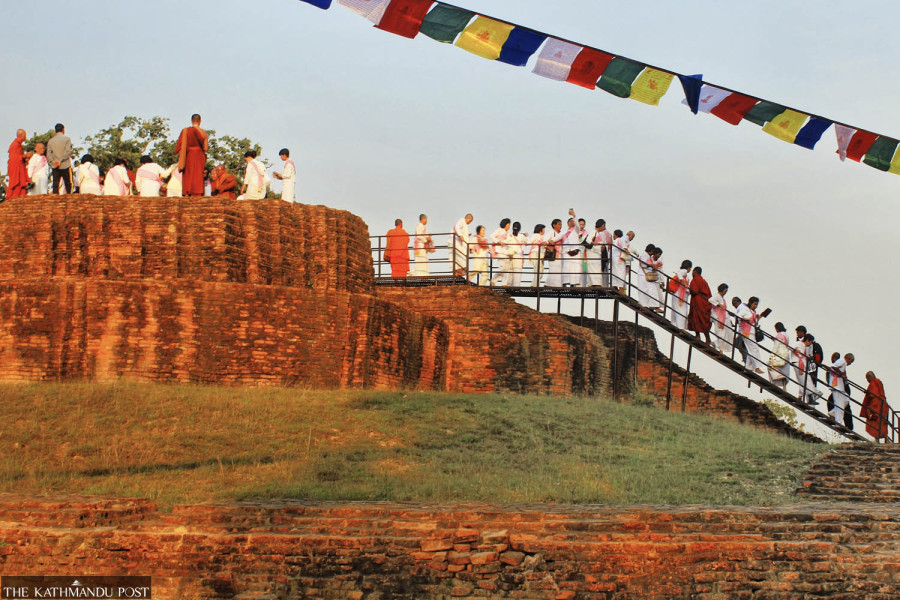
Pilgrims at a stupa at Nigrodharam, where Buddha met his father for first time after attaining enlightenment, in Kapilvastu, in this undated photo. Post file photo
Tripathi also alleged that the government had appointed Drolma around the Dashain festival through a process involving “dealings” rather than merit. He argued that Lumbini, a World Heritage site, needed a leader capable of managing it to international standards.
Selection process under scrutiny
The dispute has also raised questions about the government’s appointment process.
Trust officials were removed under the Special Provisions on Dismissal of Public Officials Ordinance, 2026, which came into force on May 2. The Ministry of Culture, Tourism and Civil Aviation invited applications for new appointments on May 15, giving applicants just one week to apply.
The ministry said it would maintain an open competition and published a roster of applicants. A total of 727 people applied for various positions, including more than 60 for the 12 posts, among them the chief of the master plan. The vice-chair position attracted 104 applications, but no immediate appointment was made.
Tripathi said the government had solicited applications from the public but then made appointments without following the law.
“On the one hand, the government invites applications from citizens for public positions; on the other, it bypasses the law and makes appointments directly,” he said. “At a first glance, this decision is unlawful.”
He said the government had not consulted residents or interviewed applicants before making the appointment, and must explain the basis for its decision.
“The government talks about meritocracy but acts arbitrarily,” he said.
Tripathi said he was preparing to challenge the government’s decisions in court once appointments to the remaining vacant posts were announced.
Basanta Bidari, a senior archaeologist, said the uncertainty in Lumbini was damaging Nepal’s image abroad and could undermine the site’s development as a tourist destination. He urged the parties to resolve the dispute through dialogue.
“Lumbini is becoming a tourist destination, and this controversy does it no good,” he said. “The issue must be resolved immediately through mutual understanding.”
Lila Giri, a former chief minister of Lumbini province, said appointments to an institution responsible for protecting such a sacred site should not trigger widespread opposition.
“The atmosphere created by those supporting and opposing the appointment will not have a positive impact,” he said. “The government itself must think about this.”
Stakeholders fear that if the protests spread, qualified candidates may become reluctant to take up positions at the trust.
Daya Nidhi Gautam, head of the central campus of Lumbini Buddhist University, said recurring disputes risked undermining the image of Lumbini as a symbol of peace and spirituality.
“This could have a negative impact internationally,” he said. “The stakeholders should meet and resolve the problem soon.”
Gautam added that the authorities concerned must clarify the questions raised about Drolma, while residents should raise their concerns peacefully and responsibly.
Master plan remains unfinished
The controversy comes as Lumbini’s long-delayed development master plan remains incomplete. The plan was intended to transform the birthplace of the Buddha into an international centre for peace and spiritual tourism, with work expected to be completed within 17 years. Nearly 48 years later, it is still unfinished.
The government does not allocate a budget for the trust’s day-to-day administration. Funding is provided for implementing the master plan, while the trust relies on its own income to pay staff salaries and cover routine operating costs.
The trust earns around Rs170 million to Rs180 million a year but spends Rs120 million to Rs130 million on salaries and allowances alone. Including administrative, operational and other routine expenses pushes total spending above income, leaving the trust in deficit for the past three years.
Its largest source of revenue is the conservation fee charged to visitors entering the Maya Devi Temple, which generates Rs80 million to Rs100 million a year. Donations and other contributions bring in another Rs20 million to Rs30 million. The trust earns a further Rs20 million to Rs30 million annually through leases of land and property, contracts and auctions.
Japanese architect Kenzo Tange, internationally renowned for his work, spent six years developing Lumbini’s master plan, which was approved by the then Lumbini Development Committee in 1978. Implementation began that year, but nearly five decades later, the plan remains incomplete.
Lumbini is the country’s principal tourist destination, with 27 to 28 monasteries and temples representing different Buddhist traditions. Governments from China, Myanmar, Sri Lanka and Thailand have built monasteries at the site.




 15.34°C Kathmandu