How Rajina Bista fought from local karate rings to Tokyo mats and Bangkok podiums
Beyond the viral social media posts celebrating Rajina Bista’s win over a Thai fighter, the 27-year-old martial artist overcame financial hurdles and institutional neglect to claim silver at the Amazing Muay Thai World Festival.Rajina Bista
Rajina Bista, 27, has a dream: to represent Nepal at the biggest Muay Thai events like ONE Championship and Rajadamnern World Series (RWS).
Bista is currently in Bangkok, Thailand. She has extended her stay to learn more about Muay Thai at the home of the martial art itself.
Photos of Bista recently circulated like wildfire on social media, celebrating her landmark victory over a Thai fighter at the birthplace of Muay Thai. But the posts missed a crucial detail: she had not just conquered one Thai opponent.
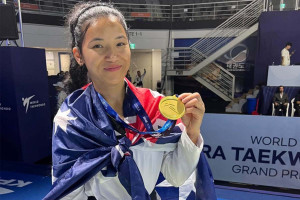
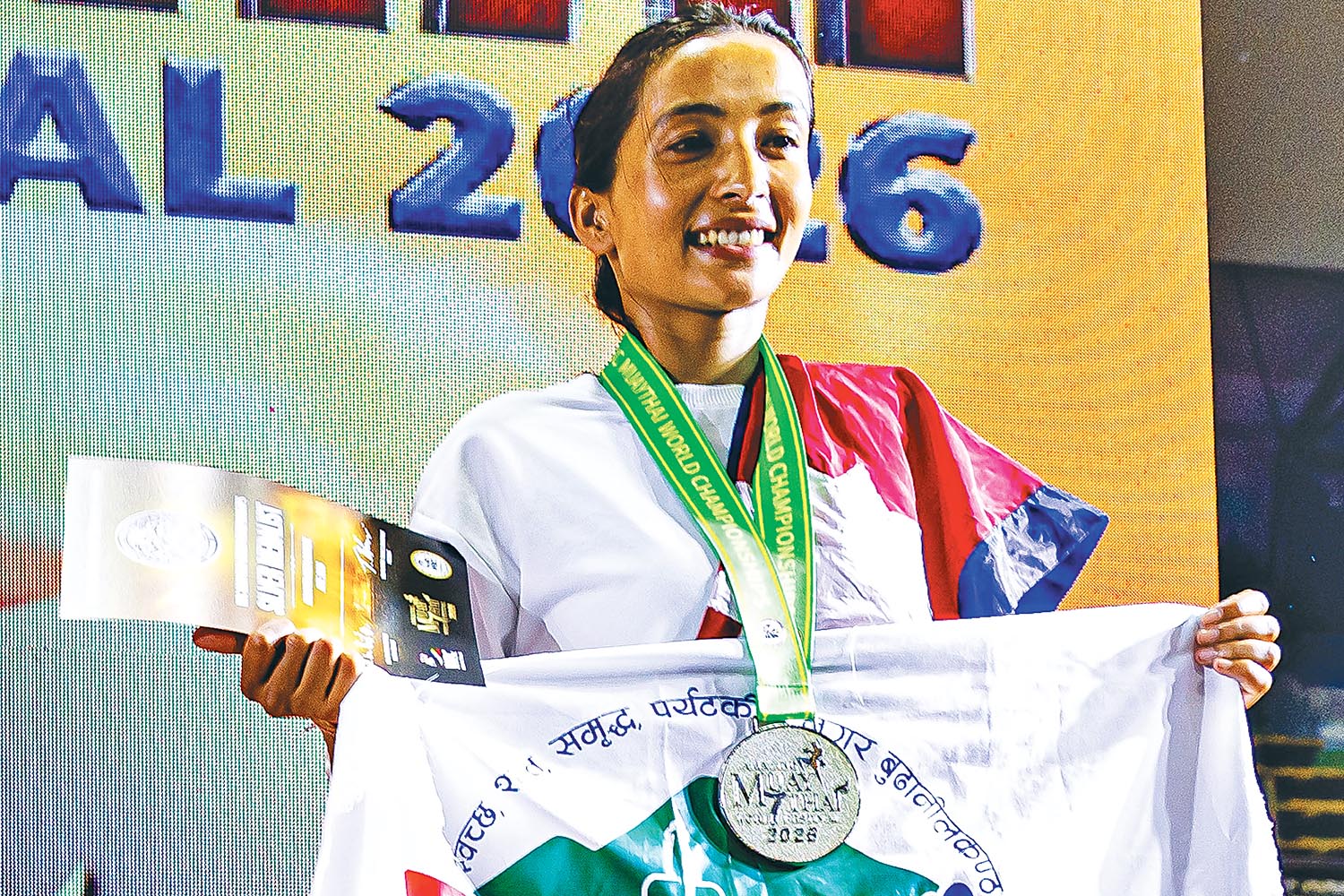
Bista defeated two Thai fighters—Phet Nanin and Theptida Sor Pichai —to reach the finals of the 2026 Amazing Muay Thai World Festival in Bangkok, Thailand. She lost the final to USA’s Layal Shafee by judges’ scores after an intense five-round fight and had to settle for the silver on July 29. But by then, she had already made history, becoming the first Nepali woman to defeat a Thai opponent in a professional Muay Thai fight.
“Well, I believe I should have won that final match,” Bista told the Post over a phone call on Sunday. She had fought in the Adult Elite/Advanced -51kg category. “I am returning home next week to search for sponsors who can back me up as I move forward—towards ONE Championship and RWS.”
But it is not Bista’s sole dream. She wants to do it for her father—Radheshyam Bista—and her husband—Paras Rawal. And for those who have believed in her to date.
“My father loves martial arts and wanted to be a fighter himself, but he never got the chance to continue it on the big stages,” Bista said. “Before my younger brother was born, my parents had three daughters. But we were never treated as weak or constrained by what society expects of girls. I am carrying our father’s dream forward.”
Nepal’s Rajina Bista came second after losing to USA’s Layal Shafee in the final of their 2026 Amazing Muay Thai World Festival fight in Bangkok, Thailand, on July 29. Courtesy of Layal Shafee’s Instagram
How happy Radheshyam is with his daughter can be seen on his Facebook. He has proudly shared every post he has come across regarding Rajina’s martial arts journey.
Bista was eight years old when she started her martial arts journey when her father enrolled her and her elder sister Renu Bista at a newly opened Narharipur Karate Dojo in Chandragiri, Kathmandu.
“I remember sparring within three months of joining the dojo,” Bista recalls. “I lost the fight and was sad to see others in joy with medals. It was then that I told myself: I am going to win that medal that looks like gold.”
While her elder sister discontinued karate after getting married, Bista never considered quitting.
“Well, I would have stopped had I not got so much support from not only my family, but from my in-laws as well,” she said proudly.
Bista married Rawal, a former national age-group cricketer, last year. “My husband also dreamed of playing cricket for Nepal at the highest level, but he couldn’t continue his journey,” she said. “Now I am carrying his dream forward alongside mine.”
Bista considers herself fortunate to have unwavering backing from her family.
“When people ask my mother-in-law when we are going to start a family or when I will stop fighting—saying it doesn’t suit a girl—she defends me,” Bista shared. “She tells them she wants to see me achieve my dreams because she never got the chance to pursue hers. That is a reality so many women in Nepal face, and she wants a different path for me.”
From karate to Muay Thai
Bista went on to participate and win medals across several national and international karate tournaments during her childhood and teenage days. And her accolades led the Japanese to call her to be part of an emerging martial art called Sei-Za.
Bista was only 16 when she and another Nepali martial artist—Radha Manandhar—joined emerging martial artists from Russia, Brazil and Australia in Tokyo, Japan.
“It was a new experience. I enjoyed it. It taught me different forms of martial arts as well,” she said. Sei-Za is an all-female Japanese combat sport that blends full-contact kickboxing strikes with sumo’s ring-out dynamics.
But the sport lacked adequate funding and sponsorship and could not develop. As a result, Bista also did not see a quality future in Sei-Za. But she says that coming across kickboxing while practising Sei-Za allowed her to take up a new martial art.
“Most importantly, it was karate that helped me,” she says. “Karate is a martial art that improves your basics and helps you cope with other martial arts a bit more easily.”
In 2018, Bista started practising kickboxing in Japan. She worked as an English teacher and a kickboxing coach at a kindergarten, and then supported her own kickboxing journey.
“After working at a kindergarten, I used to go to my training in the evening,” Bista said. She has played in over eight amateur and professional kickboxing bouts since 2021. Her latest kickboxing bout was against Yuzuki Horita at the NJKF—New Japan Kickboxing Federation—promotion in March last year.
But Bista was still seeking something more.
“I returned to Kathmandu in 2023 and found out about Erawan Muay Thai Fight Gym in Bansbari,” she remembers.
And the rest is history.
Bista was selected to represent Nepal at the Amazing Muay Thai World Festival in Bangkok as the WBC Muay Thai Nepal National gold medalist in the 51kg division. It means she is at the top of Muay Thai among female fighters in the country.
But Bista argues that Nepal does not have many female Muay Thai fighters. “That is why I also tried MMA once,” she added.
Bista had fought Sangita Dhami, one of Nepal’s best female MMA fighters, at Omega Championship Fight in July 2023. Bista lost it.
“Losses have, meanwhile, never stopped me,” Bista said. “In this sport, it is always about getting stronger.”
She is inspiring many
Earning a sustainable living from combat sports remains an uphill battle for Nepali martial artists—whether they are Paralympic medalist Palesha Goverdhan, Asian Games silver medalist karateka Arika Gurung, or professional MMA fighter Rabindra Dhant. For athletes like Bista, however, giving up has never been an option.
“Fighting is not an easy sport,” Bista shared. “And to take it up as a source of livelihood is a bigger challenge, especially for a girl, and that too in a country like Nepal.”
But she has learnt to stand up stronger as a martial artist.
“We had to pay a registration fee of 330 euros (approximately Rs58,000) for the tournament in Bangkok. Then the ticket fare,” Bista said. “I also paid 35,000 Thai Baht (approximately Rs160,726) for a month-long training at Sor Chokmeechai, a Muay Thai gym.”
Rajina Bista at Sor Chokmeechai, a Muay Thai gym in Thailand.
Bista exhausted all the savings she had earned working as a trainer at Erawan Muay Thai Fight Gym to make the trip. “I had to participate in this tournament because it had been a year since my last fight,” she said. “Trying to secure support from local municipalities was a hassle. I was even told that the maximum a municipality could offer was Rs2,000 to Rs3,000.”
For an athlete well aware of how rare government support is for non-mainstream combat sports, the institutional neglect came as no surprise.
“I sought state support only with a faint hope of ‘what if’,” she said with a wry laugh. “Since government backing has never materialised before, being turned away didn’t hurt. The sacrifices we fighters make have never been seen.”
Still, she refuses to let cynicism take over. “What remains if we lose hope?” she asked.
Bista now plans to approach corporate houses to fund the next chapter of her Muay Thai career.
“Once I return to Kathmandu, I plan to visit business houses for sponsorships so I can continue training in Thailand and become a better fighter,” Bista said with determination. “I was so happy to see so many Nepalis sharing my victories in Thailand on social media. I hope that visibility helps me land a few good deals.”
She recognises the reality of modern athletics: digital presence equals leverage. “In today’s sporting world, sponsorship follows popularity,” she noted. “That’s why I try to stay active online.”
Bista regularly produces short videos and longer vlogs documenting her training sessions and fight trips to build her audience. “Yet, without formal backing from the state, you always feel like something vital is missing,” she added.
Amid the financial hurdles, what keeps her going is the growing impact she has on the next generation of female fighters.
“We have a national Muay Thai promotion called the Erawan Fight Stadium (EFS), and its eighth season is coming up,” Bista said. “With every edition, I see more young women joining from gyms across the country. When those young girls approach me during tournaments and tell me I inspire them, it makes me immensely proud. Moments like those make me want to keep pushing higher.”
Bista also argues that parents should let their daughters pick up a martial art.
“We all know how unsafe girls are. Even if not as a professional, girls should be taught martial arts for self-defence and to boost their confidence,” Bista added.
When asked how long Bista would want to continue her career as a fighter, she replied, “It is not about age. It is all about you. You can continue to be a fighter until you give up. In my case, I feel my journey has only started.”
And it is where Bista stresses the need for a professional ecosystem in martial arts.
“This is a sport where injury can happen any moment,” Bista said. “It is why there is a major need for professional coaches, physios, doctors and much more technical manpower. Without these, we Nepali fighters will always struggle against better-supported athletes across the globe.”
For Bista, every punch, kick and hurdle is no longer just about personal glory—it is about proving that a Nepali woman can stand at the very top of the combat sports world.
Nayak Paudel covers sports for The Kathmandu Post. He previously worked at the Post (2018–19) and spent over five years at The Rising Nepal. His reporting spans crime, health, education, and social issues.




 27.12°C Kathmandu


.jpeg)