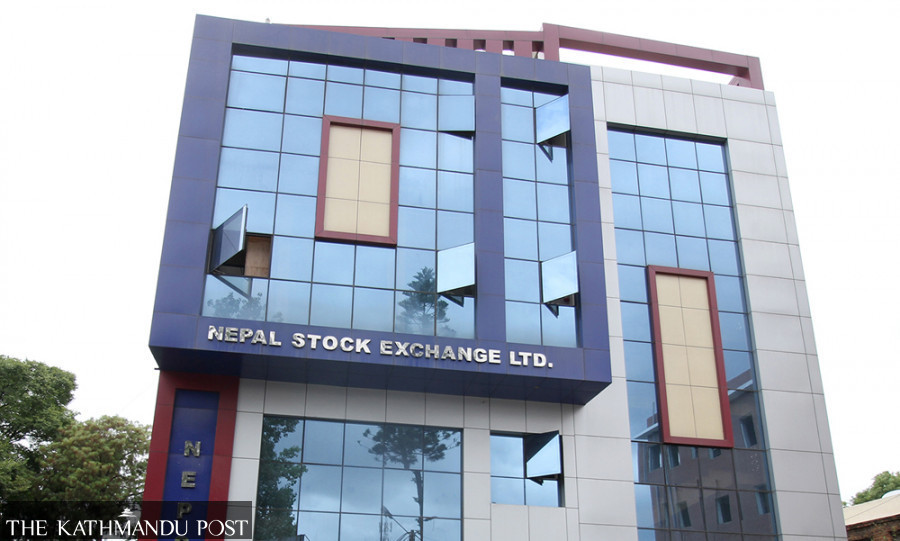
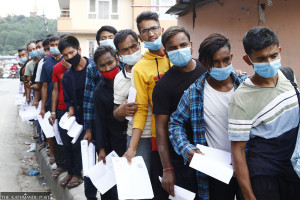
Repeated breakdowns at Nepse, broker firms, data centres and trading systems are eroding investor confidence and raising concerns over the security of more than Rs4.5 trillion in assets. Post file photo
Repeated technical glitches at Nepal’s Stock Exchange have raised concerns over the reliability of the country’s capital market, with experts warning that such disruptions are undermining investor confidence and putting more than Rs4.5 trillion in investors’ assets at risk.
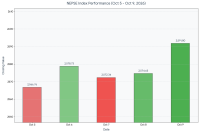
On February 17, 2026, the Nepse index was shown to have plunged by 885.32 points, or 33.34 percent, after the closing prices of some companies were displayed as zero. The stock exchange attributed the unusual fall to a technical error.
On July 23, about 15 minutes after trading had closed, the Nepse website and trading management system (TMS) simultaneously showed the index falling by 1,008 points, or around 37 percent, to 1,717 points. The sharp decline was not an actual market movement but the result of a data or technical error.
On September 21, Nepse halted share trading for the day after a technical problem at Data Hub Pvt Ltd, the data centre used by 72 brokers.
These are only some recent examples. At different times, disruptions have been blamed on technical problems at Nepse, broker firms, YCo Pvt.Ltd (the company managing the trading system), and data centres.
Experts say such recurring disruptions are among the reasons Nepal’s capital market has failed to make significant progress even after more than three and a half decades.
With problems piling up at the country’s sole stock exchange, investors are also being hit by periodic disruptions at broker firms, data centres and the company managing the trading system, says share market expert Niraj Giri.
He says such problems keep recurring because Nepal’s stock market has lacked long-term thinking and planning from the beginning.
“The problems keep recurring because Nepse and other stakeholders have not been sensitive enough to the development and expansion of the capital market,” he said. “Even when I was working at the Securities Board [of Nepal], I had been calling for the introduction of a good, internationally standard trading system, but the market continues to face problems time and again.”
Giri said although the trading system, data centre and other infrastructure are managed by different entities, Nepse should exercise overall control and bear ultimate responsibility for ensuring the market’s reliability.
Such incidents, he said, erode investor confidence in the stock market and create risks to the security of their assets.
Investors have also complained that a limited number of companies have a monopoly over key systems used to conduct share trading, leading to repeated problems.
Investor Subhash Chandra Dhungana said such a monopoly was one reason the problems remain unresolved. “Investors are already struggling to maintain confidence in the market,” he said. “Repeated problems only add to their uncertainty.”
While technical problems in trading systems can occur, Dhungana said the lack of alternative arrangements was a serious weakness.
“The market was closed on Monday, but even now no one knows whether it will open tomorrow,” he said. “Why is there such uncertainty? How can investors feel reassured in such a market?”
Of the 90 broker firms currently operating, 72 were using Data Hub’s data centre. A ransomware attack was detected at the data centre at around 4 am on Sunday and this affected the systems of the 72 broker forms. Nepse suspended trading on Monday following a written request from the Stock Brokers Association.
Brokers, however, said the problem was not of their making.
Narendra Raj Sijapati, former president of the Stock Brokers Association, said brokers had been restricted from managing key infrastructure such as data centres and trading systems, which remained under the control of a small number of business groups. “Whenever there is a technical problem, responsibility is shifted from one place to another. But investors and brokers are always the ones who suffer,” he said.
The Nepse board met on Monday evening to discuss the incident and agreed that trading would not be suspended on Tuesday even if the Data Hub problem remained unresolved, according to a source. “If the problem at Data Hub is resolved, the entire market will open. If not, trading will be allowed through the remaining 18 brokers,” the source said.
The data of the 18 other brokers are hosted by other companies. Those brokers had also requested that trading be allowed on Monday, but Nepse did not agree.
Nepse spokesperson Murahari Parajuli said the market had been closed following a request from the affected brokers after the technical problem emerged at Data Hub. He said there was a possibility of regular trading resuming on Tuesday.
The Securities Board of Nepal (Sebon), Finance Ministry and Prime Minister’s Office were also informed about the market closure and sent their respective teams to gather information.
Sebon chairman Gopal Bhatta said the board was investigating the incident.
“As the regulator, I have sent a team and asked it to investigate,” he said. “The board has instructed Nepse to conduct a thorough study into the circumstances that led to the suspension of trading and submit a report by September 28, along with recommendations to prevent such incidents from recurring.”
The board said it had taken serious note of the technical problem at the data centre where the servers of 72 of the 92 licensed securities brokerage companies were hosted. It deployed a five-member inspection team led by a deputy executive director to identify the technical problems and determine why trading had to be suspended.
The incident, which was detected at Data Hub’s data centre on Sunday morning, remained unresolved until around 11 am on Monday. Data Hub subsequently asked the affected brokers, through YCo, the company managing their trading systems, to suspend trading.
YCo later informed the Stock Brokers Association that the incident had affected multiple systems and services, including the trading management system, systems related to Central Depository System and Clearing , payment gateways and other interconnected services. The affected systems were isolated as a precaution.
According to YCo, the network connection between the data centre and Nepse meant the disruption could pose cybersecurity, operational and data-security risks. It said continuing trading while the impact and extent of the incident were still being assessed could create additional risks.
Stock Brokers Association president Sagar Dhakal said the association asked Nepse to suspend trading after receiving information from YCo about the disruption.




 23.7°C Kathmandu