No school, but a graduation cap for women dairy farmers
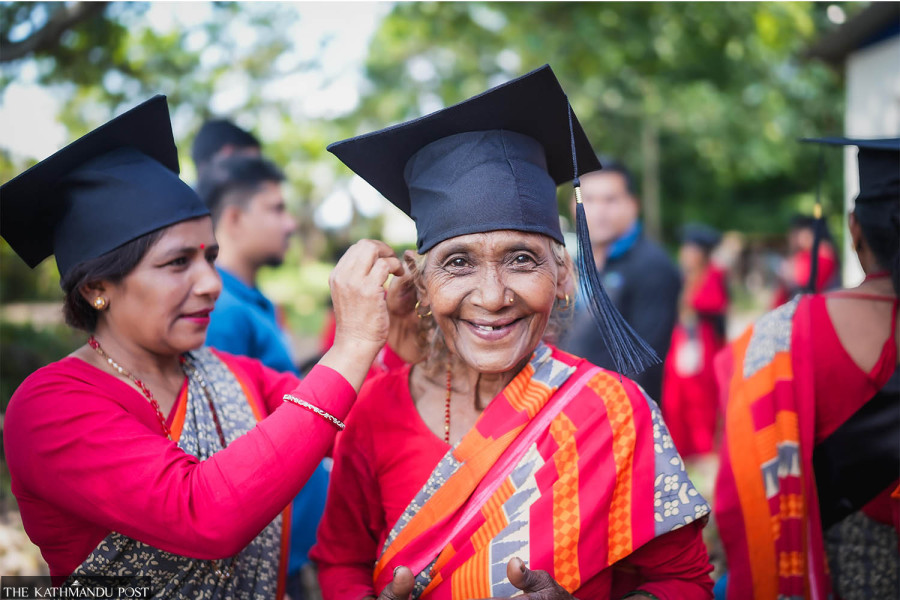
Fifty-six women farmers in Sindhuli have completed four years of training under a Korea-Nepal initiative. They learned modern dairy farming, animal care and financial management. Kamala Subedi, 70, prepares for farmers' school graduation ceremony on Friday in Sindhuli. Sangam Prasain/TKP
At 70, Kamala Subedi has achieved something she never imagined possible: graduating from a school, despite never having attended one.
The graduation, however, was not from a conventional school. After four years of training in animal husbandry, she has received a certificate recognising her completion of 48 sessions at a farmers’ field school in Kamalamai Municipality, Sindhuli.
Subedi's new qualification is already shaping her ambitions as a dairy farmer. Having seen her youngest son, who lives separately, earn a substantial income from raising high-yielding cows, she has acquired a Holstein calf and hopes to follow in his footsteps.
“My youngest son earns Rs120,000 a month as he owns two high-breed cows,” she said.
The difference in milk production between indigenous cattle and improved breed has convinced her that dairy farming can provide a better livelihood.
“I used to get four litres of milk from a cow I reared earlier. This new breed produces 25-30 litres daily. I hope this breed will give me a big income like my son from next year,” Subedi said.
The training has also given her something beyond the prospect of higher earnings: the confidence to manage her livestock using knowledge she had never acquired before.
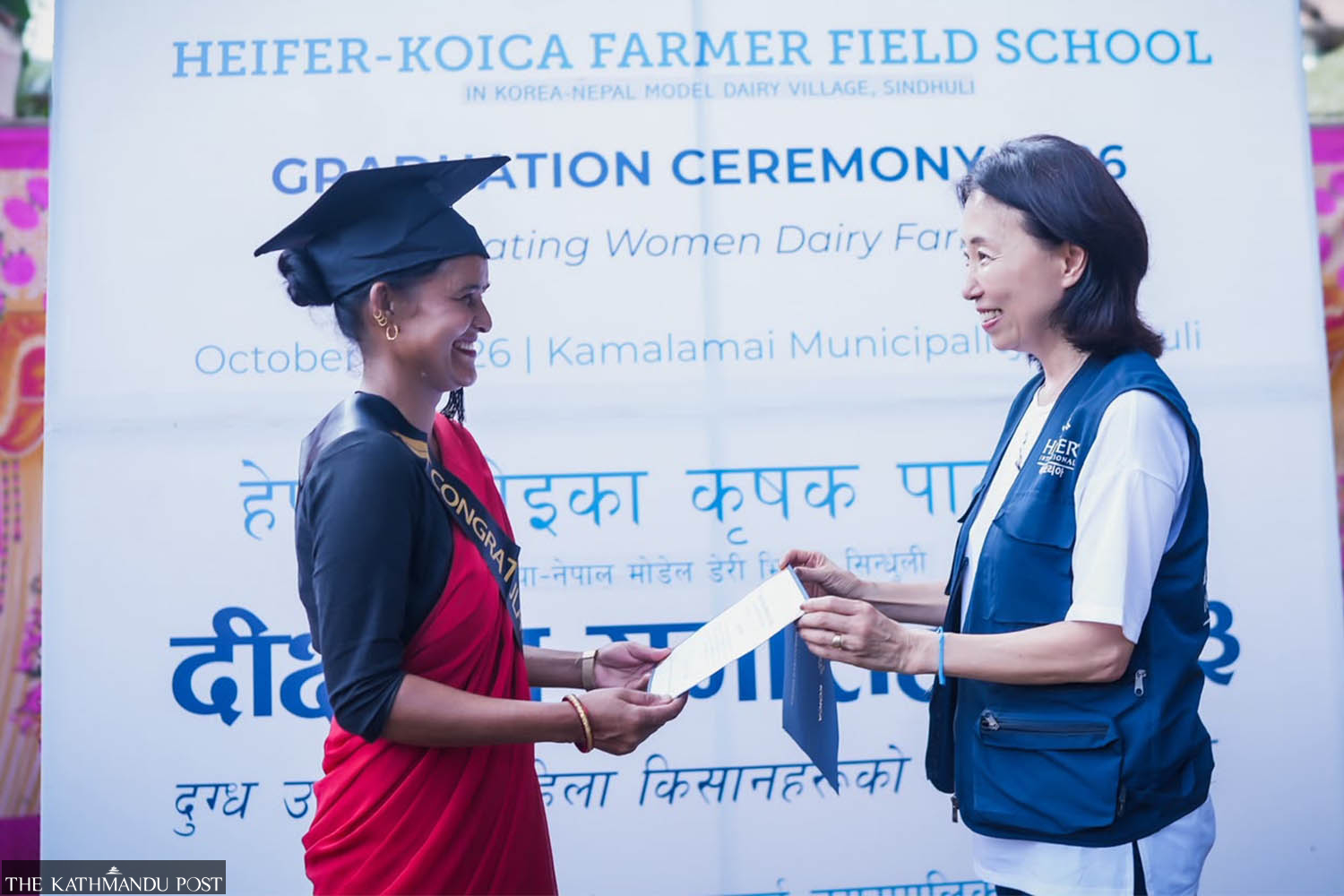
Subedi was among 56 dairy farmers who graduated from the Heifer-KOICA Farmers Field School in Sindhuli on Friday, in what organisers describe as Nepal's first graduation ceremony for dairy farmers completing a structured field school programme.
For the women, the achievement represents more than a certificate. It signals a shift from traditional livestock rearing towards a more systematic approach to farming, while giving them greater confidence in managing money, speaking in public, and participating in community decisions.
For Shanta Thapa, another graduate, the prospect of wearing a graduation cap initially filled her with excitement, but also drew ridicule from neighbours.
“When we first knew, a few weeks before, that we would be graduating and wearing a black hat, we were extremely happy. Some neighbours, however, criticised us. They commented how a woman who cuts grass and collects dung could become a graduate,” Thapa said.
“Today, we received a certificate of graduation. I am extremely happy.”
Before joining the farmers’ field school, Thapa said, her understanding of animal health and modern dairy farming was limited. The classes have since changed how she manages her livestock and views her role as a farmer.
“Before joining the farmers field school, I had limited knowledge of animal health and modern dairy practices. These classes have changed the way I work,” she said.
After four years of training in animal husbandry, farmers received certificates recognising their completion of 48 sessions at a farmers’ field school in Kamalamai Municipality, Sindhuli. Sangam Prasain/TKP
The programme has also helped women develop skills that extend beyond the cowshed. Thapa said the farmers had learned to open bank accounts, save money, and speak at public forums. These skills could strengthen their independence and their participation in community affairs.
“Actually, this is a big honour to all farmers and such an initiative should be taken across the country to make farming a respected profession,” she said. “We now know how to care for our livestock. Most importantly, the farmers' school has taught us to speak in public and raise our voices.”
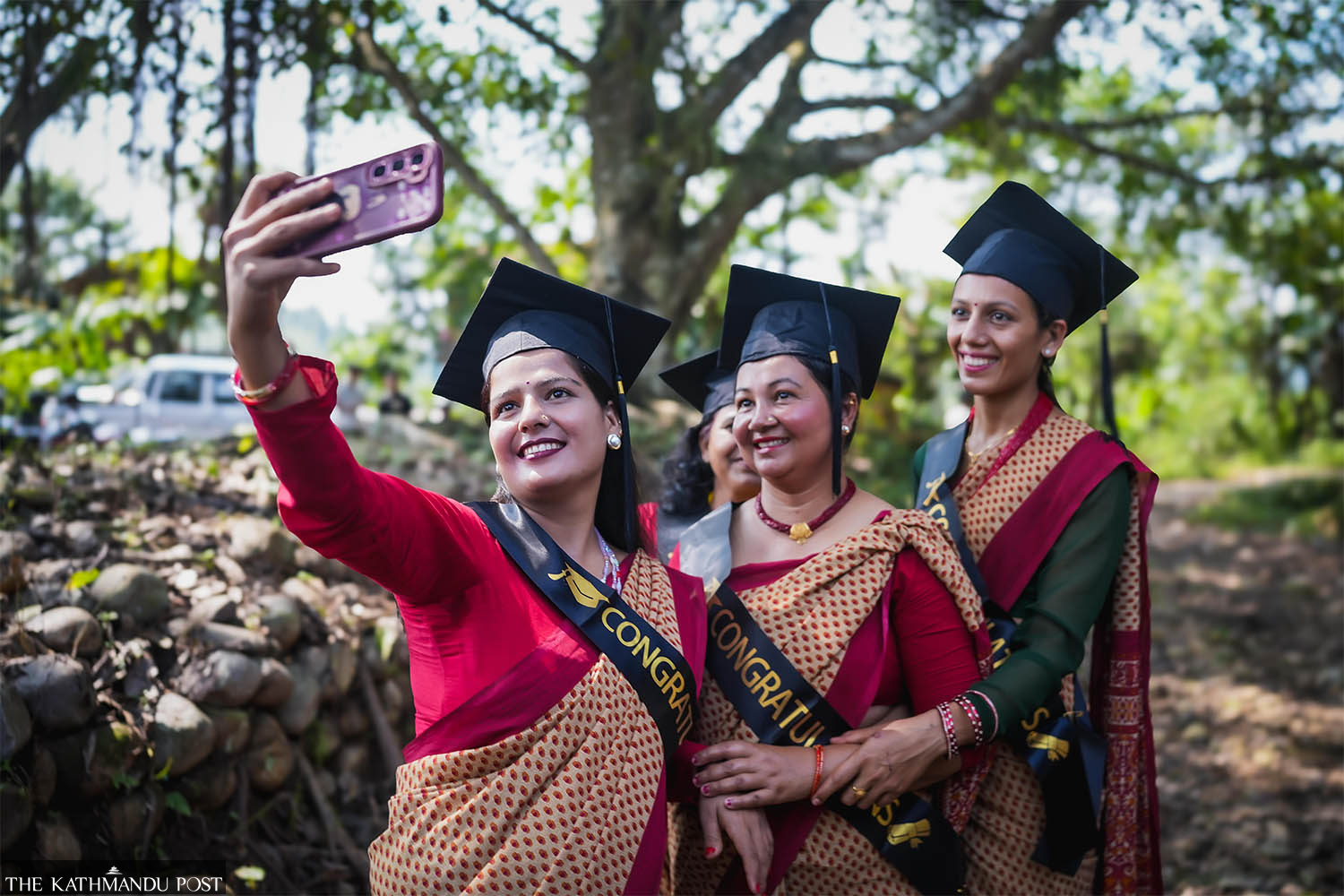
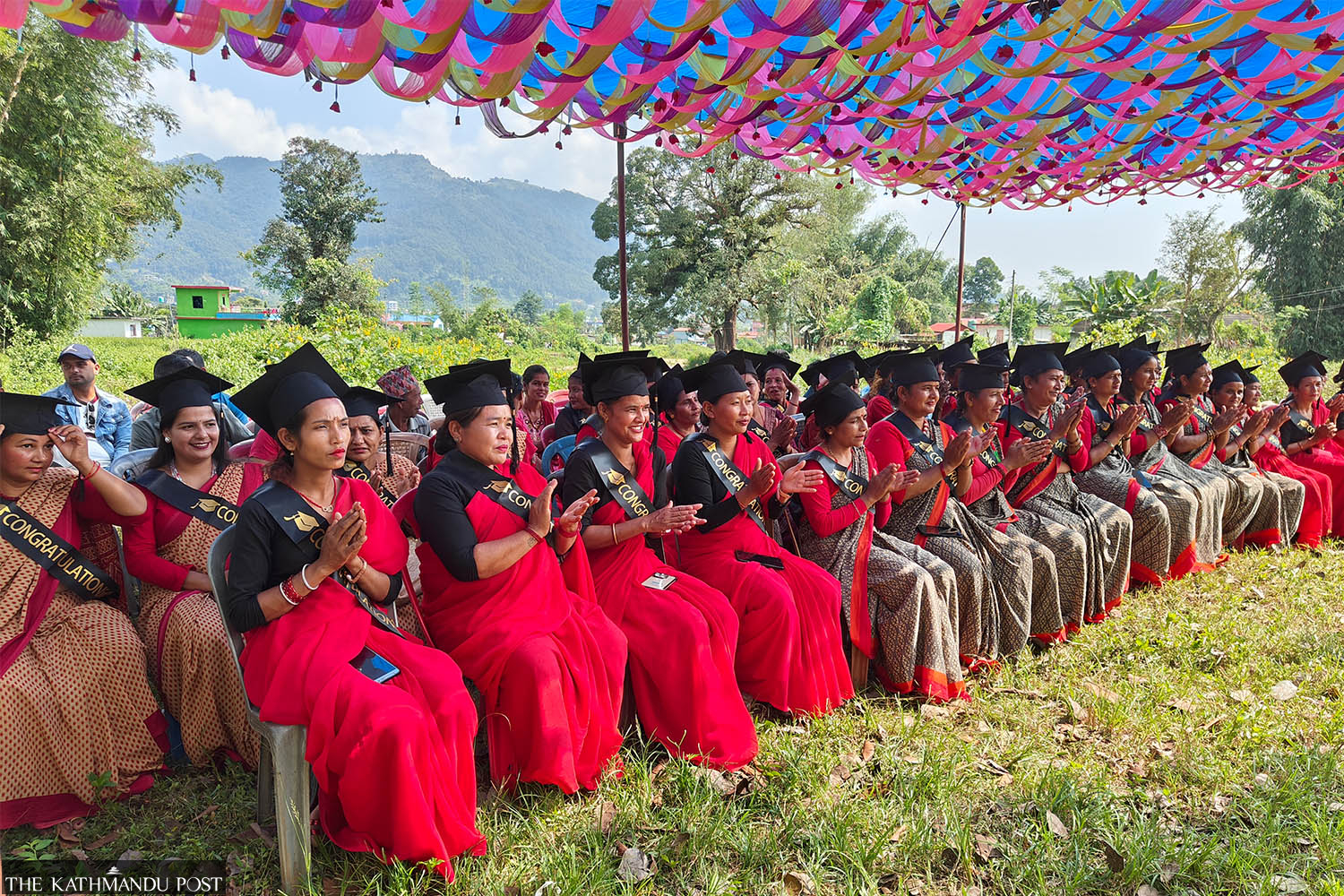
On Friday morning, under a peepal [holy fig] tree in Kamalamai Municipality, 56 women farmers received certificates recognising their completion of the training. The ceremony was a milestone for the Korea-Nepal Model Dairy Village initiative, which seeks to boost milk productivity by combining improved cattle breeds with technical training and modern farm management.
Over the past four years, 105 farmers from ward 5 of the municipality, organised into eight self-help groups, have attended monthly classes. Participants had to complete 48 sessions and maintain at least 80 percent attendance to graduate. The remaining participants are scheduled to graduate in December.
The curriculum covered good animal husbandry practices, animal health and reproduction, and enterprise development. Veterinary technicians, municipal veterinarians and South Korean dairy and veterinary experts provided the training.
For the organisers, the underlying principle is that introducing high-yielding cattle alone will not transform Nepal's dairy sector. Farmers must also understand animal nutrition, disease prevention, breeding, milk production, and the economics of running a dairy enterprise.
Shanta's husband, Ishwar Subedi, 43, said the training had challenged the perception that dairy farming involved little more than cutting grass and collecting dung.
“The field school not only teaches farmers to collect dung and cut grasses, it also teaches modern farming practices. It teaches basic animal care and treatment, how to feed animals and, most importantly, to talk in a group like a leader,” he said.
Bibek Koirala, senior veterinary technician at Heifer Nepal, said technicians had visited farmers' cowsheds over the past four years to impart practical knowledge about nutrition, treatment, and other good farming practices.
“We have shared our knowledge with the farmers. As we believe, a stitch in time saves nine. In an emergency, farmers can provide basic treatment to their cattle,” Koirala said.
Better feeding and healthcare can also increase milk output and improve the productivity of individual animals.
Farmers have also begun using digital tools to maintain records of their livestock. Mobile applications allow them to track activities ranging from fodder and water requirements to milking and milk sales, giving them a clearer picture of the animals' needs and farm operations.
“To keep animals healthy, farmers need proper training and the project objective is not just to give them a cow, but also to teach them how to care for it,” Koirala said.
The initiative is part of a broader effort to improve the genetics of Nepal's dairy cattle and raise the incomes of smallholder farmers.
On Friday morning, under a peepal [holy fig] tree in Kamalamai Municipality, 56 women farmers received certificates recognising their completion of the training. Sangam Prasain/TKP
In December 2022, South Korean dairy farmers and donors, mobilised through Heifer Korea, gifted 100 purebred Holstein heifers, six breeding bulls and high-quality frozen semen to Nepal as part of cooperation between the two countries.
In March 2023, two additional super breeding bulls, each valued at $250,000, were shipped to Nepal to help address the country's shortage of high-quality genetic material.
The aim is to establish a nucleus herd capable of producing high-quality milking cows, boosting dairy productivity, and improving the livelihoods of an estimated half a million smallholder farming households.
Of the donated cattle, 80 were distributed to 51 farming families in Kamalamai Municipality to establish the Korea-Nepal Model Dairy Village. Under Heifer's “passing on the gift” initiative, participating families pass on their firstborn calves to other community members, allowing the improved breed to spread through the farming community.
The programme has since helped expand the population of purebred Holstein cattle in the municipality.
According to the project, Sindhuli now has 169 purebred Holsteins, including 35 bulls, following the introduction and breeding programme over the past four years.
The improved cattle produce substantially more milk than conventional cross-bred cows, and have the potential to transform the economics of small-scale dairy farming.
A cross-bred cow typically produces around 3,200 litres of milk over a 10-month lactation period, while a Holstein can produce about 10,000 litres over the same period, according to Heifer International Nepal.
Some Holstein cows are producing as much as 49 litres a day. This demonstrates the potential of improved genetics when combined with adequate nutrition and veterinary care.
Dr Tirtha Raj Regmi, country director of Heifer International Nepal, said the organisation intended to expand the breed-improvement initiative across the country.
“The Holstein breed has changed the livelihood of many farmers,” Regmi said, adding that a cow producing around 35 litres of milk a day on average could generate sales worth approximately Rs2,275 at the current farm-gate price of Rs65 per litre. Over a 10-month lactation period, that would amount to nearly Rs700,000 from a single cow.
“This is our national campaign for breed improvement. The campaign is becoming real and visible,” he said.
The farmers' field school programme has also given the participants something beyond the prospect of higher earnings: the confidence to manage their livestock using knowledge many of them had never acquired before. Sangam Prasain/TKP
Higher milk production, however, is only part of the challenge. Farmers also need reliable collection systems, processing facilities, and markets that can absorb the additional output.
Kamalamai's milk collection and chilling centre supports more than 300 cooperative members organised into eight groups. The project aims to increase daily milk production to 10,000 litres over the next two years, from around 5,000 litres currently.
Several cooperatives are already supplying about 2,300 litres of milk a day to Sujal Dairy, one of Nepal's largest private-sector milk processing and dairy companies, based in Pokhara.
Farmers receive an average of Rs65 per litre, while the retail market price is around Rs100. The difference reflects the costs and margins involved in collection, processing, transportation, and distribution. It also points to the need to ensure that rising productivity translates into better returns for producers.
The dairy sector contributes around 9 percent to Nepal's GDP. More than 500,000 farming families are associated with the industry, which directly employs over 30,000 people.
Kamala Subedi's graduation may not resemble the conventional educational milestone that many people achieve in their youth. But after a lifetime without formal schooling, she now has a certificate and a new ambition: to turn a Holstein calf into a reliable source of income.
“I have never been to school, but now I know how to care for my cows and earn more. This training has given me confidence and hope for a better future,” said Subedi.
Sangam Prasain is Business Editor at The Kathmandu Post, covering tourism, agriculture, mountaineering, aviation, infrastructure and other economic affairs. He joined The Kathmandu Post in October 2009.




 22.28°C Kathmandu