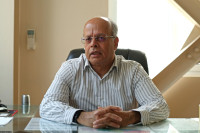
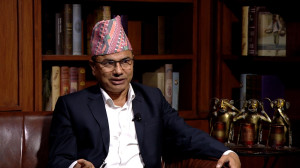
Aviation tycoon Birendra Bahadur Basnet on why farming is safer than flying
After a Rs25 million operating loss at his rice mill, the Buddha Air founder says better storage, distribution and bank-backed guarantees can make agriculture profitable.
Few businesses sit further apart than aviation and rice. Birendra Bahadur Basnet, founder of Buddha Air, has spent a lifetime in one and is now betting heavily on the other. Born in Banaras and raised in Morang, he began farming commercially in the mid-1980s. Today he is building an ‘anchor enterprise’ around Arjun Rice Mill, aiming to link 10,000 bigha of smallholder paddy to bank credit, machinery and a guaranteed buyer.
The experiment is young and has so far lost money. But Basnet believes it offers a template for a country where six in ten people still depend on farming, and where many of the young leave to work abroad. Kantipur’s Suraj Kunwar interviewed Basnet about his family’s land, his father's costly failures, and why he thinks the economics of two bigha can be made to work.
Aviation and agriculture seem like opposite poles. Why did you turn to farming?
It is in the blood. My ancestors came from Solu to Bhojpur, and wherever the family settled, it lived off the land. When they moved down to Tarai, farming remained our livelihood. I was born in Banaras, but Morang is where I did my work. I grew up hearing farming discussed at every meal. I started farming commercially when I was 21.
What was farming like then?
My father bought one of the first tractors in Nepal, a Belarus-built one, and the first thresher. We still kept about 40 oxen, mostly local breeds, for ploughing and for hauling grain. The carts were bamboo-framed with wooden wheels, and carried perhaps 600 kilograms. Taking the harvest to our store in Biratnagar took a night. Today it takes 30 minutes by car.
Your father also introduced commercial bananas to Nepal, and tried coconuts. How did that go?
He brought Malbhog bananas from Assam and other varieties from across the border, and they grew beautifully. The problem was the market. Biratnagar could not absorb the harvest, and half of what we sent to Kathmandu rotted on the way. The coconuts were worse. He saw five trees heavy with fruit near Itahari and planted 2,000 saplings. In today’s money, we lost millions. Fish fry, however, worked. By the late 1980s, we were selling fry worth Rs1.5 million to Rs2 million a year. The lesson was simple: producing is the easy part. Markets are where you lose money.
That problem remains. Why are Nepal’s farmers trapped?
Because too many people farm too little. Roughly 60 percent of Nepalis depend on agriculture. We have no minerals to speak of, no industrial base and no trained workforce for one, so people either stay on the land or leave the country. As I understand it, about 1.4 million of our roughly 1.7 million to 1.8 million hectares of arable land is paddy. Fewer people must farm more land, with machines. Today it is the reverse: many people, small plots, subsistence farming.
What does that mean for the average household?
A household in the Tarai holds about two bigha. At the minimum support price we have announced, I estimate a net profit of about Rs200,000 per bigha, so Rs400,000 a year. That is roughly Rs32,000 to Rs33,000 a month. A worker in the Gulf earns about the same, but in brutal heat and far from his family. The farmer also has hens, a few goats, a cow or two, which add another Rs5,000 to Rs10,000. So he is no worse off staying. But he is not prospering, either.
Larger plots would help. Is land pooling the answer?
Not as a political project. Two bighas are everything to that family, and in the Tarai it is worth Rs8 million to Rs15 million. Try to pool it by force, and there will be bloodshed. So we do it by service. The owner keeps his land. An entrepreneur with machines ploughs, transplants and harvests on a fixed schedule, across hundreds of bighas. The owner no longer tends the bunds. He follows the progress on an app.
How do the machines pay for themselves?
By scale. One mechanised transplanter covers about 25 bigha. For 10,000 bigha we need roughly 100 harvesters and 400 transplanters, run by about 50 young entrepreneurs. That is Rs1 billion in equipment. Machine transplanting also lets us use the System of Rice Intensification, where younger seedlings produce far more tillers. Drones will tell us where to spray or fertilise.
Where does the rice mill fit in?
The mill is the anchor. First, we announced a minimum support price before planting. Farmers are cautious, so it took two to three years of honouring it before they believed us. We also promoted a fine-grain variety developed by Nepal’s own research council, which competes with Indian jeera masino, instead of cheap coarse rice. Now we have about 5,000 bigha organised around Belbari, across 12 or 13 farmer groups, and we are heading for 10,000. The mill buys both the spring and the main-season crop.
And the banks?
That came afterwards, and it changed everything. Once a mill commits to buying a farmer's crop, a bank can lend against that guarantee. NMB Bank's chief executive, his deputy and a credit manager came to see me, and Everest Bank is on board too. The farmer gets working capital or an overdraft in advance. If a family member falls ill, he does not need the village moneylender, who charges two to four percent a month. When the paddy is delivered, the loan is renewed, and the cycle starts again.
What stops a farmer from selling to someone else?
Local governments. Under the Local Government Operation Act of 2074 BS, they can make their own laws to govern such arrangements, including action against defaulters. We are in discussions with them.
Let me ask about the numbers. Is the mill making money?
Not yet. Two years ago we sold paddy worth about Rs200 million. Last year we sold rice worth about Rs400 million, but recorded an operating loss of about Rs25 million, almost all of it interest paid to the banks. We had bought 10,000 tonnes of paddy at Rs50 a kilogram, then prices collapsed, and we sold the rice at a loss, at Rs73 a kilogram. We also made technical mistakes. We stored 1,200 tonnes of spring paddy at 15 percent moisture, and it grew fungus. It needed to be 13 percent.
Distribution seems to have been a headache too.
I once said we would cut out the middlemen. That is hard. You need distributors, and the genuine ones were slow to appear. About Rs30 million to Rs40 million was stuck with one of them. After the change of government, enforcement improved. Police acted, and the money began to come back. This year’s target is 20,000 tonnes, or about Rs1 billion in sales, and a profit of around Rs150 million.
How do you grow beyond one mill?
The Madhesh Province government is preparing tenders for mills, and we are planning a much larger one, of about 100,000 tonnes a year, supported by around 20,000 bigha. Nepal Krishi Company would hold about 10 percent. Farmers would hold 40 to 50 percent. The rest would go to institutional investors, such as the Social Security Fund, insurers, IFC or ADB. Buddha Air has no involvement. We would remain anchor shareholders and not sell.
And once paddy is established?
The rotation fills out: mustard, maize or potato after rice. Each creates its own small industries: feed mills, oil mills, hatcheries, cold storage. A farmer in my district already makes sausages from 2,000 kilogrammes of chicken. Nepal and India are among the few places that still sell live meat. Elsewhere it is frozen, and the feathers, blood and offal are also used. A broiler is optimal at 45 days. Cold storage lets you sell on demand, not on the chicken’s schedule.
You come from aviation, an industry known for risk. Is farming safer?
I think so. Aviation is exposed to the dollar, fuel, spare parts and the market. When roads are open, occupancy falls. Agriculture is not inherently risky. The risk is in the process, in joining the dots, and crops can be insured. We already compete with Indian rice and make money. With El Niño, Indonesia’s paddy has failed, and I am told rain is hitting Thailand. Whoever secures the food supply will win.
Suraj Kunwar is a senior correspondent with over two decades experience covering Aviation, Tourism and Mountaineering. He received the IFJ Tolerance Award in 2005.




 16.49°C Kathmandu