Locals alerted each other of Budhigandaki flood an hour before official warning
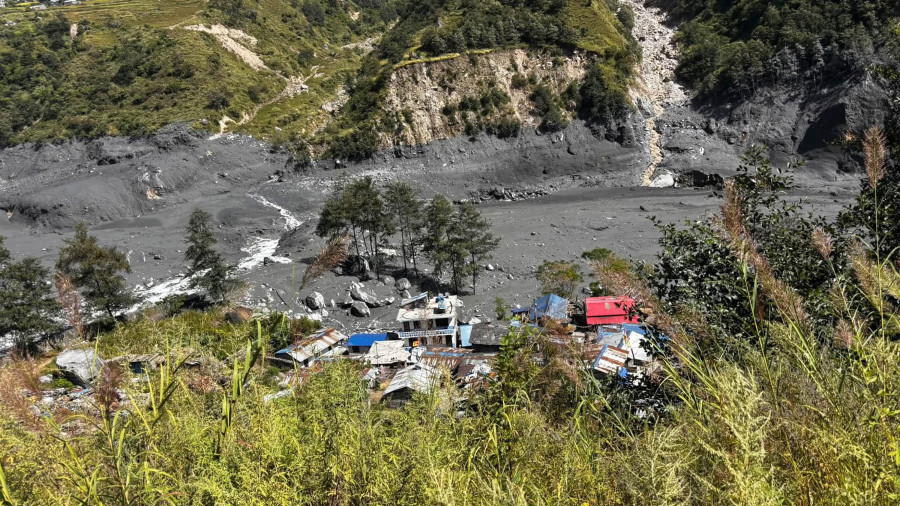
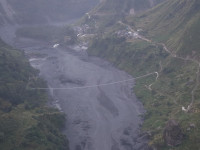
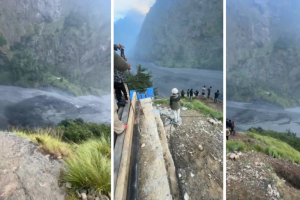
Locals began alerting one another at 4:45 am, but the local police post in Gorkha released the first official warning only at 5:30am. The devastation caused by the Budhigandaki River in Gorkha on Sunday. RSS
When Suna Gurung’s phone rang at around 4:45 am on Sunday, he was fast asleep in Jagatbagar, a riverside settlement in ward 7 of Chumnubri Rural Municipality in Gorkha. He had no idea that a flash flood was surging down the Budigandaki river. A familiar caller from Ghattekhola warned him that a landslide-dammed river upstream had burst and urged him to flee immediately.
“I had driven up to drop off tourists heading for the Manaslu trek and was fast asleep,” said Gurung. “When the call came, I initially couldn’t believe it. But when he mentioned a barrier lake flood, I rushed outside. Within ten minutes, the river swelled dramatically in the dark. We raised an alarm, woke everyone up, and fled into the forest.”
At 4:52 am, local resident Bishal Ghale started a Facebook livestream, appealing to downstream communities towards Arughat to evacuate after his own home was swept away. By 5:06 am, videos posted by another resident of Jagatbagar captured terrified residents fleeing towards higher grounds. Yet, government authorities had yet to issue a warning.
It was only at 5:30 am that the local police post in Arughat released the first official warning. The Flood Forecasting Division and the National Disaster Risk Reduction and Management Authority (NDRRMA) did not receive initial reports until 6:00 am, eventually issuing mass SMS alerts at 6:40 am—nearly two hours after locals had already alerted one another and safely evacuated.
“By the time I received the government SMS on my phone warning us to stay safe, we had already been sheltering in the forest for over an hour,” said Gurung. “The river dried up and surged violently nearly ten times before washing everything. All houses and parked vehicles in Jagatbagar were swept away, and the Manaslu trekking trail has been completely damaged.”
The fact that no one died in Chumanubri was entirely due to community vigilance rather than any state-run early warning systems. Kushal Ghale, another local resident, confirmed that swift action ensured everyone escaped in time. “There were tourists in the market area too,” Ghale said over the telephone. “We rushed everyone uphill into the woods before the surge hit. Not a single life was lost.”
The failure of government warning systems during the Budigandaki disaster reflects long-standing infrastructure deficits across the country’s high-altitude river basins. Remote regions like northern Gorkha, Mustang, and Dolakha lack automated hydrometric stations. As a result, state agencies have little or no advance warning of sudden Glacial Lake Outburst Floods and landslide dam outburst floods.
Previous disasters along the Bhotekoshi river pointed to similar systemic gaps, where early warning networks remained concentrated in lower plains, and this forced mountain communities to rely solely on informal phone chains and social media.
Rajan Bhattarai, deputy director and spokesperson at the Flood Forecasting Division, acknowledged the significant delay in government alerts. “The flood appears to have started around 4:30 am,” admitted Bhattarai. “We sent SMS alerts to upper-belt residents between 6:30 am and 6:40 am, while messages to lower regions were dispatched only after 9:00 am.”
Bhattarai explained that the hydrology department lacks monitoring equipment along the upper stretches of the Budigandaki. The nearest automated water-level sensor is located at Arughat Bazar, roughly 65 kilometres downstream from the landslide site at Tumche in ward 6 of Chumnubri Rural Municipality. “It is extremely difficult to detect flash floods in unmonitored tributaries,” he added. “We ultimately relied on reports from locals and elected officials before triggering the automated SMS system.”
The NDRRMA confirmed sending 221 targeted SMS alerts to security officials and local representatives in Gorkha, Dhading, and Chitwan after 6:00 am. NDRRMA spokesperson Shanti Mahat said emergency notices were broadcast once information was verified. Similarly, Nepal Police posted a public warning on Facebook at 7:17 am, urging residents across Gorkha, Tanahun, Chitwan, and Nawalparasi to move to safer locations.
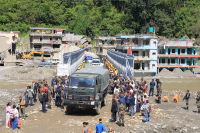
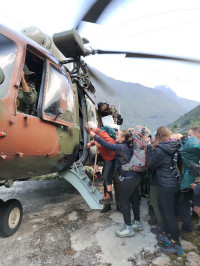
Despite the loss of physical property, bridges, and trekking infrastructure, stranded residents and tourists were later rescued from Philim and Jagat by Nepali Army helicopters, which launched aerial reconnaissance flights at 7:52 am.
While state officials insist that technical constraints in rugged terrain hinder real-time monitoring, affected residents say the incident proves that community-led communication remains the only effective lifeline in the mountains. “If we had waited for the government’s official text message, dozens of us would have been swept away in our sleep,” said Gurung.




 16.49°C Kathmandu