Nepal’s 74-year-old Law Commission remains sidelined in lawmaking
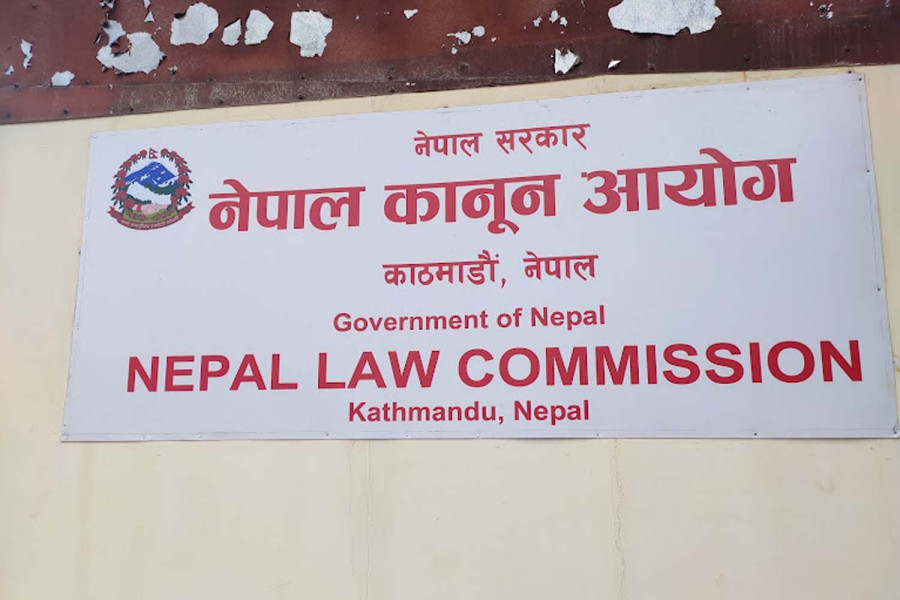
The body was created to research, draft and review laws, but most of its bills never reach Parliament, while ministries continue to make legislation that often becomes contentious. Google Maps
Nepal’s Law Commission spent the last fiscal year studying some of the country’s most complex emerging legal issues, from artificial intelligence and egg donation to same-sex marriage and the pay and perks of public officials.
It also prepared five draft bills and sent them to the government, covering the National Youth Council, compensation for victims of malicious investigation and prosecution, Nepal Scouts, the rights and development of Dalit communities, and amendments to the law governing the commission.
Yet when the government drew up its legislative programme for the current fiscal year, the commission’s work barely featured.
The list of bills to be drafted in 2026-27, submitted by Law, Justice and Parliamentary Affairs Minister Sobita Gautam to Speaker DP Aryal on July 16, contained 166 bills, including 97 new bills and 69 amendments. Only two were directly linked to recommendations from the Law Commission: bills concerning the commission itself and artificial intelligence.
The contrast points to a longstanding question: why is an institution with a 74-year history not at the centre of Nepal’s lawmaking process?
The commission’s own annual report for 2025-26 says it has prepared and submitted 43 draft bills to the government since the Constitution was promulgated in 2015. Around 95 percent of those drafts have yet to become law.
The commission had also prepared four draft bills in fiscal 2023-24, including legislation to tackle conflict-of-interest, amendments to the Prevention of Corruption Act 2002, amendments and consolidation of laws governing medicines, and the National Vigilance Centre.
It had lobbied for a long time to be given responsibility for studying the School Education Bill. Instead, the bill originated at the ministry and later became the focus of a nationwide teachers’ protest.
Teachers staged a Kathmandu-centred movement that lasted nearly a month before ending in an agreement, although they remain dissatisfied with the legislation. The bill has been included again in the government’s latest legislative programme.
The commission was also not involved in drafting bills concerning civil servants, police and the army, despite their implications for Nepal’s constitutional and federal structure.
Commission officials say this pattern helps explain why some major pieces of legislation become contentious.
What the commission is supposed to do
The Law Commission is responsible for drafting laws, studying and reviewing existing legislation, promoting consistency in lawmaking, recommending amendments, maintaining electronic legal records, advising on legal reform and examining whether laws conform to principles established by the Supreme Court. Before drafting a bill, the government can assign the commission to study the subject.
The commission examines its economic and social implications and the concerns of relevant stakeholders, and prepares a study report. Based on that report, it can recommend that the government proceed with drafting legislation. The government then assigns the commission to prepare the bill. The draft goes through the relevant ministry or the Law Ministry before being presented to the federal parliament.
Madhav Poudel, former chair of the commission, says the process is designed to ensure that legislation is grounded in evidence and takes account of those who will be affected.
According to Poudel, the commission normally goes through three stages before drafting legislation: studying the issue, consulting stakeholders, and assessing the economic and practical feasibility of implementation.
“The problem is that most laws drafted by ministries are conceived within Singha Durbar, often without sufficient understanding of realities outside it, and with the involvement of interest groups,” Poudel said. “Our process is designed to produce legislation based on realities rather than the demands of interest groups.”
A former commission official, speaking on condition of anonymity, said ministers and secretaries often lack the initiative or institutional capacity needed to develop legislation.
“If we are allowed to draft the bills, interest groups cannot dominate the process,” the former official said. “Bills involving civil servants, education, health and the economy attract greater vested interests, which is one reason they often do not reach the commission.”
Govinda Sharma Bandi, former law minister, also believes bills drafted through the commission would be less vulnerable to pressure from interest groups and could therefore face fewer disputes.
But the commission’s own drafts have also struggled to make it into law.
On April 13, 2019, it sent the government a draft bill to amend and consolidate legislation governing the establishment, registration and operation of social organisations. The proposal sought to make it easier for citizens to establish organisations while bringing non-governmental organisations within a clearer legal framework.
More than seven years later, it has still not become law. Disagreements between the Ministry of Home Affairs and the Ministry of Women, Children and Senior Citizens prevented it from moving forward, while corresponding legislation at the provincial and local levels has also failed to materialise.
On April 14, 2020, the commission submitted a draft bill to amend and consolidate laws governing land acquisition. It sought to make acquisition for public purposes easier while establishing standards for compensation, resettlement and rehabilitation.
Nearly six years later, the draft has still not progressed towards becoming law. Disputes among the Ministry of Land Management, the home ministry and the National Planning Commission stalled it, even as land-related problems remain a major issue at the local level.
The commission also submitted a bill in April 2019 aimed at speeding up the construction and development of nationally prioritised infrastructure projects. That draft, too, disappeared after reaching the ministry.
More recently, the law ministry separately studied the possibility of establishing a specialised court for infrastructure-related cases and has submitted its report to the Supreme Court’s full court.
These examples illustrate that the problem is not simply that ministries bypass the commission. Even when the commission prepares legislation, institutional disputes and government priorities can prevent the drafts from advancing.
A commission without political leadership
Established in 1953 as the law commission, the institution later became the Law Reform Commission and eventually the Nepal Law Commission. The Nepal Law Commission Act 2007 assigns it a broad role in lawmaking, including drafting bills, researching existing laws and recommending amendments and reforms.
Yet despite that legal mandate, the commission has not been given a central role in the government’s legislative process.
It is currently without its political leadership.
The law provides for experts to be appointed as the commission’s chair and vice-chair.
Jageshwar Subedi, the most recent chair, was appointed on August 26, 2021, and left office on July 30, 2025. The commission has had no chair or vice-chair since then.
Three members currently serve on the commission: law secretary at the ministry Parashwar Dhungana, law secretary at the prime minister’s office Pushkar Sapkota and deputy attorney general Uddhav Pudasaini. All are government officials. Commission secretary Indira Dahal serves as member-secretary.
The commission’s annual report says that since the 2015 Constitution came into force, it has submitted around 50 draft bills to the government, but only 5 percent have become law.
“Initially, there is an attempt to keep the draft bills at the commission itself,” one commission member said. “If they move forward from here, they often reach a ministry and stop there.”
Some of the commission’s recommendations have taken years to move forward. Drafts on consumer protection, amendments to the Senior Citizens Act and food rights were submitted nearly a decade ago.
The government has moved ahead with some of the recommendations, including the Electronic Commerce Bill and amendments to the Prevention of Corruption Act. Other commission-drafted legislation has already become law, including the Privacy Bill, Consumer Protection Bill, Compulsory and Free Education Bill and Evidence Act.
Poudel, who served as chair, says the commission was able to accomplish considerably more during his tenure but has since slowed down as successive governments have paid less attention to it.
“Once the perception took hold that the law ministry and the law commission are competitors, the problem began,” he said. “The commission needs the right people as chair and vice-chair if it is to produce results. The government must then provide adequate financial and human resources. Sadly, neither has happened.”
The commission’s mandate also extends beyond drafting new bills. It can study conflicting laws and recommend their amendment, revision or repeal. It can identify laws that are unequal, discriminatory or inconsistent with human rights and can gather public opinion during the lawmaking process.
But officials and former office-holders say the government rarely uses those powers.
Bandi argues that the solution is to give the commission primary responsibility for drafting legislation while ministries provide policy direction and support.
“The main purpose of the commission is to help protect fundamental rights, reform laws and strengthen the justice system, but the government has not given it the opportunity to fulfil that role,” Bandi said. “If legislation is to be drafted independently of interest groups, bills should come through the Law Commission. Drafts coming from ministries and other agencies often reflect vested interests.”
Poudel is similarly critical of the commission’s current role.
“It is true that the commission has failed to achieve the purpose for which it was established more than seven decades ago,” he said.
He argues that allowing inexperienced individuals or institutions to draft laws wastes time and public resources and makes it harder to maintain consistency in legislation.
The commission itself has repeatedly recommended in its annual reports that Nepal adopt a mandatory single-window system under which legislation is drafted through the commission.
“If the government does not recognise the commission as the country’s official institution for legal research and study, it will never become strong,” Poudel said.
The commission also lacks its own building and faces shortages of staff, according to its latest annual report. It says employees are reluctant to work there and the commission has repeatedly asked the government to create incentives to attract and retain staff.
Secretary Dahal says the commission is working within the limits of its legal mandate and available resources.
“The positions exist, but there are no staff,” she said. “The ministry has also cut our budget, so we haven’t been able to start many of the things we would have liked to do.”
A proposed change raises new questions
The commission’s future role has now become part of another dispute.
The government has proposed amendments to the Nepal Law Commission Act 2007 that would significantly change its leadership structure. Under the existing system, the commission has a separately appointed chair. The proposed bill would instead make the law minister the chair.
The proposal has drawn objections from legal experts and former commission officials, even as the government argues that it would strengthen the state’s capacity to draft legislation.
Law Minister Gautam has acknowledged that, in the past, the government often lacked sufficient institutional capacity to draft legislation and consequently relied on external consultants.
“We raised this issue in Parliament after the 2022 election. How appropriate is it to have the core draft of such a sensitive document, which carries the government’s policies, priorities and legal perspective, prepared by an external institution?” Gautam said. “Expert advice is necessary, but the core capacity to draft bills must exist within the state, and the government must take ownership and responsibility for it.”
She says the proposed legislation seeks to develop the law commission as a centre of excellence for legislative drafting.
Under the proposed arrangement, she said, the commission would prepare the initial draft, the relevant ministry would retain policy ownership, and the bill would go to Parliament only after Cabinet approval. She argues that this would promote consistency in legislation.
Gautam has also rejected the argument that the commission needs a separately appointed chair.
“Some have argued that a separate chair should be appointed. The existing law already provides for a separate chair, but has the commission become stronger?” she said in a social media post. “The Nepal Law Commission is not a constitutional commission like the Election Commission or the National Human Rights Commission. It is an institution intended to strengthen the government’s capacity for legislative drafting and legal reform.”
She also said the proposed arrangement would not provide a separate salary or remuneration for the minister as chair. The executive responsibilities, she said, would remain with the vice-chair.
Her stated objective is to establish a permanent, professional and capable institution for legislative drafting within the state.
RSP lawmaker Yagya Mani Neupane disagrees with that approach. He argues that the commission should be protected from direct government influence and developed as an independent, expert and accountable institution.
Neupane has registered 22 amendments to different clauses and schedules of the bill under Clause 111 of the House of Representatives Rules 2022. His proposed changes address the commission’s structure, appointment of officials, qualifications and tenure, jurisdiction, management of experts, lawmaking by provincial and local governments, and accountability to Parliament.
Poudel also opposes making the law minister the commission’s chair.
“This is an institution whose chair should be a former Supreme Court justice or someone of equivalent standing,” he said. “A minister is a political person. This institution needs expertise and should be kept separate from government and politics.”
He questions how the commission could advise the government on how to make laws if the law minister were simultaneously running it.
“If the minister wants to study a legal issue, the ministry itself can do that. There is no need to go to the Law Commission or elsewhere,” Poudel said. “Rather than making the law minister the chair, the commission should be given an environment in which it can work. It cannot function under the government’s supervision and direction.”
Bandi, however, says he tried to strengthen the commission during his tenure as law minister by providing resources and assigning it work.
“I tried to activate the commission in studying what laws needed to be made, what amendments were necessary and in drafting bills,” he said.
Capacity is still the immediate problem
The commission’s relevance, however, depends not only on what the government does but also on its own ability to deliver.
Dahal says the commission is working with the staff and resources available to it.
A draft bill on egg donation is in the works, she said. The commission is also studying public officials’ pay and benefits because of inconsistencies across public bodies and is working on a draft based on that study.
Other ongoing work includes research into ways to improve and make the justice process more effective, as well as identifying laws that are no longer justified and recommending their repeal, revision or amendment.
The commission is also working on a legal dictionary and upgrading its website.
The institution was established after the political change of February 18, 1951, with a mandate to support legal reform through new legislation, codification and review and amendment of existing laws. It has since operated under a separate law, but successive governments have struggled to turn it into the effective legislative institution envisaged by its mandate.
Poudel says successive governments have treated appointments to the commission as political allocations, weakening its ability to build specialist capacity. He points to law commissions in common-law countries such as India and Britain as examples of institutions that play a more established role in legal reform, and says the government has repeatedly ignored proposals to strengthen Nepal’s commission.
“If political appointments are made simply to fulfil the formality of having a commission, how can better results be expected?” he said.
For now, the central problem remains the gap between what the law commission is legally empowered to do and the role it actually plays.




 20.51°C Kathmandu