Nepali football in free fall as FIFA ban, league shutdown drive players away
With stalled domestic leagues, an indefinite FIFA suspension, and players moving abroad, the country’s most popular sport keeps sinking into an unprecedented crisis.Former national footballer Bishal Shrestha (centre), who is now serving as the vice chairperson at the National Sports Council, gives a speech when players left their medals hanging at ANFA’s gate as a form of protest demanding resumption of domestic football in November last year. Post file photo
Nepal’s top-tier domestic club football competition, the Martyr’s Memorial ‘A’ Division League, has not been organised for over 1,100 days—since Church Boys United lifted the title, on June 10, 2023, on their debut in the top flight.
The inability to organise the club football cycle—A, B and C Division and C-Division Qualifier—timely has led an increasing number of footballers to leave the game—and the country—in search of other sources of livelihood abroad.
Things took a turn for the worse when, on June 24, FIFA, the global footballing body, suspended Nepali football for an indefinite period. Stakeholders now worry that football in Nepal—once the country’s most loved game—is dying a slow death.
“I don’t think Nepali football has ever hit a lower point,” says Bal Gopal Maharjan, a veteran coach and former footballer.
Maharjan recalls a comparable period of uncertainty around 2000, when two parallel ANFA factions existed. But even that, he notes, was not as dire as the current situation.
A legend of his playing era, Maharjan went on to become one of the most successful coaches in both domestic and international football. His primary concern now is the regression of Nepali football’s competitive standards.
Ever since FIFA suspended ANFA, citing third-party interference, all footballing activity has effectively ground to a halt. Stakeholders remain silent.
Without regular matches, the danger is not just losing players, but a dramatic decline in the country’s overall football standard. “At the South Asian level, we could at least go toe-to-toe and mount a strong challenge,” Maharjan recalls. “We entered every tournament as title contenders. That might no longer be the case. As players leave, it will directly hit performance levels.”
To make matters worse, there is no clarity on when Nepal will next play international football. The last time Nepal’s men’s team played international football was on March 31, in the Asian Cup Qualifiers against Laos.
Had everything been on track, the national team would currently be preparing for the SAFF Championship. Head coach Guglielmo Arena had even arrived in Kathmandu for that purpose, but returned home after resigning from the role, citing the FIFA ban and uncertainty of football’s future in the country.
The South Asian tournament is scheduled to run from November 4 to 17 in Dhaka, Bangladesh. But while SAFF announced the dates, it did not detail how the competition would be structured without Nepal, one of their biggest audiences.
It is clear that the regional body is waiting to see when FIFA lifts its ban on Nepal. If a concrete resolution is not reached soon, the SAFF Championship could be held without Nepal for the first time in history.
And without football, more players are disappearing.
“Right now, even the remaining players lack both match exposure and experience. Football isn’t just played on the pitch. It’s a mental game,” Maharjan adds. “It is tough for everyone—from coaches to referees—but players are suffering the most as the income dries up; everyone searches for something else. My biggest fear is that we will see more players leaving the country.”
When Arena was still in Nepal, he had only one message: football must keep happening, and national team training must run continuously. Regular training maintains a team’s baseline performance, and without it, he warned, the situation would become precarious.
But with over three years of no regular domestic football followed by a FIFA suspension, Nepali football has hit rock bottom. It means that hundreds of footballers have seen years pass without their main source of livelihood.
“We are in constant contact with the players. Everyone is frustrated and uncertain about their future,” says Bikram Lama, president of the Nepal Football Players Association. “Right now, football players have zero income. Everyone is effectively unemployed. If this continues, players will be forced to look for alternative careers.”
However, Lama maintained that efforts are being made from their side to end the crisis.
The last official domestic competition held was the National League, a separate event in the football cycle that saw its format changed only to shut the critics. It is initially a 10-team tournament—comprising the top four teams of the President League and the top six teams from the previous ‘A’ Division League.
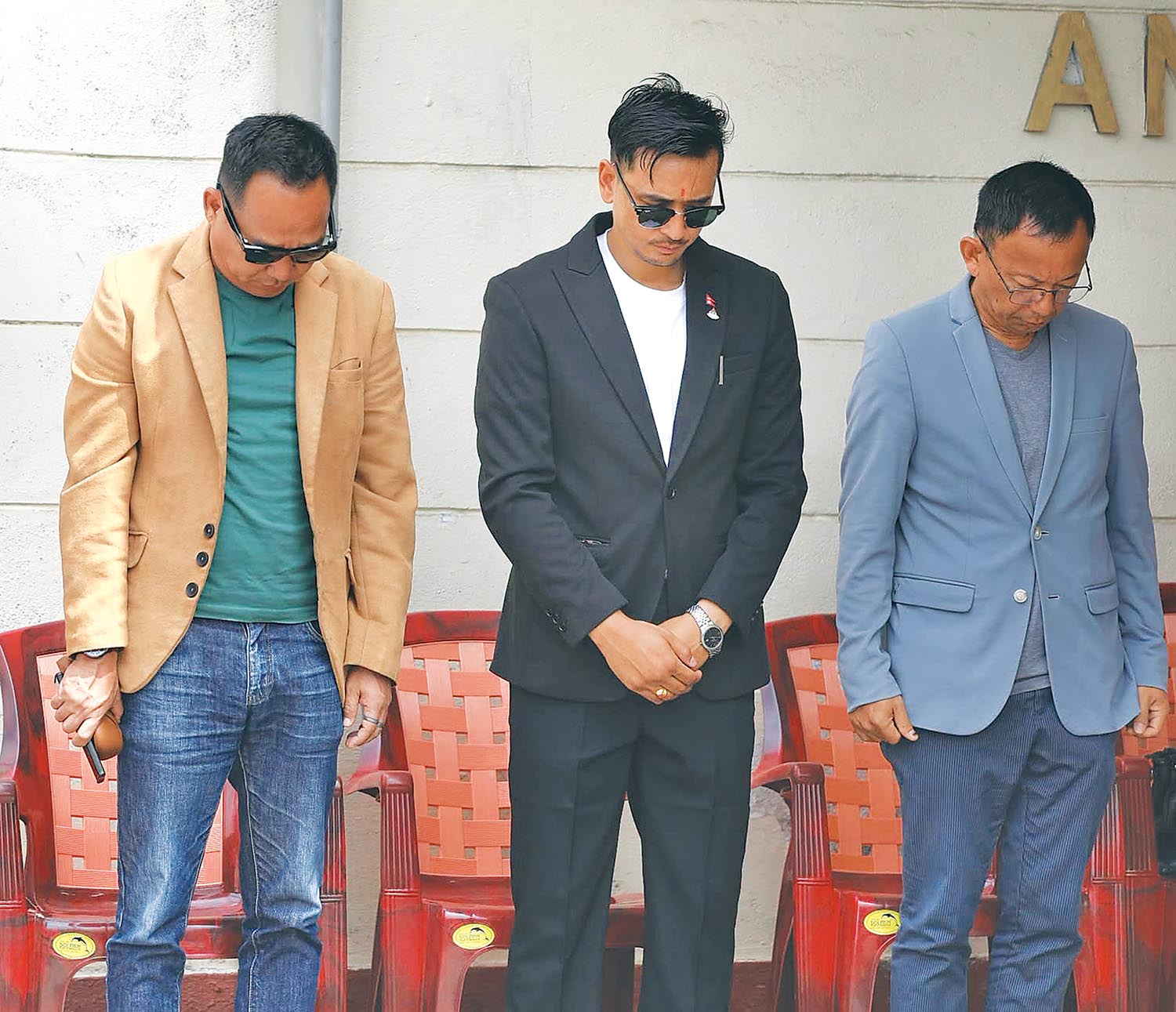
(From left) Kiran Rai, ANFA general secretary, Bishal Shrestha, NSC’s vice chair, and Pankaj Bikram Nembang, ANFA president, observe silence during the 11th death anniversary of former ANFA President Lalit Krishna Shrestha at ANFA Complex in Lalitpur on June 12. Courtesy of ANFA’s Facebook
However, when the National League commenced on January 14, it saw 17 teams as ANFA caved in to the pressure from the remaining A-Division clubs, who kept pressuring for the regular division league football, and allowed all of them to participate. Had Himalayan Sherpa Club also participated, the number would have been 18.
But the National League never concluded as it got postponed on March 18 with 38 of the 136 matches remaining. Not only the National League, but even the Martyr’s Memorial ANFA Women’s League got postponed on March 19, only a day after the tournament began.
The tussle between the NSC and ANFA also saw the national women’s team lose their participation in the FIFA Series. The players, who were training with uncertainty, felt lucky when they could participate at the SAFF Women’s Championship in Goa, India, last month.
But now, it is uncertain when Nepal will next play an international match, let alone the resumption of the domestic football cycle.
“Since the National League and Women’s League were postponed, almost all players have been left without an income,” Lama said. “Mid-tier players have largely disappeared from the setup, while national team members remain conflicted about their next steps, reluctant to speak publicly about their future plans.”
Insiders acknowledge a grim reality: by the time ANFA’s suspension is lifted and football returns to the pitch, finding enough active players could prove difficult. It was already difficult for the teams in the National League.
According to ANFA’s own data, there are 60 national team players across the men’s and women’s squads, 92 ANFA-licensed coaches, and 14 FIFA referees.
Across the division cycle, there would have been 1,260 registered players. Similarly, the domestic women’s scene would have seen at least 360 active female footballers.
A few days ago, several clubs released a joint press statement emphasising that thousands of players, coaches, officials, and dependents are suffering severe hardship.
Among them was Sankata Club. Its president, Indra Man Tuladhar, insists that domestic football must keep moving regardless.
“FIFA hasn’t banned domestic football,” notes Tuladhar, who is also the chief executive officer of ANFA. “At the very least, domestic tournaments should continue.”
Clubs had signed players on three-month contracts for the now-halted National League, but those contracts have expired. Aside from departmental team players, almost no footballers are currently under professional contract.
“However, under the National Sports Council’s latest directive, even domestic football cannot take place. FIFA’s ban only restricts international participation. It is high time domestic football got moving again. When the FIFA ban will be lifted is one thing, but that shouldn't stop domestic football from running.”
Meanwhile, former national team player Bishal Shrestha currently holds a leadership position, vice chairperson, at the NSC. Shrestha effectively retired from playing upon joining the council—prior to which he was one of domestic football’s longest-serving players.
“We are certainly worried about the players,” Shrestha says. “We are actively trying to find solutions to this crisis in Nepali football. Something needs to be done to keep domestic football active, but for concrete steps to be taken, we simply have to wait a little longer.”
How long? Nobody knows. Even the government, which has been directed by FIFA to ensure that ANFA can operate independently for the suspension to be lifted, has remained mostly silent about it.




 15.26°C Kathmandu