Crop-raiding monkeys are leaving hill farmers nothing to live on
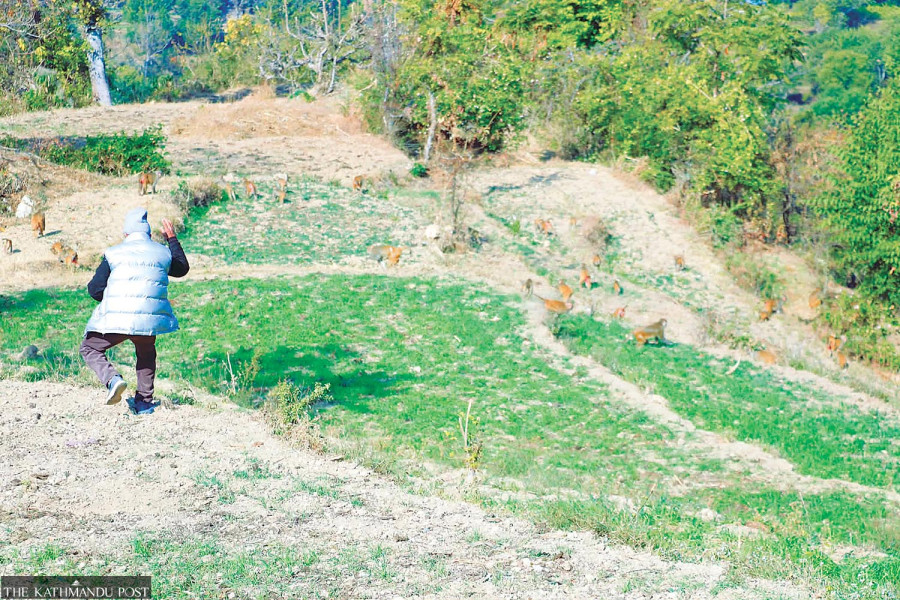
Farmers and local authorities have tried everything to protect their crops—planting fruit trees in forests, cutting down trees near fields, firing guns to scare animals, and guarding farms all day—but nothing seems to work. A man goes after monkeys in a field in Dasharathchand Municipality, Baitadi. Post photo
From east to west, monkey menace on farms has become a growing crisis across Nepal’s mid-hills, driving farmers to despair, emptying granaries and, in some places, forcing entire settlements to abandon agriculture and migrate elsewhere.
The problem has become so severe that migration caused by monkey attacks is now seen as almost routine in many rural communities.
Farmers and local governments have tried a raft of measures to protect crops, from planting fruit trees in forests and diverting monkeys away from villages, to cutting down trees near fields, firing guns to scare animals and guarding farms throughout the day.
Last Friday, Laligurans Municipality in Tehrathum district even declared a public holiday so residents could focus on driving monkeys away from farms.
Frustrated locals say they now demand monkey-control programmes from municipalities instead of development projects. While local governments are typically expected to address education, healthcare, employment and infrastructure, farmers increasingly ask authorities for funds to protect crops from wildlife.
But residents say the government has neither a long-term plan nor an effective solution.
During the House of Representatives elections in March, candidates from various political parties had made monkey control a key election agenda. Voters, recounting the hardship they have endured, had placed monkey control at the top of their demands.
In line with the electoral promise, lawmakers representing those districts have now begun raising the issue in Parliament. While some MPs have argued that the menace must be curbed even if it means killing the monkeys, others have objected to such proposals.
Monkeys have not only been destroying crops but have also forced local residents to abandon their settlements across the hills after years of relentless hardship and distress.
In Kartike of Phungling Municipality-3 in Taplejung, four of the five sons of local resident Lilaram Puri have migrated elsewhere with their families. The remaining son no longer lives in the village either. Similarly, six of the seven children of Lilaram’s brother Tularam have also left their birthplace.
According to neighbour Netra Prasad Bhattarai, relentless attacks by rhesus monkeys and langurs drove residents out. “When families were larger, people would gather in groups to chase the monkeys away,” he said. “But once several large families began leaving, more than a dozen other households gradually followed, and the village emptied.”
With residents gone, farming in Kartike has virtually stopped. The abandoned settlement is now dominated by monkeys, langurs, porcupines and deer.
In Bhedabari of Phungling-8, farmer Chaitanya Ghimire has repeatedly appealed to local authorities for help controlling the animals. Despite cultivating maize, paddy, fruits, vegetables and saplings, he has failed to save his crops or find reliable preventive measures. “They climb the saplings and snap off top shoots. Once the tip breaks, the tree grows crooked. Even bamboo shoots are destroyed before they can grow,” said Chaitanya.
Kuruletenupa village in Chaubise Rural Municipality of Dhankuta has been left deserted. Residents abandoned their ancestral homes after growing frustrated by the destruction of crops caused by monkeys and other wild animals. Settlements that were once densely populated are now lined with empty houses. Many homes have already collapsed, while others remain locked and abandoned. Most of the houses, roofed with thatch, have begun deteriorating rapidly.
According to local resident Gopi Krishna Bhandari, the outmigration has steadily intensified since 2006, with the situation becoming even more alarming from last year onwards. “People have been leaving the village because wild animals continue to destroy crops and there is also a severe shortage of drinking water,” Bhandari said. “If the problem of wild animals could be controlled, it would provide some relief.”
Nearly 300 families have already been displaced from Kuruletenupa, which forms wards 3 and 4 of Chaubise Rural Municipality. The Bajathala area is also gradually emptying, while most houses in Andheri village now stand vacant.
Rajkumar Chemjong, chairperson of Chaubise Rural Municipality, said the pages of migration registration records are steadily filling up as more residents continue to leave their villages in search of safer and more sustainable livelihoods elsewhere.
In Panchthar district, residents of ward 4 in Phidim Municipality have begun organised patrols after monkeys increasingly destroyed crops. Villagers now take turns guarding fields, with at least one member from each household participating.
Somnath Dhakal, a resident, said monkeys have become a major problem in Salghari, Thakle, Thapatar, Tiratire, Saranta and areas around the Hewa river.
Residents say monkeys no longer target only ripe crops. They also eat newly sprouted plants, young shoots and even stored grain such as maize kept inside homes.
Ward offices have begun allocating small budgets for protection efforts. Phidim-4, for instance, set aside Rs100,000 this fiscal year for monkey management. The money is being used mainly to provide snacks for villagers guarding fields.
Likewise, ward 1 of Kummayak Rural Municipality in Panchthar has hired nine guards to protect maize from monkeys. The guards receive about Rs16,000 each through daily wage payments, while the ward office has supplied equipment used to chase monkeys away.
In Dolakha’s Shailung Rural Municipality-8, Ram Bahadur Karki, aged 56, died of a heart attack in July, 2022, while chasing monkeys away from his maize field. According to Nakul KC, former ward chair of Bhimeshwar-8, Karki collapsed in the field as he was running after the animals and died on the spot.
Relentless monkey attacks have also forced residents of Baharkoche in Bhimeshwar Municipality-8 to abandon their homes. Former ward chair KC said 15 families had migrated to safer locations since 2017 after monkeys repeatedly entered houses and attacked family members. The growing menace has left many residents feeling unsafe even inside their homes.
The impact has also been severe in Raut village near Charikot, the district headquarters in Bhimeshwar-3, once known for its thriving commercial vegetable farming. Farmers there have now been driven away from vegetable cultivation because of constant crop destruction caused by monkeys.
Every morning before dawn, Goma BK heads to the edge of her fields to guard her crops from marauding monkeys. Her daily routine revolves around watching over the farmland for hours to prevent the animals from destroying vegetables and other produce. She only returns home when another family member arrives to take over the watch so that she can eat and rest briefly.
Locals say the monkey menace has transformed daily life across many settlements in Dolakha, where people now spend much of their time protecting crops instead of farming productively. Farmers complain that years of labour and investment are being wiped out within hours by troops of monkeys descending on fields and orchards.
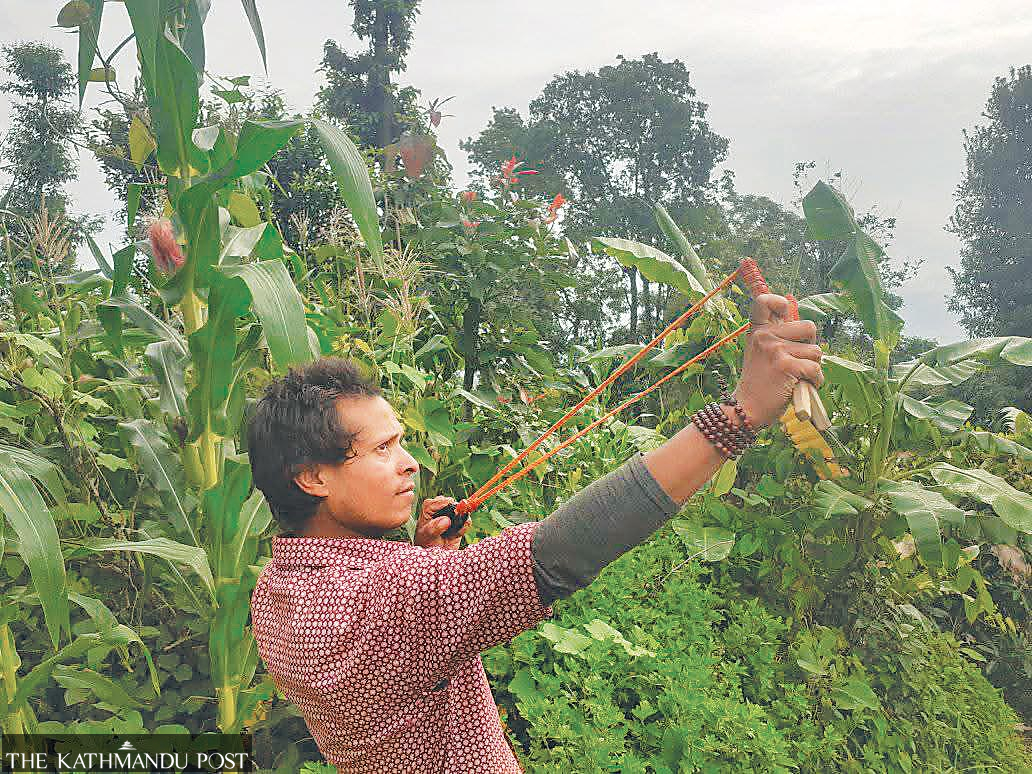
A man trains his catapult at a monkey (not in picture) to scare away the animal in Dolakha. Post photo
In 2013, residents of Dharan formed the ‘Monkey Victims Struggle Committee’ to draw the attention of all three tiers of government to the growing monkey menace. However, according to Shanta Rai of Dharan Sub-Metropolitan City-12, local, provincial and federal authorities have failed to take the issue seriously.
“Despite repeatedly raising our concerns, the monkey problem remains unresolved,” she said. “Everyone treats it as a joke. Life has become unbearable for us. People may find such incidents amusing when they see them on social media, but only those enduring it truly understand the suffering.”
Residents of Dharan wards 1, 2, 3, 12 and 14 have been among the worst affected. In the old market area, monkeys have reportedly become even more aggressive after incidents in which some were electrocuted and fell to the ground.
Locals say the animals frequently enter homes, contaminate food, tear household belongings and damage property, leaving residents frightened and exhausted by the constant disturbances.
In western hill districts such as Arghakhanchi, Gulmi and Palpa, residents say monkey and wild boar attacks are increasingly forcing people to leave farming and migrate elsewhere.
Kul Bahadur Pariyar of Shitganga, Arghakhanchi, said repeated destruction of maize, millet and potato crops by monkeys and wild boars has accelerated the abandonment of agriculture.
Leela Pokharel of Panini Rural Municipality said people from all eight local units in Arghakhanchi are migrating every year in search of jobs and safer livelihoods because they can no longer protect crops from wildlife. According to him, around 1,700 people leave the district annually.
The crisis is particularly severe in settlements near forests in Shitganga, Bhumikastan, Malarani, Chhatradev, Panini and Sandhikharka. Farmers in these areas have increasingly demanded compensation. Between the fiscal years 2022-23 and 2025-26, nearly 600 applications seeking relief for wildlife-related crop losses were filed at the Division Forest Office in Arghakhanchi.
Although forest authorities coordinated with local governments to hire 20 guards last year, locals say the effort was largely ineffective. Hari Prasad Basyal, a federal lawmaker elected from Arghakhanchi, has also raised the issue with the government.
Farmers in Palpa say they have struggled with monkey attacks for more than a decade. Krishna Prasad Pandey of Ribdikot said troops of monkeys can destroy a season’s crops within minutes, rendering farmers’ efforts futile.
Although all 10 local governments in Palpa mention wildlife control in their annual policies and programmes, residents say little or no budget is allocated.
“With people migrating to cities, monkeys now rule the villages,” said Mukti Aryal of Rampur.
Ribdikot Rural Municipality-1 hired nine guards last year and plans to continue the programme this year. The Division Forest Office in Palpa also plans to install 160 metres of barbed-wire fencing this year.
Khil Bahadur Tamang, information officer at the office, said promoting crops less attractive to wildlife, such as broom grass, timur pepper and bay leaves, could help reduce human-wildlife conflict.
In Baglung, some farmers have cut down trees around farmland to stop monkeys from using them as shelter and launching points for attacks on crops.
Chandra Bahadur KC of ward 13 in Baglung Municipality said locals in wards 12, 13 and 14 felled trees themselves after monkeys began gathering around homes and fields, destroying crops and harassing residents.
Narayan Prasad Paudel, ward chair of Baglung Municipality-13, said migration from the southern parts of the district has steadily increased because of the monkey menace.
Studies estimate Nepal’s monkey population at around 500,000. Researchers say the animals require roughly 1,000 metric tonnes of food every day, with about half coming from crops. The growing dependence of monkeys on cultivated land, experts say, is intensifying conflict between humans and wildlife across rural Nepal.
In Salyan, attacks by monkeys and wild boars have also intensified. Farmers say the animals destroy maize, wheat and other crops, while incidents involving attacks on people and livestock are also increasing.
Many farmers now spend entire nights awake in fields to protect crops. In some places, recurring losses have led farmers to stop cultivation altogether.
According to the Division Forest Office in Salyan, 114 applications seeking relief for wildlife-related losses to crops, livestock and humans were filed in the previous fiscal year. Office chief Tek Bahadur Rawal said 129 applications have already been submitted this fiscal year. One person was killed in a tiger attack during the period.
Efforts to control monkey menace bear no fruit
Local governments experiment with guards, traps and plantations, but farmers say crop destruction continues unabated.
Local governments have introduced various measures to control the growing monkey menace, but most efforts have yielded little success, leaving farmers increasingly frustrated.
Pakhribas Municipality in Dhankuta deployed two monkey watchers equipped with gumboots, slingshots, torches and sticks after crops began suffering heavy damage. Mayor Gyan Bahadur Gurung said the scheme, launched in January, covers all wards and mobilises watchers whenever residents report monkey intrusions.
The National Citrus Research Programme in Paripatle has allocated Rs500,000 for monkey watchers to protect its annual orange production of around 30 metric tons. However, locals say such measures have done little to reduce crop losses.
Dhankuta Municipality had earlier launched a campaign with a Rs1 million budget to capture and relocate monkeys using trained manpower. Although authorities claimed around 600 monkeys were relocated, residents say the problem remains as severe as before.
Sahidbhumi Rural Municipality has started planting fruit saplings in forests and barren land, hoping monkeys will remain in jungle areas instead of entering settlements. Chairperson Manoj Rai said the initiative was aimed at maintaining ecological balance while reducing attacks on villages. Yet farmers in the fruit-producing region continue struggling to protect litchi, mango and banana orchards.
In Dolakha, local governments experimented with firecrackers and other deterrents, but none proved effective. Kalinchok Rural Municipality even proposed a ‘one house, one monkey’ scheme, though legal hurdles prevented implementation.
Meanwhile, Ribdikot Rural Municipality in Palpa plans to continue hiring monkey watchers and installing barbed-wire fencing after limited success last year.
Nepal is home to three species of monkeys—the rhesus macaque (Macaca mulatta), the Assamese monkey (Macaca assamensis) and the Hanuman langur (Semnopithecus entellus).
Nepal is a signatory to the Convention on International Trade in Endangered Species of Wild Fauna and Flora (CITES), the global treaty that regulates trade in species under threat. That rhesus monkeys are listed in CITES means their international trade is restricted. It prohibits the export of wild animals and plants without government permission.
The National Park and Wildlife Conservation Act also includes rhesus monkeys on the list of protected animals, thereby prohibiting its export without government permission. However, the act does not mention any measures for controlling protected animals that threaten people and agricultural production.
(Ananda Gautam in Taplejung, Ramesh Chandra Adhikari in Dhankuta, Dambar Singh Rai in Khotang, Elina Rai in Dharan, Madhav Aryal in Palpa, Biplob Maharjan in Salyan, Prakash Baral in Baglung, Santosh Mahatara in Gulmi, Birendra KC in Arghakhanchi reported this story.)




 19.26°C Kathmandu