



 16.76°C Kathmandu
Sat, Oct 10, 2026
National
Women are often at the centre of Nepali films. Why are men still telling most of their stories?
A debate over an all-male film pitch panel has reopened deeper questions about power, representation and who gets to shape women’s narratives.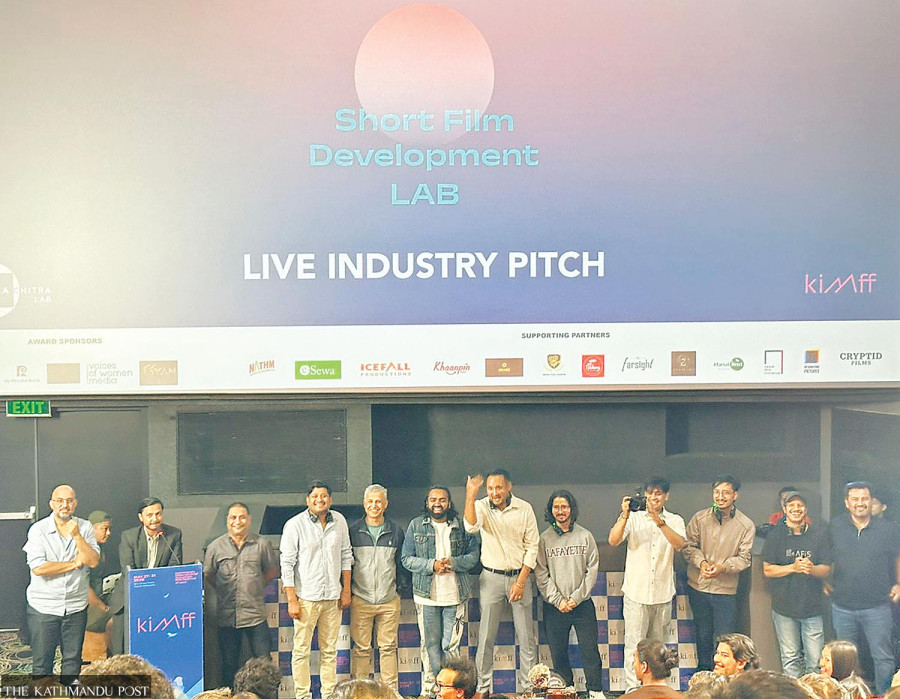
bookmark
Aarya Chand
Published at : June 7, 2026
Updated at : June 8, 2026 19:07
Kathmandu
On Saturday morning, filmmaker Prasuna Dongol posted a heartfelt status on Facebook, describing her experience attending a film pitch programme in Kathmandu. She reported what she saw at the inaugural Short Film Development Lab pitch event: a room full of energy, teams ready to pitch, and a stage full of gatekeepers. When the organising team was called up, she counted twelve men. There were no women mentors.
Most of the projects that day, she wrote, were stories about women. That, in itself, did not trouble her. ‘‘Stories should be told across experiences,’’ she wrote. What did was how many of the pitches ‘‘seemed to lack the depth, research, empathy, or genuine engagement that such stories deserve.’’ Then she looked at the stage. ‘‘If we are still standing on stages in 2026 and seeing all-male panels, all-male organising teams, and predominantly male gatekeepers deciding which women’s stories get told,” she added, “then perhaps we’re not as far along as we’d like to believe.’’
This disconnect she described is not a new problem. It is a structural one. Across Nepal’s film industry, from writing rooms to funding decisions to festival selections, the gatekeepers remain largely unchanged. What feels new is how visible the gap has become between who tells the story and whose story gets told.
At the Chalachitra Lab pitch, that gap was literal: it was right there on the stage.
The evidence is already apparent in the films themselves.
When Lali Bazaar released earlier this month, it arrived with a substantial force. Directed by Yam Thapa and starring Swastima Khadka and Rabindra Singh Baniya, the social drama about the exploitation and struggles of women from the Badi community has grossed over Rs57 million at the box office, drawing both audiences and serious conversation. It has also drawn legal challenge, a high court case over allegations that it negatively portrays the Badi community, and is still screening nationwide.
Lingering alongside the film’s success is a quieter discomfort: no one from the Badi community was part of the film’s core creative team. Not in the writing room, not in the direction, not among the producers.
A similar question surfaced around Purna Bahadur Ko Sarangi, the 2024 social drama directed by Saroj Poudel about a marginalised Gandharva community father struggling to give his son a better life through education. It became the highest-grossing film in Nepali cinema history. However, its writing team also had no one from the Dalit or Gandharva community.
Both films were largely received as sincere work made by people who clearly cared about their subjects. The people behind the Chalachitra Lab, similarly, say they are motivated by genuine intent: to widen access, to build infrastructure and to support filmmakers who might otherwise have no path in. But caring about a subject and having the structural insight to represent it fully are not the same thing. In rooms where stories are shaped and funded, good intentions without diversity create blind spots—ones that are often invisible to the people who hold the power.
Chalachitra Lab was launched in 2025 and is an independent non-profit organisation which collaborated with the Kathmandu International Mountain Film Festival (KIMFF). Its first Short Film Development Lab drew 32 applications, more than the team had expected. Of those, 10 included women in some capacity. Six projects were selected; three had women as writers, directors or producers. One team later withdrew, leaving five projects, two of which had female participation.
Co-founder Sushant Shrestha said that when only a few female applications appeared during the call, the team extended the deadline by a week and personally reached out through their networks. ‘‘While we were unable to achieve the mentor balance we had hoped for in this edition, it was not due to a lack of effort or intention,’’ he said.
On the composition of the stage he said that the women involved with the organisation were unable to attend the final pitch event. ‘‘For that misunderstanding, we would like to extend our apologies,’’ he said. The board, he added, consists of three men and two women, with wider membership that includes equal numbers of both.
When asked whether the gender imbalance needs to be addressed or whether the selection was merit-based and neutral, he did not see those as opposing aims. ‘‘Both can be true,’’ he said. ‘‘The film industry, not only in Nepal but around the world, continues to face gender imbalances that deserve serious attention.” At the same time, he added, “we believe the selection process for this particular lab was fair, merit-based, and neutral. We also recognise that no initiative is perfect, especially in its first edition. We welcome constructive feedback.’’
Filmmaker Deepak Rauniyar, whose debut feature Highway became the first Nepali film to screen at the Berlin International Film Festival in 2012, said the lab must still answer for the stage it presented.
‘‘Having twelve men on stage at the launch for stories that include women’s narratives is a weakness we need to recognise,’’ he said. Rauniyar added that he did not doubt the organisers’ intentions but argued that future editions should show a stronger commitment to inclusion.
For Rauniyar, the issue extends beyond a single event, into how filmmakers approach stories outside their own lived experience. ‘‘When working on subjects outside your own experience, you must find honest collaborators,’’ he said. ‘‘People bring me scripts about topics like Chhaupadi, but a filmmaker from Kathmandu can’t just make a film on that without deep research and the participation of those who have lived it. We should discourage projects that don’t show that effort.’’
He argues that representation behind the camera matters particularly when dealing with marginalised communities. “That’s not to say only Dalits can tell Dalit stories, or only women can tell women’s stories’’ he wrote in a public response to Dongol’s post. ‘‘But when you’re telling a story that isn’t yours by lived experience, the responsibility is real: seek collaborators from within those communities, do rigorous research, and be deliberate about who you bring onto your team. Honesty and authenticity aren’t optional in filmmaking. It’s the foundation.’’
Inside Chalachitra Lab, organisers say efforts at inclusion have taken different forms.
Board member Janaki Kadayat, who was not on stage at the pitch event, said the selection committee included two female board members. She also pointed to a Producers Workshop the lab ran before the Short Film Development Lab, which had four female mentors and four female participants, a detail largely absent from the public debate that followed the pitch event. On the all-male organising team, she said the lab issued an open call for female volunteers, received two applications, and could not bring them on board due to budget constraints.
“Although the lab was officially registered this year, I have been part of this initiative for the past two years,’’ she said. ‘‘I never felt alone at Chalachitra Lab. I have always felt included and valued as part of the team.’’
For screenwriter and lab mentor Keshab Pandey, Dongol’s post landed heavily. He argued that selection had to be based on the submitted material, not gender alone. ‘‘We can’t select someone just because they are female,” he said. “We have to look at the material they submit.’’
Pandey also questioned the idea that a male mentor is inherently unable to guide women’s stories. Pointing to his own practice of reading women writers, he asked, ‘‘Just because I am a man doesn’t mean I only understand men’s stories. If we follow that logic, should a Brahmin only be allowed to tell Brahmin stories?’’
Outside the lab, many women working in Nepal’s independent film circuit said they recognised the stage Dongol described.
‘‘Female filmmakers are often deliberately denied space,’’ said writer and director Raksha Thapa. ‘‘I was not shocked or surprised because this has happened so many times before.’’
For her, the problem is not access but prioritisation. ‘‘If there is a choice between a talented man and a talented woman, they almost always choose the man,’’ she said. This holds true even within Nepal’s non-mainstream circles. ‘‘In mainstream cinema, it’s everywhere,” she added. “It’s so normalised that the thought of including women doesn’t even enter their minds.’’
She has experienced this directly. Thapa began her career as an assistant director. ‘‘Everyone said I was good,’’ she said. ‘‘But then I stopped getting work offers for no reason. Male ADs who started under me are now Chief ADs. Women don’t get those chances. It’s a loop.’’ She eventually started her own production company because no other door stayed open.
She traces that pattern into the films themselves. ‘‘You see women-centric movies where there isn’t a single woman in the writing or direction team,’’ she said. ‘‘On one crew of 55 people, the only woman was the lead actress. They want to ride the feminism wave for marketing but don’t want to hire women.’’
The consequence is visible on screen. ‘‘The way they write rape scenes, they make it look like woman are enjoying it, which is unrealistic,” she said. “They just don’t care.’’
She recalled being part of a writers room for an anthology about women’s mental health where only two of the writers were women. ‘‘It was traumatising. They use things like menstruation or so-called ‘cat fights’ as excuse to dismiss the entire gender, yet they don’t hold men to the same standard even when someone has been involved in a rape case.’’
She is equally dismissive of budget constraints as an explanation for not hiring women. ‘‘Who is getting paid anyway? Nobody in these spaces is getting paid well. The budget is just an excuse,’’ she said. She has had to plead with crews to hire a female camera assistant and is currently learning editing herself because she does not trust that the right emotional cuts will otherwise be made.
Filmmaker Rajeela Shrestha, who attended the pitch event, said she felt disheartened, and, in some ways, familiar with what she was seeing.
She has spent her career navigating male-dominated spaces where women are welcome as long as they agree, and where something shifts when they say no. ‘‘As long as women follow the rules and don’t question things, they are treated well,’’ she said. ‘‘The moment you say no or raise a concern, things change.’’
After the event, she messaged one of the organiser directly. He took her concerns seriously, she said, and they discussed the possible collaboration.
She added, ‘‘I will not always admire every work just because I know the person or team. I think this is also my responsibility to question and raise awareness so we all can learn from each other. The only way forward is going together, learning, unlearning and re-learning from one another.’’
Shrestha also pointed to a gap few programmes address: sustained support for women trying to maintain continuous careers in film. Most workshops target emerging filmmakers; women who are already working, without the financial or professional safety nets their male peers more often have, receive far less institutional attention.
Both Raksha and Rajeela emphasised that there is a need for a community of female filmmakers to share energy and protect one another. ‘‘There should be equality in crew composition at every level. Changes need to start from the Film Development Board and unions themselves.’’
Among the participants themselves, the conversation is more layered.
Male participant Grishm Shrestha said he approaches his work without a strict gender lens. ‘‘I believe I have the right to tell the story of my sister, my mother, or my daughter,’’ he said. ‘‘The important thing is to do the research.’’
Still, he acknowledged that perspective has its limits. When asked if a female mentor could have added something to a story with women at its centre, he said: ‘‘Of course, I realise that. While a man might understand the emotions of a father, he might not fully grasp the specific emotions of a mother. Having a female mentor would have brought another dimension.’’
For female participant, Sanjila Jugjali Pun, one of the three women selected to direct a project at the lab and someone without formal film school training, the experience was both empowering and incomplete. Her team entered the lab knowing the composition of the mentoring panel.
‘‘We knew there was a 50-50 chance of not having women mentors,’’ she said. ‘‘It wasn’t like we did not know.’’ Their story is centred on women so they had raised the issue of wanting women mentors. To this they were very open and honest about their struggle of not finding other suitable mentors.
Pun said the effort to connect them with women in the industry has continued beyond the formal programme. ‘‘Even after the lab has ended, they are still trying to connect us with women directors and writers,’’ she said.
Nepal is a country where women make up 51 percent of the population. Stories about women have become some of the most commercially and critically significant works in Nepali cinema. And yet, the rooms where those stories are developed, funded, and selected remain overwhelmingly male.
The question is not whether women exist in sufficient numbers to be part of these spaces—they do. The question is why Nepal’s film industry continues to trust its stories predominantly to men—and whose silence it has learned to mistake for absence.
Aarya Chand
Aarya Chand is a reporter at The Kathmandu Post covering social issues. Before moving to the social beat, Chand was an intern covering culture and lifestyle for the Post.

Most Read from National
Balendra Shah UN speech: Full transcript of Nepal prime minister’s address to the 81st UN General Assembly
Heavy rains cut off key roads to Kathmandu
The speech Nepal — and the world — had been waiting for
For 26 years, India has searched passengers at Kathmandu airport. Nepal can’t say why
14 Nepalis missing on Himlung after avalanche as bad weather hampers rescue
Editor's Picks

Constitutional Bench caught in seniority, ‘pick and choose’ dispute

A Dom boy’s long road to becoming a doctor

From blankets to handmade dolls, two foreign women bring comfort to flood survivors

News Analysis: When institutional defence exposes institutional fault lines

It’s a bird … it’s a plane … it’s the Indian ambassador’s farewell tweets
E-PAPER | October 10, 2026

×