Sarlahi farmers finally home, but the fertiliser crisis remains
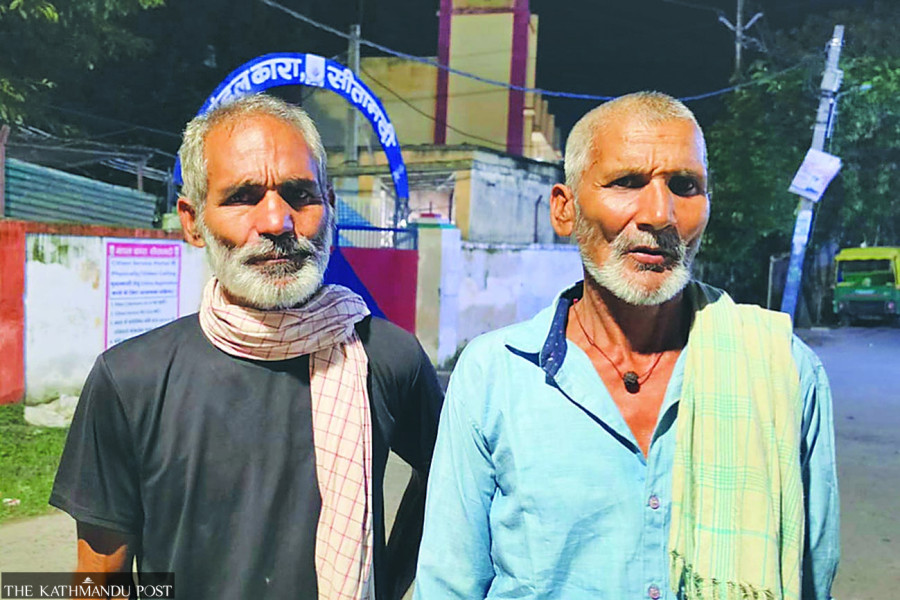
The arrest of Suresh Prasad Singh and Nagendra Prasad Singh while carrying fertiliser for personal use has renewed debate over Nepal’s failure to ensure timely supplies of vital farm inputs.Suresh Singh, 55, and his elder brother Nagendra Singh, 60, outside the Dumra jail in Sitamarhi, after their release on Friday. Shiva Puri/TKP
Two Nepali brothers who spent 38 days in an Indian jail after being arrested while carrying fertiliser home for their farm have been released on bail, bringing an end to a weeks-long legal ordeal that has drawn attention to Nepal's chronic fertiliser shortages.
Suresh Prasad Singh, 55, and his elder brother Nagendra Prasad Singh, 60, of ward 5 of Balara Municipality in Sarlahi district were freed on Friday, two days after an Indian court granted them bail.
The brothers had crossed into the Indian border town of Sonbarsa on July 1 to buy fertiliser after failing to obtain it in Nepal during the peak paddy planting season.
Like many farmers across Nepal's southern plains, they had struggled to secure subsidised chemical fertiliser as the monsoon planting season got underway. With no fertiliser available locally and fearing their rice crop would fail, they decided to make the short trip across the border.
On their way back, carrying two sacks of urea and six sacks of diammonium phosphate (DAP) on bicycles, they were stopped by a joint team from India's Sashastra Seema Bal (SSB) and the agriculture department.
Indian authorities accused them of illegally transporting fertiliser across the border and charged them with fertiliser smuggling. They were first taken to Sonbarsa police station before being transferred to Dumra Jail in Sitamarhi district, where they remained in custody for 38 days.
For the two brothers, who had crossed the border simply to save their rice crop, the experience became one of the most traumatic episodes of their lives.
The ordeal of 38 days behind bars was visible on the brothers' faces after their release.
"It was something I never imagined," Nagendra said. "I ended up in prison in another country. It was an extremely painful experience."
He described the 38 days behind bars as feeling like "living through another lifetime."
On Wednesday, a single bench of Principal District and Sessions Judge, Akhilesh Kumar Jha, of the Dumra Civil Court in Sitamarhi district ordered the brothers' release on bail.
Although the court granted bail immediately, procedural formalities delayed their release.
The bail order was forwarded to Dumra Jail on Thursday after court officials completed the paperwork. The brothers signed the required documents inside the prison before being taken back to the court, where the bail process was formally completed.
Their lawyer, Sanjay Kumar Jha, said the brothers were released only after relatives pledged family land as bail bonds.
Under Indian law, local guarantors were required for bail.
Two Indian citizens, Tapeshwar Singh and Baleshwar Singh, both relatives of the family through marriage, stood surety for the brothers by mortgaging land worth 10,000 Indian rupees each.
The brothers must now appear before the Indian court every month until their case is resolved. Failure to attend could result in legal consequences for their guarantors, another lawyer representing them, Kiran Kumar Chaudhary, said.
Their arrest has highlighted a problem that returns almost every year in Nepal's southern border districts: chronic shortages of chemical fertiliser during the most critical stages of the farming season.
Unable to obtain fertiliser through official distribution channels, the brothers travelled across the border, hoping to secure enough supplies for their own fields.
Instead, they found themselves facing criminal charges in a foreign country.
"A small effort to save my own crop turned into legal and psychological suffering," Suresh said.
Back home, the prolonged detention placed heavy emotional and financial strain on the family.
Suresh's son, Abhishek Singh, said the family had struggled in the absence of its two senior members.
"When the heads of the family are suddenly gone, it's impossible to describe what life becomes," he said. "My father and uncle have finally been released after a long wait. We have learned a painful lesson. Our ordeal should serve as a wake-up call for the Nepal government."
The family said they still have not been able to obtain fertiliser in Nepal.
Their release was delayed repeatedly because of the Indian court process.
Abhishek had filed a petition seeking an early hearing on July 24, but the hearing was postponed thrice after the chief judge went on leave.
The brothers finally secured bail on August 5 after lawyers Sanjay Kumar Jha and Kiran Chaudhary argued that they were ordinary Nepali farmers, not fertiliser smugglers.
Even after the bail order was issued, another obstacle emerged.
Indian law required local citizens to act as guarantors, leaving the family scrambling for someone eligible to meet the legal requirement. Their release became possible only after relatives living in India agreed to stand surety.
Former lawmaker Dev Prasad Timilsina said the case has once again exposed the hardships routinely faced by farmers in Nepal's Madhesh Province and elsewhere in the country.
"Every year the government promises to support agriculture and subsidise fertiliser," he said. "Yet when farmers need fertiliser the most, during planting or weeding season, they cannot get it."
He said the brothers' release had brought relief to their family, but their ordeal reflected the reality faced by hundreds of thousands of Nepali farmers.
"So long as the state fails to establish a reliable system that provides farmers with seeds and fertiliser on time, more farmers trying simply to save their crops will continue to face unnecessary hardship and even criminal punishment along the border," Timilsina said.
Kantipur was the first to report on the arrest of the Singh brothers. Following the report, Foreign Minister Shisir Khanal took up the matter and began diplomatic coordination with the Indian government through Nepal’s embassy in New Delhi. However, their release was delayed because of the court process. Khanal said the delay was due to legal procedures in India.
Nepal faces severe shortages of chemical fertiliser almost every year during the peak farming season. Because the government has repeatedly failed to ensure adequate and timely supplies, farmers in border areas have been forced to depend on Indian markets to protect their livelihoods and crops.
Although many farmers cross the border only to buy small quantities of fertiliser for their own fields rather than for commercial purposes, Indian security agencies have taken a much stricter approach this year. Increased border surveillance and tougher enforcement have added to the difficulties faced by farmers in the region.
Farmers say the problem begins within the country, where local allocations are far below actual demand and distribution systems lack transparency, preventing fertiliser from reaching smallholders.
Manoj Mehta, ward 5 chair of Balara Municipality, where the Singh brothers live, said the ward needs around 2,000 sacks of urea during the farming season but received only 40 sacks.
“How can we distribute such a small quantity among farmers? When there is no fertiliser available, farmers have no option but to cross the border,” he said. “If they go to India, they are accused of smuggling. In Nepal, the fertiliser is unavailable. When will this problem facing farmers finally be solved?”
The Singh brothers are residents of his ward.
For years, farmers living along the border have travelled to Indian markets early in the morning by bicycle or motorcycle to buy one or two sacks of fertiliser for personal agricultural use.
But recent restrictions by Indian security personnel have made that increasingly difficult, said Mohammad Asim, a farmer from Jingdawa in Paroha Municipality.
“In previous years, when farmers carried small quantities of fertiliser for household use, the Sashastra Seema Bal personnel would usually allow them through after brief questioning or with some flexibility,” he said. “This year, the situation is completely different. They are now quick to label farmers as smugglers.”
The arrest of the Singh brothers, who spent weeks in Sitamarhi jail after being caught carrying urea and DAP fertiliser intended for their own fields, has created fear among farmers living in Nepal’s border districts.
Indian authorities say the crackdown is linked to restrictions on the export of subsidised fertiliser provided by the Indian government to its own farmers. Because such fertiliser cannot legally be taken out of India without permission, the SSB has been treating even small quantities carried by Nepali farmers as illegal exports, leading to arrests and criminal proceedings.
Under India’s Fertiliser (Control) Order (FCO), introduced to regulate the price, quality and supply of fertiliser, agricultural fertilisers are classified as subsidised commodities distributed to farmers. The rules prohibit their export outside India without authorisation, particularly for commercial purposes.
Citing these regulations, Indian security officials have tightened controls along the Nepal border in recent years. Farmers say even a single sack of fertiliser is now being stopped from entering Nepal.
The restrictions come at a critical time for Nepali farmers, as paddy transplantation has ended and fields require fertiliser application. Yet many farmers say they are still unable to obtain the supplies they need.




 23.73°C Kathmandu