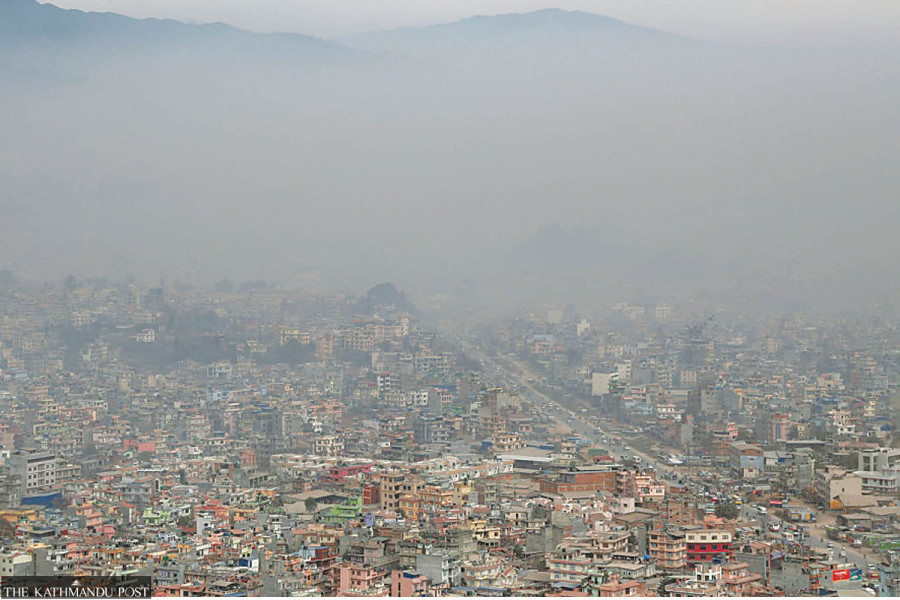
As the post-monsoon dry season begins, air pollution is beginning to build up in the Kathmandu Valley.
According to air quality data recorded by IQAir, a Swiss group that collects air quality data from around the world, air quality in many places in the Kathmandu Valley reached unhealthy levels on Thursday morning.
The data show that Mid-Baneshwar area recorded the highest PM2.5 concentration at 153 micrograms per cubic metre (μg/m³), followed by Shantichowk in Bhaktapur at 151, Tarakeshwar at 147, Ranibari at 145, Teku at 139, Gaushala Chowk and Chhetrapati at 138 each, and Balaju at 134.
According to the US Environmental Protection Agency’sAir Quality Index, a PM2.5 reading of 101 to 150 is considered unhealthy for sensitive groups, who may experience adverse health effects.
The general public is less likely to be affected. A reading of 151 to 200 is considered unhealthy for everyone, and people may experience health effects, and members of sensitive groups could experience more serious effects, according to the agency.
PM2.5 refers to particulate matter (solid or liquid droplets) in the air that is less than 2.5 micrometres in diameter. It is among the most dangerous pollutants that can get past the nose and throat to penetrate the lungs and even the bloodstream. PM2.5 particles are small and are also likely to stay suspended in the air for a long time, increasing the chances of people inhaling them.
The World Health Organization recommends an annual average PM2.5 concentration of no more than 5 micrograms per cubic metre and a 24-hour average of 15 micrograms per cubic metre.
Air quality in Nepal, especially in the Kathmandu Valley, gets worse during the dry season. Pollution levels often reach hazardous levels, and sometimes make the capital the world’s most polluted city.
Environmentalists and air quality experts warn that the worst is yet to come, as the stubble-burning season has just begun in Nepal’s Tarai region and neighbouring India. During the Diwali festival (Tihar in Nepal), air pollution levels in India often reach toxic levels, and the polluted air also drifts across the border into Nepal.
Nepal’s border towns — Butwal and Dhangadhi — recorded PM2.5 readings of 160 each on Thursday morning.
“This is a peak harvesting season of paddy crops both in India and in Nepal, and stubble burning has already started,” said Bhupendra Das, an air quality expert. “The worst days are yet to come, as we have done so little to check the air pollution in the country.”
Despite years of recurring air pollution, authorities have done little to fix potholes and control road dust or run awareness campaigns against stubble and waste burning. Experts say official inaction and public indifference have allowed the problem to persist.
“The health costs of worsening air quality will be far greater than the public realises,” said Das.
A new report by the United Nations Children’s Fund (UNICEF) shows that 9.9 million children in Nepal are exposed to unhealthy levels of air pollution, and identifies it as one of the most widespread environmental threats facing children in the country.
According to the report, 7.3 million children are exposed to drought, which threatens their access to water supplies, food production, nutrition, and livelihoods. Similarly, 5.7 million children face extreme heat, with rising temperatures jeopardising their health, well-being and learning. Another 2.9 million are exposed to rainfall-triggered landslides, while an estimated 2.4 million face multiple high-intensity climate hazards, compounding risks and making recovery more difficult, the report says.
Of late, air pollution has emerged as the number one risk factor for death and disability in Nepal, surpassing malnutrition and tobacco use, according to the World Bank report.
The report titled, ‘Towards Clean Air in Nepal: Benefits, Pollution Sources, and Solutions,’ unveiled last year, stated that polluted air cuts life expectancy by 3.4 years for the average Nepali and causes approximately 26,000 premature deaths annually.
Air pollution heavily contributes to various diseases: 75 percent of chronic obstructive pulmonary disease cases, 46 percent of strokes, 44 percent of ischemic heart disease, 41 percent of lower respiratory infections, 38 percent of lung cancer, 30 percent of neonatal issues like low birth weight and preterm birth, and 20 percent of diabetes, the World Bank report published in 2025 says.
Arjun Poudel is a health reporter for The Kathmandu Post. Before joining the Post, he worked for Sagarmatha Television, Naya Patrika, Republica and The Himalayan Times.




 18.26°C Kathmandu