Reconstruction aid, strategic ties, pending disputes on PM’s India visit agenda
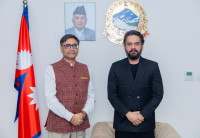
Prime Minister Balendra Shah’s proposed four-day visit starting November 22 comes at a critical juncture in Nepal-India relations. Kathmandu is seeking billions in aid for post-flood recovery, air connectivity, and progress on stalled projects. Indian Foreign Secretary Vikram Misri (left) calls on Prime Minister Balendra Shah, Thursday. RSS
Nepal and India have stepped up preparations for Prime Minister Balendra Shah’s first official bilateral visit to New Delhi, setting the stage for a high-level engagement.
The visit could shape the trajectory of bilateral relations at a time when Kathmandu is seeking to balance its development priorities with longstanding geopolitical sensitivities, observers say.
Scheduled to begin on November 22, the proposed four-day visit comes at a particularly important moment for Nepal. The country is seeking substantial Indian financial assistance for post-flood reconstruction, while pushing New Delhi to address longstanding concerns over air connectivity, water resources, trade and transit. Several major bilateral projects have remained stalled for years despite repeated political commitments.
For Shah, who took office on March 27, the trip will be an early test of his government’s foreign policy priorities and its ability to translate political engagement with India’s leadership into tangible economic and strategic gains.
The visit also offers New Delhi an opportunity to deepen engagement with Nepal’s new political leadership and reinforce its influence in a country whose geography, economic dependence, and strategic location make its relationship with India particularly consequential.
The proposed dates were discussed during Indian Foreign Secretary Vikram Misri’s two-day visit to Kathmandu, which concluded on Thursday. Misri held meetings with Shah, Foreign Minister Shisir Khanal, Finance Minister Swarnim Wagle, Energy Minister Biraj Bhakta Shrestha, and other senior officials.
He also met Rastriya Swatantra Party President Rabi Lamichhane and Nepali Congress President Gagan Kumar Thapa.
The main engagement is scheduled for November 23, when Prime Minister Shah and his Indian counterpart Narendra Modi will hold delegation-level talks and sign several agreements. New Delhi is also expected to announce an economic assistance package for Nepal.
The Indian foreign secretary highlighted the wide-ranging engagement and overall progress in diverse areas of bilateral cooperation, and discussed possible outcomes and initiatives in the context of Prime Minister Shah’s upcoming visit to India, said a statement issued by the foreign ministry.
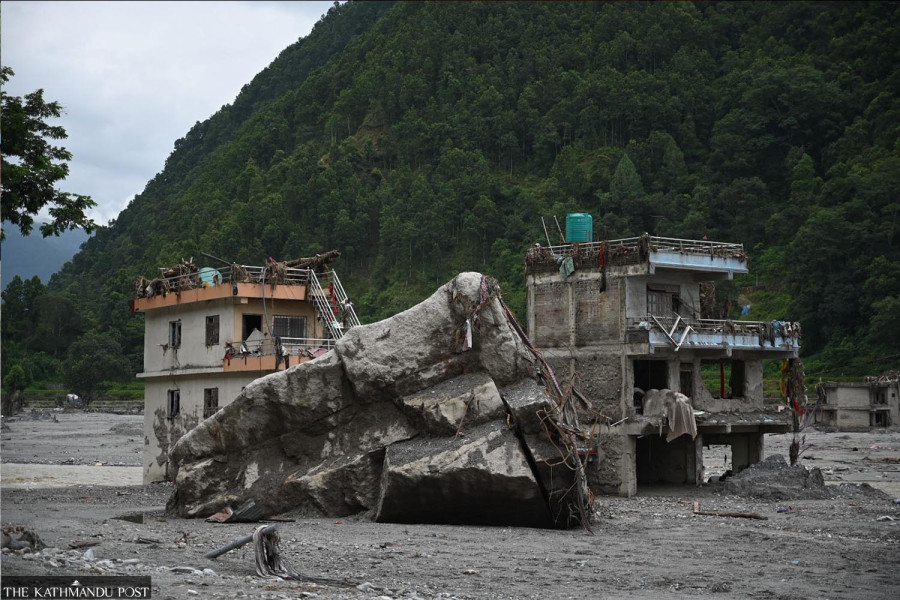
One of Kathmandu’s biggest priorities is securing $2 billion in Indian assistance through a combination of concessional lines of credit, grants, and reconstruction support. Nepal has formally proposed $1 billion in lines of credit, $500 million in grants, and another $500 million for reconstruction and rehabilitation following the devastating August 26 floods in the Rasuwa-Bhotekoshi corridor.
“The formal proposal has been tabled by our side. It is now up to India to take a call on it,” a senior Foreign Ministry official said.
The scale of the proposed assistance reflects Nepal’s immediate financial requirements following the disaster, which severely damaged infrastructure and disrupted connectivity with China. India's response will be an important indicator of how far New Delhi is prepared to support Nepal's reconstruction and development priorities.
During Misri’s visit, Indian officials expressed readiness to consider Nepal’s proposals for reconstruction and rehabilitation assistance. Preliminary bilateral consultations have already taken place, with more detailed discussions expected during Shah’s visit.
“The difficult circumstances following the Bhotekoshi floods have provided an opportunity to demonstrate this partnership,” Misri said, according to Nepali officials. He also acknowledged the extensive damage to Nepal’s infrastructure and said India was prepared to consider reconstruction and rehabilitation proposals.
India’s role as a first responder following the floods, including the provision of relief materials and deployment of rescue teams, was acknowledged by Shah during his meeting with Misri. Earlier the prime minister, through a phone call, thanked Modi for expressing solidarity with Nepal following the flood.
Strategic connectivity and unresolved questions
Beyond reconstruction assistance, Nepal is seeking progress on two strategically important issues: additional air-entry points from India and the long-delayed Pancheshwar Multipurpose Project.
Since 2014, Nepal has repeatedly requested additional air-entry routes to facilitate the operation of its two international airports in Bhairahawa and Pokhara. The lack of suitable international flight corridors has constrained the country’s efforts to make these airports fully operational and attract international airlines.
Officials from the civil aviation authorities of both countries are expected to meet within the next 10 days to discuss the issue before Shah’s visit.
Two senior Nepali officials said Delhi appeared positive about Kathmandu’s request, although a final understanding is yet to be reached.
An official who attended the discussions said both sides had agreed to hold technical-level meetings on air-entry permissions for Gautam Buddha International Airport in Bhairahawa.
For Nepal, securing additional air routes is not merely an aviation issue. It is closely tied to the commercial viability of its international airports, tourism expansion, and the country’s broader connectivity ambitions. The issue also demonstrates how Nepal’s access to international markets and destinations remains influenced by its geographical dependence on Indian airspace.
The Pancheshwar Multipurpose Project, another major item on the agenda, illustrates the difficulties of translating political agreements into implementation.
Conceived under the 1996 Mahakali Treaty, the project has remained largely on paper despite decades of negotiations. The two countries have made some progress in narrowing differences over construction cost-sharing, with officials discussing possible arrangements under which Nepal would bear 25-30 percent of the cost and India the remaining 70-75 percent.
A massive boulder deposited by Bhotekoshi-Trishuli flood at Betrawati, Nuwakot on August 26. Post File Photo
However, the more contentious question of sharing the benefits of water resources remains unresolved.
“Officials have narrowed their differences over cost-sharing arrangements between Nepal and India for the project’s construction. The ratio could be 25:75 or 30:70. The crux of the issue, however, is water sharing between Nepal and India,” an official said.
Both sides have agreed to hold another round of technical discussions before Shah’s visit, with the aim of advancing the detailed project report in accordance with the spirit of the Mahakali Treaty.
The project is strategically significant for Nepal because of its potential to generate electricity, regulate water flows, and provide irrigation benefits. But differences over how the benefits should be calculated and distributed have repeatedly delayed progress.
The geopolitical fault lines
While the proposed visit is expected to focus on economic cooperation and infrastructure development, several politically sensitive issues continue to complicate Nepal-India relations.
The boundary disputes involving Kalapani and Susta remain unresolved. Nepali officials said these issues did not feature in any of Misri's meetings in Kathmandu, although they hope the matters will be included in the agenda for the prime minister’s visit.
The absence of substantive discussion on the boundary question highlights the challenge facing Kathmandu: maintaining constructive relations with its southern neighbour while pursuing its territorial claims.
Trade and transit are other areas where Nepal has longstanding concerns. India remains Nepal’s largest trading partner and a major source of foreign investment, but the widening trade deficit has continued to put pressure on Nepal’s external sector.
These issues did not feature prominently in Misri’s discussions, although they were raised during his meetings with Finance Minister Wagle and Foreign Secretary Amrit Bahadur Rai.
Nepal’s dependence on Indian routes for much of its international trade and third-country transit gives the relationship an inherently asymmetric character. Kathmandu has sought to diversify its connectivity options, including through northern routes, but infrastructure constraints, and difficult geography have limited the alternatives.
The recent floods in the Rasuwa-Bhotekoshi corridor, which disrupted Nepal’s principal land trade route with China, have once again exposed the vulnerability of the country’s cross-border supply chains.
The disruption also underscores the importance of developing multiple trade and transit routes rather than relying heavily on a limited number of border crossings.
Against this backdrop, Kathmandu is seeking to advance connectivity with both neighbours while avoiding geopolitical complications.
India, meanwhile, has its own strategic and economic interests in Nepal, particularly in hydropower development, cross-border energy trade, infrastructure connectivity, and regional security.
During Misri’s visit, the two sides discussed challenges facing Indian hydropower projects in Nepal and agreed to accelerate cooperation in energy, roads, bridges, railways, petroleum pipelines, transmission lines, and digital connectivity.
A long list of projects
The proposed visit is also expected to produce concrete outcomes through the inauguration and launch of several India-supported projects.
The two prime ministers are expected to inaugurate the Nepal Police Academy in Panauti, Kavrepalanchok; a bridge in Darchula; the integrated check post in Bhairahawa; and a motorable bridge over the Mahakali River.
They are also expected to jointly launch construction of the integrated check post in Dodhara Chandani, the Lower Arun hydropower project, and a petroleum pipeline connecting Siliguri in India with Charali in Jhapa.
India has also informed Nepal that preparations have been completed to operate a railway service between Ayodhya and Janakpur. A trial run on the route was conducted on Thursday, according to Misri.
The proposed railway connection could strengthen religious tourism and people-to-people ties, adding another dimension to the two countries’ extensive cultural and historical links.
The Indian side has also proposed taking Shah beyond New Delhi during the visit, including a possible trip to Ahmedabad in Gujarat, where Modi served as chief minister before becoming prime minister in 2014. Kathmandu has yet to confirm the proposal.
Shah has instructed officials to keep his delegation small, with fewer than 15 members.
The two countries have more than 40 bilateral mechanisms covering border management, trade, security, water resources, hydropower, and connectivity. Regular meetings of these mechanisms have recently concluded, Misri informed Shah.
The challenge, however, lies in ensuring that the agreements reached through these mechanisms translate into implementation.
For Nepal’s new government, the November visit is an opportunity to reset engagement with New Delhi and secure concrete commitments on issues that have remained unresolved across successive administrations, according to the top officials at the foreign ministry.
“During various engagements, the Nepali leadership expressed gratitude for India’s swift and substantial humanitarian and technical assistance in the aftermath of the Rasuwa-Bhotekoshi floods,” said the foreign ministry in a statement issued after Misri’s visit.
Both sides expressed satisfaction at the cooperation in areas including trade and commerce, hydropower, border management, and energy as well as newer avenues for collaboration such as start-ups, digital connectivity, AI, and sports, according to the statement.
Anil Giri is a Chief Sub Editor covering diplomacy, international relations and national politics for The Kathmandu Post. Giri has been working as a journalist for more than two decades, contributing to numerous national and international media outlets.




 14.49°C Kathmandu