Claims of TU land recovery spark controversy amid ongoing encroachments
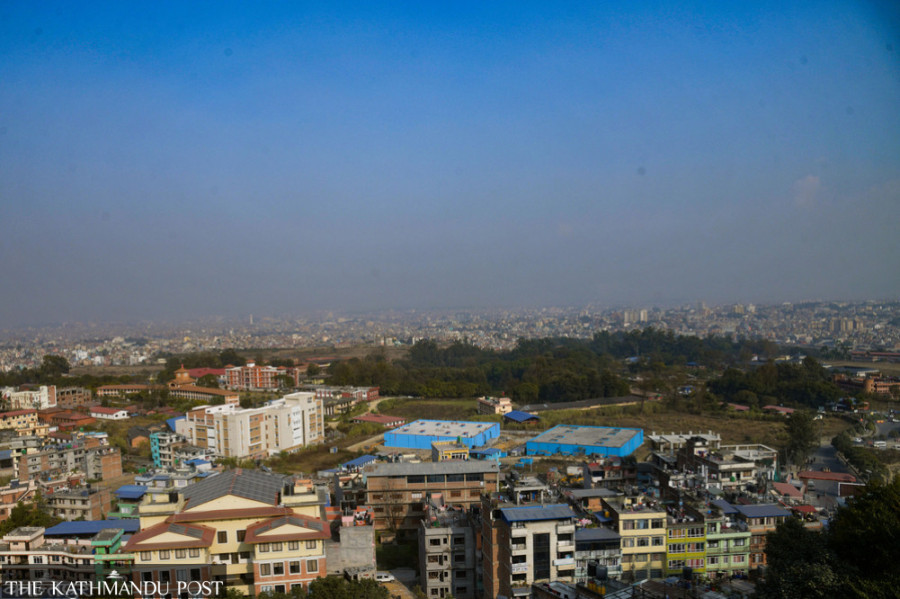
Education Minister Sasmit Pokharel says over 35 hectares of land have been recovered in Kathmandu Valley, but university employees and professors say no land has actually been handed back. Education minister claims 705 ropani of TU land recovered, but university staff say no property has actually been handed back. Post File Photo
The education ministry’s statement that 705 ropani (approximately 35.5 hectares) of Tribhuvan University land have been reclaimed in Kathmandu Valley is disputed by university employees and professors, who say not a single plot has actually been vacated and handed back.
Education and Sports Minister Sasmit Pokharel, who is also the university’s pro-chancellor, announced on Wednesday that the TU had recovered around 705 ropani land after six months of efforts. But officials in its administration division say the ministry has treated letters expressing willingness to return land as proof that the properties have already been handed over.
Petrol pumps, a private school, a hotel and other structures continue to operate on university land, while contractors are still storing materials there without authorisation, employees said.
“The land has not been returned. After the Commission for Investigation of Abuse of Authority and other agencies began inquiries into encroachment, some institutions wrote to the university saying they were ready to return the land,” a TU administration employee told the Post.
“But not even a single piece of land has come back. The petrol pump is still operating on university property, the Lab School is still there, and contractors continue to store materials unlawfully.”
Pokharel said in a Facebook post that reclaiming university property had been a priority since he took charge of the ministry. He said the ministry directed the university administration to clear land occupied or used without authorisation, and that coordination with the university had resulted in the recovery of 705 ropanis within six months.
“The land, which had remained neglected and disorderly for years, was a priority,” he wrote, adding that it would be used in the university’s interest, including for research centres and educational infrastructure.
The announcement prompted students and teachers to ask where the land had been recovered and whether occupants had moved out. Deepak Raj Joshi, chair of the Free Students’ Union at the central campus and a member of the university senate, challenged the minister publicly.
The university had issued a 35-day notice on April 16, asking occupants to return about 2,500 ropanis of encroached land, said Joshi. Seven months later, he said, there was still no clear account of what had been recovered and no visible action against structures occupying the property.
“Why does the law allow bulldozers to be sent to structures built by landless people after seven days’ notice, but become ineffective when influential people encroach on university land?” the student leader asked. He questioned why those running private schools and collecting rent off university property had not been brought within the law.
Joshi urged the minister and university administration to publish figures showing how much land had been returned, where it was located, how much remained occupied and what steps were being taken to recover the rest. “I urge the education minister to rise above cheap publicity and answer with facts and figures,” he wrote on social media.
Registrar Rabindra Shiwakoti defended the announcement, saying the university had received letters from several organisations agreeing in principle to return land. He said the university had provided the ministry with details indicating that more than 700 ropanis had been returned nationwide, including around 700 ropanis in the Valley.
“In principle, we have received letters saying that most of the encroached land will be returned. Only the practical handover remains,” Shiwakoti admitted. “The university will manage the land once it is returned.”
However, a professor who visited the sites said a petrol pump was still operating on land leased by the employees association and a hotel remained on land rented out by the professors’ association as of Thursday.
An official at the registrar’s office said some organisations sent letters after the anti-graft commission began investigating the encroachment, apparently seeking to avoid scrutiny. “On the basis of those letters, it was publicised that the university’s land had already been returned,” the official said. “In reality, not even one ropani has been handed back.”
The dispute follows a long-running effort to address the misuse of university property. A probe committee was formed under former secretary Mahendra Bahadur Thapa in 2024 during the tenure of Sumana Shrestha as education minister. The committee recommended recovery and legal action against those responsible. The report identified around 2,539 ropanis (around 129 hectares) of university land as encroached upon or misused.
The committee recommended investigations by the commission, police and district authorities. It also called for a Central Investigation Bureau probe into allegations that Laboratory Secondary School operators used forged documents in an attempt to grab 108 ropanis of university land.
The committee submitted its findings to then-prime minister KP Sharma Oli on December 17, 2024. The report, initially withheld, was made public on October 12, 2025, by the succeeding education minister Mahabir Pun. Of the 5,218 ropanis (around 265 hectares) acquired by the state in 1956 and 1973 for the university, roughly 2,539 ropanis (129 hectares) have been encroached upon, the report states.
Within the Kirtipur campus, about 1,843 ropanis (94 hectares) have been encroached upon or misused. Outside the campus, 696 ropanis (35 hectares) have also been encroached upon.
At the central campus alone, around 843 ropanis (43 hectares) are occupied by 21 organisations and groups. The report also finds that 148 ropanis (about 7.5 hectares) belonging to constituent campuses in Kathmandu Valley have been misused.
A field survey of 18 out of 22 campuses found encroachment affecting roughly 150 ropanis (7.6 hectares) across seven campuses. Constituent campuses across Kathmandu, Lalitpur and Bhaktapur hold about 1,253 ropanis (64 hectares) in total.
Entities using university land include the Radha Swami Satsang Byas Nepal, staff and professors’ unions, BP Koirala Memorial Planetarium, the National Ayurveda Research & Training Centre, and Nepal Netra Jyoti Sangh.
Others include Nepal Bank Limited, Global IME Bank, police units in Kirtipur, Balkhu and Kalimati, the Lions Blood Transfusion Centre, and the Cricket Association of Nepal, among others.
Public bodies such as the Kathmandu Valley Water Supply Management Board, Kirtipur Municipality, and the Nepal Electricity Authority are also among TU land users.
Outside Kirtipur, 696 ropanis (35 hectares) in Naikap, Dillibazar, Tripureshwar, Lubhu, Kapan and Swayambhu remain encroached upon. The committee has urged immediate recovery, citing prolonged administrative negligence as a key factor behind the loss.




 16.32°C Kathmandu