Five key issues on the agenda during Prime Minister Shah’s India visit
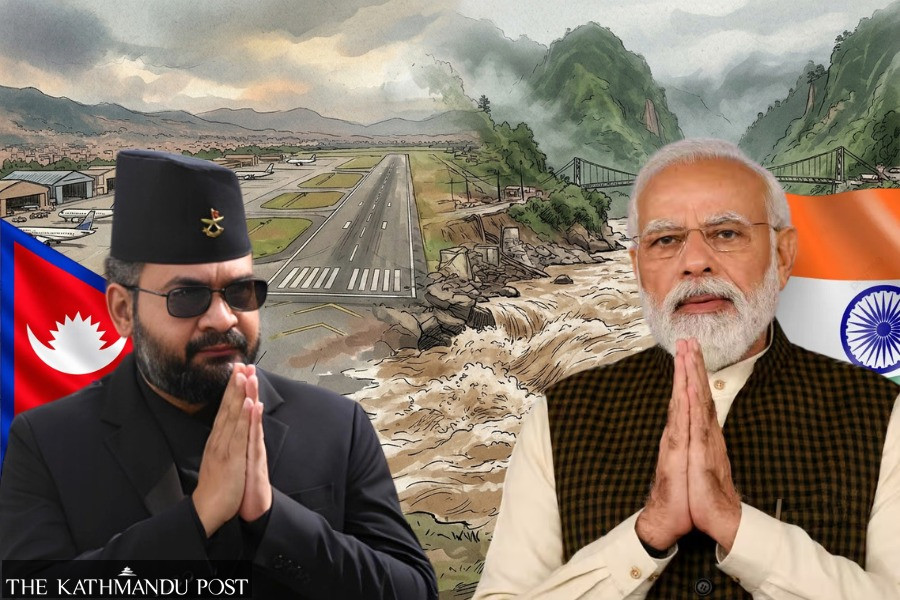
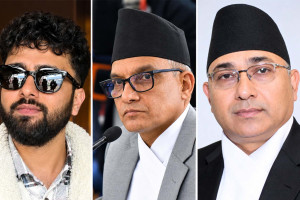
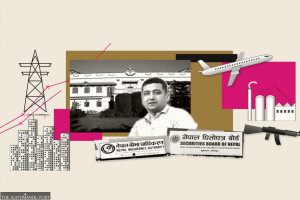
Kathmandu is seeking $2 billion for flood recovery, more air routes and progress on the Pancheshwar project, while hoping border disputes feature in the agenda. Prime Minister Balendra Shah is expected to hold delegation-level talks with Indian Prime Minister Narendra Modi on November 23. Post illustration with source photos via ekantipur and narendramodi.in
In what will be his first official bilateral trip, Prime Minister Balendra Shah is set to visit India from November 22 to 25. The visit comes as Nepal seeks Indian assistance for post-flood reconstruction and aims for progress on longstanding bilateral issues.
To lay the groundwork for the trip, Indian Foreign Secretary Vikram Misri was in Kathmandu this week for a two-day visit. The visit saw discussions on many issues of bilateral importance and conspicuously left out some, including border disputes.
During his visit, Shah is expected to hold delegation-level talks with Indian Prime Minister Narendra Modi on November 23. The two sides are also expected to sign agreements and announce an economic assistance package for the disaster-stricken country.
Here is what Kathmandu wants out of the trip, and what could complicate it, explained in five points.
A $2 billion assistance
This will be one of Kathmandu’s biggest priorities during the visit. Nepal has formally proposed $1 billion in concessional loans, $500 million in grants and another $500 million for reconstruction and rehabilitation (also likely in grant) following the August 26 floods in the Rasuwa-Bhotekoshi corridor.
The floods killed at least 1,455, left over 9,000 injured, over 5,000 unaccounted for, and caused extensive damage to infrastructure. The disaster also disrupted Nepal’s trade connectivity with China. Indian officials have expressed readiness to consider Nepal’s proposals, but the amount and terms of assistance have yet to be finalised.
More air routes for Nepal’s international airports
Nepal has been seeking additional air-entry routes from India since 2014 to facilitate international flights to Gautam Buddha International Airport in Bhairahawa and Pokhara International Airport.
The lack of suitable routes has constrained the operation of both airports and made it difficult to attract international airlines. India has reportedly responded positively to Nepal’s request, but a final agreement is pending. Officials from the two countries’ civil aviation authorities are expected to hold technical discussions regarding the matter before Shah’s visit.
Can the Pancheshwar project finally move forward?
The long-delayed Pancheshwar Multipurpose Project, conceived under the 1996 Mahakali Treaty, is another major item on the agenda. Despite decades of negotiations, the project has made little progress, largely because of differences over sharing costs and the benefits of water resources.
The two sides have reportedly narrowed their differences over construction costs, with discussions pointing to Nepal bearing 25 to 30 percent and India the remainder. But the crucial question of sharing water-related benefits remains unresolved. As with the air-entry route issue, further technical discussions on this are expected before the prime minister’s visit.
Border disputes
The boundary disputes involving Kalapani, Limpiyadhura and Susta are likely to be among the most closely watched agenda items. Shah has had a rather contradictory stance regarding India over the years. While he was the mayor, Shah once placed the Greater Nepal map in his office after India released a new map—the Akhand Bharat Map—including the disputed territories of Limpiyadhura and Kalapani. He once also moved to ban the screening of Indian films in Kathmandu. But Shah appears to have softened his stance. In May this year, he went on to say that just like India had encroached on Nepal’s land, Nepal had also encroached on India’s.
Despite its importance, at least for Nepal, the border dispute did not come up in Misri’s meetings in Kathmandu. But Nepali officials hope it will be included in the agenda. It remains to be seen if or how the issue will figure in the visit.
Launch of several India-backed projects
The visit is expected to produce some tangible outcomes through the inauguration and launch of projects supported by India.
The two prime ministers are expected to inaugurate the Nepal Police Academy in Panauti, Kavre, a bridge in Darchula, the integrated check post in Bhairahawa and a motorable bridge over the Mahakali river.
They are also expected to jointly launch construction of the integrated check post in Dodhara Chandani, the Lower Arun hydropower project and a petroleum pipeline linking Siliguri in India with Charali in Jhapa. India has also informed Nepal that preparations for a railway service between Ayodhya and Janakpur have been completed, with a trial run conducted this week.
Beyond these projects, the two sides are expected to discuss cooperation in energy, roads, railways, transmission lines and digital connectivity. The larger challenge of the visit will be to turn longstanding bilateral commitments into concrete progress.
Timothy is a copy editor for The Kathmandu Post. Previously, he was a reporter on the Features desk and deputy editor on the National News desk. He joined the Post in 2015.




 22.43°C Kathmandu