Nepal and India to resume talks on air entry routes after decade-long lull
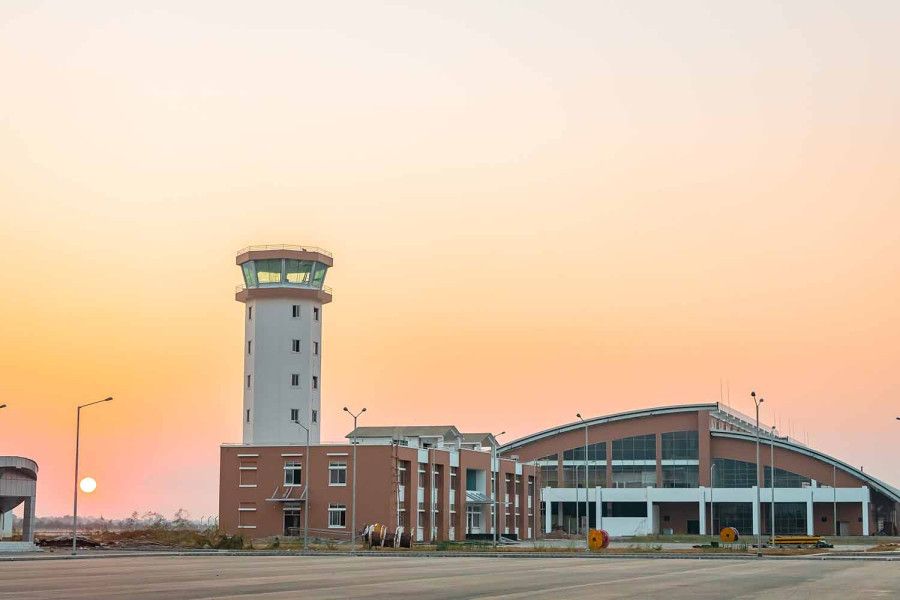
Officials will discuss additional cross-border air entry points critical for the viability of Pokhara and Bhairahawa international airports. The Bhairahawa International Airport has a 15,169 square-metre terminal building with a capacity to serve nearly a million passengers a year. Shutterstock
Nepal and India have agreed to resume talks on additional bilateral air entry routes, reviving negotiations after nearly a decade on a long-pending issue crucial to the operation of Nepal's two new international airports in Pokhara and Bhairahawa.
The additional air entry routes have long been a key demand of Nepal, as around 90 percent of international flights currently enter the country through a single, congested entry point over Simara.
India has been reluctant to grant direct, low-altitude entry points through Nepal's western and eastern corridors, citing security concerns related to sensitive military installations, including the Gorakhpur air base, as well as air traffic management complexities.
Senior officials from the two countries are expected to meet in August to discuss and negotiate additional cross-border air entry routes. The date and venue of the meeting have yet to be finalised.
The issue was discussed during a meeting between Foreign Minister Shisir Khanal and Munu Mahawar, additional secretary at India's Ministry of External Affairs, in Kathmandu on Thursday.
Mahawar is in Nepal to attend the 13th Nepal-India Joint Steering Committee meeting at the energy secretary level that concluded in Pokhara on Wednesday.
During the meeting, Khanal urged India to convene the long-delayed technical committee meeting tasked with discussing Nepal's request for additional air routes.
"Mahawar assured us that the meeting would take place next month," two sources familiar with the matter told the Post. "The technical-level mechanism will examine the bottlenecks in Nepal's request for additional air entry routes."
Another Tourism Ministry official said Nepal had recently proposed convening the meeting.
"Now that India has agreed, the agenda for the meeting will be finalised," the official said.
Nepal has been pressing India for additional air entry routes since 2009, after deciding to build international airports in Pokhara and Bhairahawa.
The issue received political backing during Indian Prime Minister Narendra Modi's visit to Nepal in August 2014. A joint communiqué issued after the visit stated that cross-border direct routes would facilitate flights to the regional airports in Pokhara and Bhairahawa, reduce travel time and costs, and improve air connectivity between the two countries.
The two prime ministers subsequently directed their respective authorities to resolve the issue within six months.
Following that directive, Nepal and India agreed in 2016 to make the L626 (Kathmandu-Mahendranagar) route two-way. Later that year, India agreed in principle to provide additional cross-border entry points for international airlines.
Nepal proposed three new entry points through Janakpur, Bhairahawa and Nepalgunj.
India, however, said it needed internal consultations before making a final decision.
New Delhi had long expressed reservations about entry points through Bhairahawa and Nepalgunj because of the strategic Gorakhpur air base, where fighter jet exercises are regularly conducted.
In February 2017, the two countries agreed to form a joint technical team to examine the feasibility of opening the three routes.
Until April 2018, India had remained positive about opening western entry routes after a technical team was formed to address safety concerns.
Officials say India's position later hardened.
Nepal-India relations deteriorated after Kathmandu withdrew from a joint military exercise of the Bay of Bengal Initiative for Multi-Sectoral Technical and Economic Cooperation (BIMSTEC) countries in Pune in September 2018 after initially agreeing to participate.
India expressed dissatisfaction over Nepal's withdrawal, particularly within its defence establishment.
The same year, Nepal participated in the second Nepal-China joint military exercise, Sagarmatha Friendship-2, in China's Sichuan province, further complicating bilateral defence sensitivities.
After that, discussions on the safety assessment of the proposed air routes stalled.
Nepal has consistently argued that expanding cross-border air routes is essential because almost all inbound international traffic depends on the Simara entry point.
In contrast, aircraft departing Nepal have access to seven exit points—Bhairahawa and Mahendranagar in the west, and Simara, Biratnagar, Tumlingtar, Mechi and Janakpur in the east.
Two additional entry points over Mechi and Tumlingtar (NONIM), used by aircraft arriving from Bhutan and Lhasa respectively, exist but handle only limited traffic.
As a result, Simara remains heavily congested.
The lack of western entry routes has also undermined the commercial viability of the Gautam Buddha International Airport in Bhairahawa and Pokhara International Airport, projects on which Nepal has spent more than Rs60 billion.
Gautam Buddha International Airport was upgraded as Nepal's second international airport on May 16, 2022, while Pokhara International Airport was inaugurated on January 1, 2023. Neither airport currently has scheduled international passenger services, handling only occasional charter flights.
Air entry routes are considered critical for both airports.
A Bhairahawa-bound aircraft approaching from the west, for example, cannot enter directly over Bhairahawa, Nepalgunj or Mahendranagar. Instead, it must make a roughly 300-kilometre detour to enter Nepal through Simara in the east before flying back west.
Experts say the longer route increases fuel consumption and operating costs, making flights more expensive.
Tourism Ministry documents show that international flights to Pokhara from the west must fly an additional 185 kilometres if new cross-border air routes are not opened.
Officials at Nepal's civil aviation authority said India had agreed in principle in 2016 to allow the three proposed routes, but the decision was never implemented.
"Meetings were held in 2019 and again in 2023, but they produced no outcome," an official said.
Meanwhile, Thursday's meeting also reviewed broader Nepal-India cooperation.
According to Nepal's Ministry of Foreign Affairs, both sides discussed holding further meetings to strengthen close and enduring bilateral ties in areas of mutual interest.
Khanal and Mahawar also welcomed the outcome of the recently concluded Joint Steering Committee meeting in Pokhara.
The two countries agreed to increase electricity trade through the 400 kV Dhalkebar-Muzaffarpur and the planned Dhalkebar-Sitamarhi cross-border transmission lines.
Following a review of the existing 1,000 MW import-export capacity through the Dhalkebar-Muzaffarpur line and a study conducted by the Joint Technical Team, both sides agreed to raise the combined transfer capacity to 1,400 MW for imports and 1,650 MW for exports through the two transmission corridors.
Mahawar also expressed satisfaction over the progress of Indian-backed hydropower projects, including the Lower Arun project.
India's Satluj Jal Vidyut Nigam (SJVN) is developing the 900 MW Arun-3 Hydropower Project and has also secured licences for the 679 MW Lower Arun and 490 MW Arun-4 projects.
Arun-4 will be developed as a joint venture between the Nepal Electricity Authority and SJVN, with the Indian company holding the majority stake.
India's NHPC Limited is also set to develop the 750 MW West Seti and 450 MW Seti River-6 projects. NHPC and Vidyut Utpadan Company Limited have already signed a memorandum of understanding to jointly develop the 480 MW Phukot Karnali Hydropower Project.
Despite repeated efforts from the Indian side, however, Nepal's prime minister's long-awaited official visit to India has yet to materialise.
Anil Giri is a Chief Sub Editor covering diplomacy, international relations and national politics for The Kathmandu Post. Giri has been working as a journalist for more than two decades, contributing to numerous national and international media outlets.
Sangam Prasain is Business Editor at The Kathmandu Post, covering tourism, agriculture, mountaineering, aviation, infrastructure and other economic affairs. He joined The Kathmandu Post in October 2009.




 19.56°C Kathmandu