The journey for fodder is too often becoming a final one
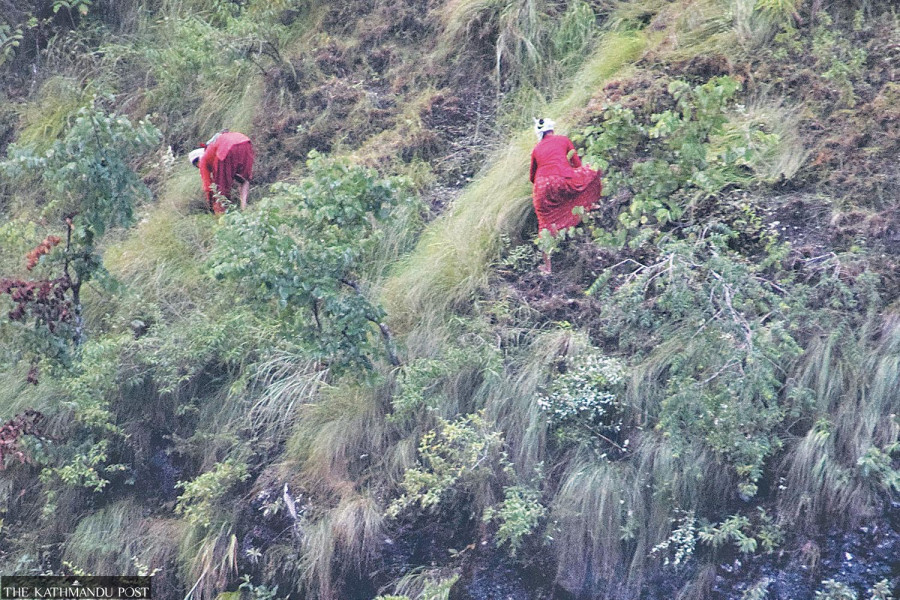
The daily search for grass and firewood has become a deadly gamble across Nepal’s hill districts, where women risk their lives to keep livestock that sustain rural livelihoods. Women cut grass on a cliff at Kafalseri in Bungal Municipality, Bajhang, in this recent photo. Basant Pratap Singh/TKP
Seventeen-year-old Dammara Dhami had set out to do what countless women and girls in rural Nepal do every day: collect grass for livestock. A week ago, that routine chore turned fatal.
Dhami, from ward 2 of Malera in Bungal Municipality of Bajhang district, tripped while cutting grass on a steep cliff and fell around 300 metres to her death.
In Bungal, her death is far from an isolated tragedy. Every year, four or five people in the municipality lose their lives in similar accidents.
“Every village here has families who have lost loved ones to these cliffs,” said Nirajan Kunwar, ward 5 chair of the municipality. “People cannot survive without raising livestock, and to feed them they have to climb dangerous cliffs. A single misstep can cost a life.”
According to Kunwar, 22 people have died in cliff-related accidents in Bungal over the past five years alone.
The tragedy is repeated across Nepal’s hills. From Sudurpaschim province in the west to Koshi province in the east, fatal falls while collecting fodder and firewood have become a grim but familiar part of rural life.
Behind almost every such death lies the same combination of poverty, rugged geography and an agrarian economy heavily dependent on livestock. Cattle and buffaloes provide milk, manure and an important source of household income, but keeping them alive often requires villagers to climb dangerous cliffs every day in search of fodder.
The burden falls disproportionately on women.
In many rural communities, collecting fodder and firewood remains largely women’s work. Every day they negotiate narrow foot trails, scale steep cliffs and carry heavy loads of grass home, often without any form of safety equipment or secure access.
Local representatives say the deaths will continue unless safer fodder sources, improved livestock management, better access trails and other practical interventions are introduced.
Some families have endured the same tragedy repeatedly.
In March 2021, 19-year-old Dammara Bohara of Bhannegada in ward 1 of Bitthadchir Rural Municipality died after falling off a cliff while cutting grass, leaving behind her two-year-old son and husband Harish Bohara.
It was the third such death in Harish’s family.
Harish's mother, Ratna Devi, died at the cliff in 2003 while collecting fodder. In 2014, Devi Bohara, another member of the family, also fell to her death there.
Haris was only 11 when his mother died. Today, after losing his wife, he is raising their seven-year-old son alone.
According to Janaki Bohara, former vice-chair of Bitthadchir Rural Municipality, at least 19 people from Bitthadchir and neighbouring Chaukham in Baitadi district have died after falling from the same cliff and surrounding areas over the past five years.
The Panakot cliff near the district headquarters of Chainpur has acquired a similarly deadly reputation.
“I have lived here since my marriage 25 years ago,” said Parbati Oli of Jayaprithvi Municipality. “Over these years, the Panakot cliff has claimed 27 lives. One or two people die almost every year. But we have no choice. If we don’t cut grass, we cannot keep cattle.”
Unlike the plains, where fodder can be cultivated more easily, settlements across Nepal’s mid-hills are scattered over rugged terrain. Forests and grasslands are often located above or below sheer cliffs, forcing villagers to negotiate hazardous slopes every day.
The danger intensifies during the monsoon, when rain makes rocks slippery and loose soil unstable. Yet despite decades of fatal accidents, few systematic measures have been introduced to reduce the risks. Many settlements still lack safe access trails, rope support systems or community fodder plantations that could reduce the need to climb dangerous cliffs.
The stories from Bajhang are echoed across the country.
In Achham, 50-year-old Dhani Budha died in December 2025 after slipping while cutting grass at Maleghadi Mela in ward 1 of Mellekh Rural Municipality. Earlier, in June 2023, 62-year-old Parudevi Budha of ward 5 of Ramaroshan Rural Municipality was killed after falling from the Sindure cliff while collecting fodder.
“We are forced to go to terrifying cliffs just to keep our kitchen fires burning,” said Parudevi’s sister-in-law, Mansara Budha. “If we don’t go, what will we feed our cattle? Our very existence depends on these cliffs.”
Similar tragedies occur every year across Karnali province.
In July 2023, Dhanamaya Khatri of ward 7 of Bafikot Rural Municipality in Rukum West died after a landslide buried her while she was cutting grass.
Official records suggest the true scale of the problem may be even greater than reported.
According to the District Police Office in Bajhang, nine people have died after falling from cliffs over the past three years. Information Officer Deepak Bista said many families perform cremations without notifying the police about deaths.
Police in Achham recorded five similar deaths during the same period.
Deputy Superintendent of Police Om Prakash Khanal, chief of the District Police Office, Achham, said the district’s rugged terrain and remoteness often make timely rescue operations impossible.
“By the time information reaches us, it is often too late,” he said.
Local officials say geography alone does not explain the high death toll.
“In rural hill communities, women are primarily responsible for collecting grass, firewood, bedding for livestock and fuel,” said Ambika Chalaune, mayor of Panchadewal Binayak Municipality. “That is why they are disproportionately exposed to these risks.”
Data from the Karnali Province Police Office show that 522 people have died after falling from cliffs over the past 12 years. The highest annual toll was recorded in the 2023-24 fiscal year, when 64 people died. In the last fiscal year (2025-26), another 33 people died in similar incidents.
Deputy Inspector General Jayaraj Sapkota, chief of the Karnali Province Police Office, said most victims die while collecting fodder or firewood. However, he said police have recently recorded fatal falls involving people distracted by mobile phones while carrying heavy loads across steep terrain.
The problem extends well beyond Karnali.
In Lumbini province, 107 people died last fiscal year after falling from cliffs, trees or wells, according to provincial police records. Palpa recorded the highest number of fatalities, with 25 deaths.
Provincial police data show that 16 people died in Pyuthan, 14 in Dang, 13 in Rolpa, 12 in Gulmi, six each in Rukum East and Rupandehi, and five each in Bardiya and Arghakhanchi.
Baburam Karki, president of the Nepal Red Cross Society, Palpa, said difficult terrain is only one factor behind the accidents.
“Poor physical condition, mental stress, anxiety or even a brief lapse in concentration while climbing trees or cliffs can prove fatal,” he said.
Koshi province presents an equally alarming picture.
Provincial police recorded 1,016 deaths from falls off cliffs and unsafe trails over the past five fiscal years. Of them, 779 were men and 237 were women.
The annual death toll stood at 224 in 2021-22; 200 in 2022-23; 210 in 2023-24; 189 in 2024-25; and 193 in 2025-26.
Senior Superintendent of Police Yogendra Singh Thapa, spokesperson for the Koshi provincial police, said the pattern differs by gender.
“Women are more likely to be involved in accidents while collecting grass and firewood, whereas men are more frequently injured or killed while grazing livestock or walking along remote trails,” he said.
Fatal falls are not confined to the remote western hills.
Even in Makawanpur, which borders the Kathmandu Valley, police recorded 16 deaths, including 10 women, from cliff falls during the last fiscal year.
On Friday, 45-year-old Ishwar Thing from ward 9 of Kailash Rural Municipality died after falling while cutting grass in a hill forest about 500 metres from his home.
Last December, 48-year-old Sitamaya Ghalan of ward 6 Raksirang Rural Municipality also died after falling off a hill in the Silinge Community Forest.
Local governments say the deaths are not isolated mishaps but the result of decades of neglect.
“There is no tradition of planting fodder trees on private farmland,” said Dev Krishna Pudasaini, chair of Indrasarowar Rural Municipality. “As a result, people are forced to venture to dangerous cliffs in search of fodder.”
Rajkumar Malla, chair of Raksirang Rural Municipality, said the danger extends beyond fodder collection.
“Even walking along narrow, slippery foot trails to reach local markets can be deadly,” he said. “Three women died in our municipality last fiscal year after falling from such trails.”




 22.94°C Kathmandu