



 14.81°C Kathmandu
Sat, Oct 24, 2026
Money
Northern border disruptions and higher duties slow Nepal’s EV boom
Electric vehicle imports fell 24 percent last fiscal year as prolonged closures at Rasuwagadhi and Tatopani choked supplies. Dealers warn fresh disruptions could delay launches at this month’s major automobile exhibitions.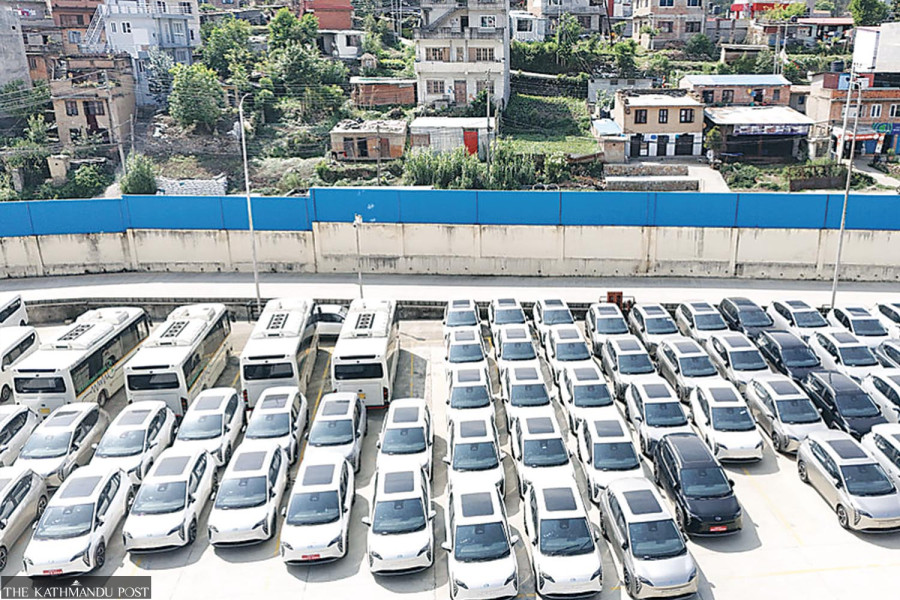
bookmark
Krishana Prasain
Published at : August 4, 2026
Updated at : August 5, 2026 06:47
Kathmandu
Months-long disruptions at Nepal’s two main northern border crossings have slowed the country’s fast-growing electric vehicle (EV) market, caused imports to fall sharply, and threatened the launch of new models ahead of this month’s two biggest automobile exhibitions.
EV imports, which had expanded rapidly over the past five years and made Nepal one of the world’s fastest adopters of electric mobility, dropped by 24.03 percent in the last fiscal year ended mid-July, according to the Department of Customs.
Overall imports of four-wheelers—including passenger buses, microbuses and private vehicles—declined by 19.07 percent during the review period.
Nepal imported 17,688 four-wheelers worth Rs40.44 billion in the last fiscal year, of which 13,004 units were EVs valued at Rs31.32 billion.
The supply crunch comes as disruptions continue along the China border, raising concerns that automakers may not be able to unveil new models on schedule at the NAIMA Nepal Mobility Expo 2026, which begins on August 11, and the NADA Auto Show 2026, starting on August 25.
“We couldn’t import 400 to 500 EVs as planned in the last fiscal year because of disruptions at the China border,” said Yamuna Shrestha, managing director of Cimex Inc, the authorised distributor of Chinese EV leader BYD.
Trade through Nepal’s northern gateways has been repeatedly disrupted over the past year.
On July 8 last year, a flash flood in the Lhende river swept away the Friendship Bridge at Kerung, one of Nepal’s principal trade gateways with China. It took nearly six months for China to construct a temporary bridge. Nepal’s Rasuwagadhi customs point lies about 24 kilometres south of Kerung.
The Tatopani border crossing in Sindhupalchok was also shut for nearly three months last year after massive landslides blocked the route.
“The northern border points remained disrupted for four to five months in the last fiscal year, including the festive season. That itself was a huge loss for traders,” Shrestha said. “Although we managed to reroute some EV shipments through the Korala border point, importing from there was difficult.”
She urged the government to act more swiftly whenever trade routes are disrupted.
“The government should ensure smooth trade whenever such obstructions occur. This is not only about importing EVs but all goods. Major trade routes should be prioritised because we have not been able to deliver EVs on time as committed,” she said.
Dhruba Thapa, chairman of Himalayan Motrox, the authorised distributor of premium EV brand Maxus, said the decline in imports was also influenced by heavy stockpiling before the previous fiscal year’s budget.
“Most EV dealers imported 20 to 25 percent more vehicles than usual before the previous fiscal year’s budget because of rumours that duties on EVs would increase. That covered demand for four to five months, resulting in a slight drop in imports in the last fiscal year,” Thapa said.
“The prolonged closure of the Rasuwagadhi and Tatopani border points also made it difficult to introduce new models during the last Dashain and Tihar festive season,” he added.
According to traders, supply disruptions prevented dealers from delivering newly launched models displayed during last year’s Nepal Automobile Importers and Manufacturers Association (NAIMA) and Nepal Automobile Dealers’ Association (NADA) auto shows.
They warn that if the Tatopani crossing remains closed, this year’s exhibitions could face similar setbacks.
“I want to launch a new Maxus model at the auto show, but it is stranded at Tatopani because of landslides,” Thapa said. “Diverting the shipment through Kerung would create documentation and transportation hassles while increasing both time and cost.“
“Even if we try to reroute vehicles through the Korala border point, the distance from the Maxus factory to that border is too long, making it impractical,” he said.
According to Thapa, 12 to 13 Maxus EVs have been stranded at Tatopani for more than two weeks.
Shyam Sapkota, president of the Electric Vehicle Importers and Manufacturers Association of Nepal, said members also plan to introduce new models during the auto shows, but many vehicles remain stranded at the border.
Himalayan Motrox imported 30 Maxus EVs last year and sold around 25 units during the year.
Thapa said demand for luxury EVs had been rising until the last fiscal year, but higher import duties introduced in the current fiscal year’s budget have sharply increased prices and rendered premium models less affordable.
The price of the Maxus MIFA 7, for example, has jumped from Rs10.25 million to Rs20.45 million in the current fiscal year.
The company is now targeting sales of around 100 Maxus electric pickup trucks this fiscal year. A Maxus pickup is priced at Rs8.8 million.
Chinese brands continued to dominate Nepal’s EV market. Of the Rs31.32 billion spent on EV imports last fiscal year, Rs23.55 billion went to Chinese models. India accounted for Rs5.22 billion, while imports from Thailand, the UK, Germany, South Korea, the United States and Austria totalled Rs2.60 billion.
Nepal imported 9,640 EVs from China, 2,507 from India and 860 from other countries.
“Road conditions on the Tatopani route are poor, while customs clearance at Rasuwagadhi takes considerable time. Documentation procedures have become stricter since the beginning of the current fiscal year,” Sapkota said.
He said around 60 EV brands—including electric cars, jeeps, vans and microbuses—are now available in Nepal.
“With so many brands in the market, competition has become intense, and customers are also becoming confused by the wide range of choices,” Sapkota said.
Despite logistical challenges, dealers say consumer demand for EVs remains strong.
However, following the new tax regime, buyers who previously looked for vehicles priced between Rs4 million and Rs5 million are shifting to models costing less than Rs4 million. Demand for premium EVs priced above Rs5 million has weakened, while competition in the lower-priced segment has intensified.
According to the National Transportation Policy 2026 prepared by the Ministry of Infrastructure Development, Nepal had registered 63,280 EVs by the end of the last fiscal year. EVs accounted for more than 70 percent of all passenger vehicles imported into the country in the fiscal year 2023-24, and made Nepal the world’s second-largest market for EVs by share of new passenger vehicle sales, after Norway. The trend continued into 2024-25 as well.
The customs data also show that Nepal imported 227,834 unassembled motorcycles worth Rs30.35 billion and 22,820 assembled motorcycles worth Rs2.72 billion in the last fiscal year. Electric two-wheelers are also gaining ground, with imports reaching 27,183 units worth Rs2.99 billion.
Krishana Prasain
Krishana Prasain is a business reporter for The Kathmandu Post covering markets. Before joining The Kathmandu Post in 2018, she spent 3 years in New Business Age magazine covering business.




Most Read from Money

Why does an hour long flight to Dhangadhi cost more than a flight to New Delhi?
Nepal travel agents threaten to stop selling Thailand trips over visa rules
Malaysia rejects Nepal’s demand to open recruitment to all manpower agencies

No school, but a graduation cap for women dairy farmers
Nepal arrests four medical service providers as Malaysia recruitment row deepens
Editor's Picks




E-PAPER | October 24, 2026

×