



 15.66°C Kathmandu
Sat, Oct 24, 2026
Money
Food is now Nepal’s next biggest dependency after fuel
The food import bill rebounded to Rs434 billion last fiscal year amid rising demand, shrinking farm labour and stagnant agricultural productivity.
bookmark![]()
Sangam Prasain
Published at : July 27, 2026
Updated at : July 28, 2026 07:20
Kathmandu
Nepal’s food import bill has started climbing again after a brief slowdown triggered by India’s export restrictions. The rebound points to the country’s growing dependence on imported agricultural products.
The country imported food worth Rs434.26 billion in the last fiscal year, driven by rising consumer demand, remittance-fuelled purchasing power and a widening gap between domestic production and consumption.
Experts have sounded the alarm, warning that food is rapidly becoming Nepal’s second major external dependency after petroleum products.
Food imports had eased for a while following the Covid pandemic and India’s restrictions on exports of several food commodities. However, with New Delhi easing exports of key staples such as rice, imports have begun rising again.
At the same time, record remittance inflows and the continued outflow of Nepali migrant workers are weakening the agricultural workforce, making the country increasingly dependent on imported food.
The trend has also been amplified by Nepal’s re-export of edible oils to India, a trade that takes advantage of tariff differentials between the two countries.
India has intermittently banned exports of essential commodities such as wheat, rice, sugar, onions and paddy, citing concerns over domestic supply. These policy shifts have directly influenced Nepal’s import patterns.
In fiscal year 2009-10, Nepal’s agricultural import bill stood at just Rs44.43 billion. A decade later, in 2019-20, it had surged to Rs250 billion. The Covid pandemic temporarily slowed the growth in 2020-21 as border closures and lockdowns disrupted trade.
Since the outbreak of the Russia-Ukraine war and the resulting global food supply disruptions, India has increasingly restricted rice exports to safeguard domestic stocks through quotas and outright bans on products such as rice and paddy.
By fiscal year 2021-22, Nepal’s agricultural imports had ballooned to Rs400 billion, prompting experts to warn that a farming country becoming so dependent on imported food represented a national emergency.
According to the Department of Customs, the latest increase in the import bill has been driven primarily by edible oils and cereals.
Nahendra Khadka, national coordinator of the National Peasants Coalition Nepal, said rising disposable incomes have boosted food consumption, resulting in a sharp increase in imports.
“Like petroleum products, we are now almost entirely dependent on imported food. This is a serious challenge for a country like Nepal,” he said.
Khadka said India has repeatedly imposed export restrictions on food products for various reasons, and Nepal is the first country to feel the impact because it imports almost everything from its southern neighbour.
In April 2024, rice prices in Nepal rose by as much as Rs800 per 25-kg bag over a year, according to a market analysis by the National Consumer Forum.
Before India’s restrictions, pearl jeera masino and similar rice varieties sold for around Rs1,600 per 25-kg bag. They cost Rs2,400 after the restriction. Prices of other varieties have also increased sharply, according to retailers.
The surge was largely attributed to India’s restrictions on non-basmati white rice exports. India is the world’s largest rice exporter, accounting for about 40 percent of global rice trade.
In July 2023, the Indian government banned exports of non-basmati white rice to protect domestic food reserves amid concerns over El Niño-related crop disruptions.
On October 18, 2023, India’s Ministry of Commerce and Industry and the Directorate General of Foreign Trade extended restrictions on sugar exports beyond October 31, 2023, until further orders.
India later imposed another ban on exports of raw, white and refined sugar until September 30, 2026, apparently to contain domestic prices, secure food supplies and mitigate crop risks associated with El Niño.
Paras Kharel, executive director of the South Asia Watch on Trade, Economics and Environment (SAWTEE), a Kathmandu-based think tank operating across five South Asian countries, said Nepal has repeatedly suffered from export restrictions imposed by India and should therefore focus on becoming self-reliant in strategically important goods.
“We should prioritise the production of goods where Nepal has a comparative advantage,” he said.
“We are talking about building an artificial intelligence computing centre and making a leap in information technology, yet the country cannot produce enough food for its own people.”
Kharel said Nepal continues to suffer from inadequate year-round irrigation and recurring shortages of chemical fertilisers.
“Farmers are abandoning agriculture because it is no longer profitable. This reflects the state's failure to address the fundamentals,” he said.
Experts also attribute the rapid growth in food imports to price competitiveness.
Under the Nepal-India Trade Treaty, agricultural products enjoy zero reciprocal duty, while rice is subject to only a 9 percent agriculture reform fee. Combined with heavy farm subsidies in India, imported food often becomes cheaper than domestically produced alternatives, encouraging higher imports.
“The food situation has become critical,” said Khadka, who also served as vice-chairman of the National Land Commission.
“Agricultural production and productivity have increased, but not enough to keep pace with rising consumption.”
As a result, Nepal faces a widening food deficit that is increasingly being met by imports from India.
“In geopolitical terms, if India were to completely halt food exports, Nepal would face a serious crisis,” Khadka said. “Food security is becoming a major concern not because we cannot produce food, but because of the level of dependency we have created.”
He stressed that Nepal urgently needs to invest in technology and mechanisation and make farming a dignified and profitable occupation.
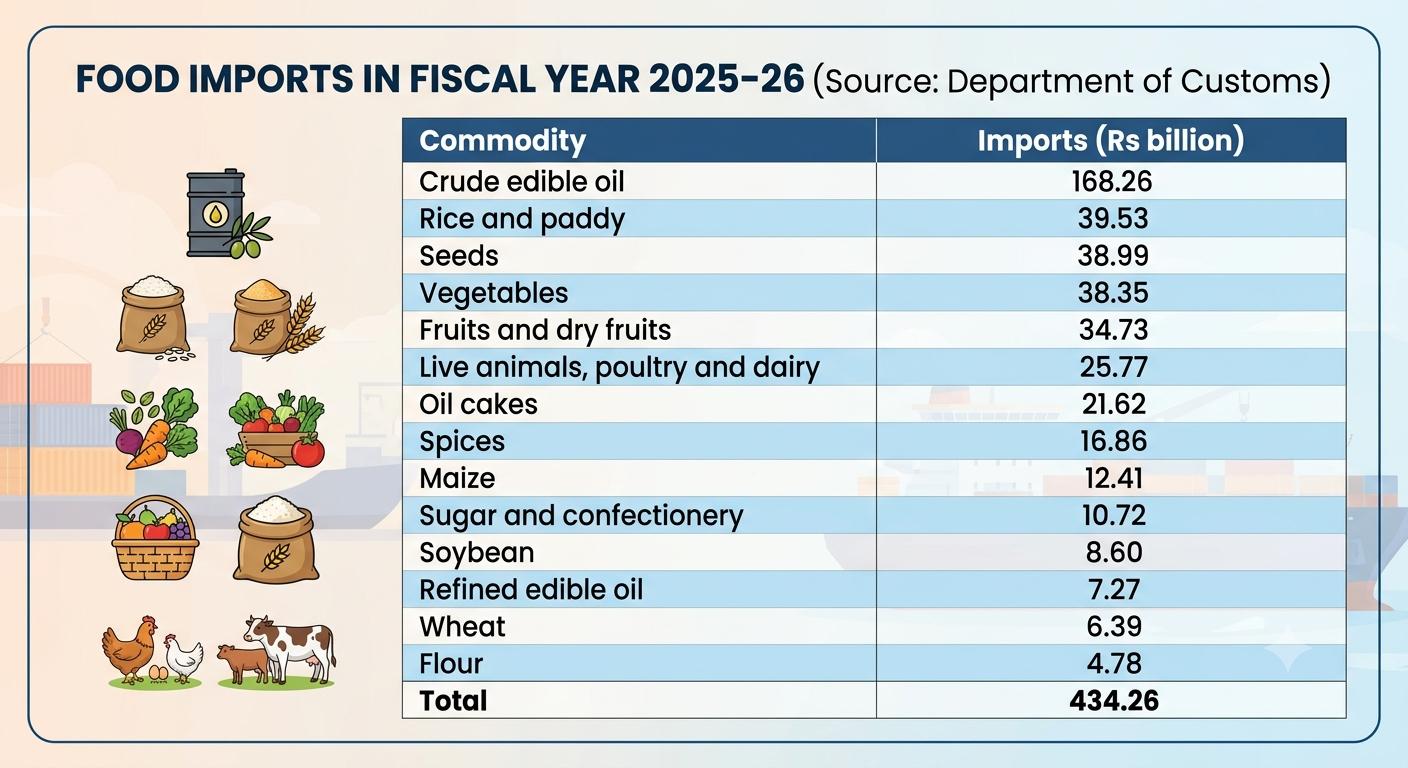
In the last fiscal year, Nepal imported crude edible oil worth Rs168.26 billion. Most of it is not consumed domestically but refined and re-exported to India.
Exports of processed edible oil reached Rs146 billion during the same period.
Experts say this trade is a classic example of rent-seeking that exploits tariff differentials without generating meaningful domestic value addition.
The rapid expansion of edible oil exports has raised concerns in both Nepal and India. Nepal spends US dollars importing crude edible oil from third countries but earns Indian rupees by exporting refined products to India. Indian vegetable oil producers argue that duty-free imports from Nepal are undermining their domestic processing industry.
After edible oil, cereals accounted for the second-largest category of imports. Nepal imported rice and paddy worth Rs39.53 billion in the last fiscal year.
Although substantial, the figure remains well below the Rs79 billion worth of rice and paddy imported in fiscal year 2021-22.
Seeds ranked as the third-largest import category at Rs38.99 billion, with experts warning that dependence on imported hybrid seeds is increasing at an alarming rate.
Nepal also imported vegetables worth Rs38.35 billion, fruits and dry fruits worth Rs34.73 billion, and live animals, poultry and dairy products worth Rs25.77 billion.
According to the Department of Customs, imports of oil cakes—used primarily as livestock feed—totalled Rs21.62 billion. Spice imports reached Rs16.86 billion, while maize imports, also largely used for animal feed, amounted to Rs12.41 billion in the last fiscal year.
Madhukar Upadhya, author of Ponds and Landslides: Water Culture, Food Systems and the Political Economy of Soil Conservation in Mid-Hill Nepal, recently wrote in the Post that the conflict in West Asia could further strain Nepal’s agriculture and increase dependence on imported food.
He said shortages of chemical fertiliser and increasingly erratic weather would continue to damage crops and farmland, while El Niño conditions are expected to intensify global temperature records with severe consequences for agriculture.
“The cumulative impacts of this evolving situation are expected to disrupt global food production. Traditional food-exporting countries may soon be unable to sustain exports as they grapple with fertiliser shortages and increasingly erratic weather,” Upadhya wrote.
“In normal times, Nepal imports most of its food from India to meet domestic demand. But fertiliser shortages are already affecting Indian agriculture, and several major fertiliser-exporting countries have halted exports to prioritise domestic needs. It is worth recalling the 2008 global food crisis, when India banned rice exports, except for basmati, creating severe hardship in Nepal.”
According to Upadhya, the current risks run much deeper.
Nepal is particularly vulnerable because of its fragile economy, weak institutions and decades of poor governance.
“Moreover, uncertainty in West Asia and its long-term impact on migrant workers could reduce remittance inflows, compounding existing challenges and creating a perfect storm that may trigger a full-blown food crisis,” he wrote.
Sangam Prasain
Sangam Prasain is Business Editor at The Kathmandu Post, covering tourism, agriculture, mountaineering, aviation, infrastructure and other economic affairs. He joined The Kathmandu Post in October 2009.



Most Read from Money

Why does an hour long flight to Dhangadhi cost more than a flight to New Delhi?

Nepal travel agents threaten to stop selling Thailand trips over visa rules
Malaysia rejects Nepal’s demand to open recruitment to all manpower agencies

No school, but a graduation cap for women dairy farmers
Nepal arrests four medical service providers as Malaysia recruitment row deepens
Editor's Picks




E-PAPER | October 24, 2026

×